Andalusian Sterling Silver Earrings: Heritage and Modernity
Al-Andalus, Cradle of Exceptional Jewelry
Between the 8th and 15th centuries, Al-Andalus—Muslim Spain—was one of the most brilliant centers of world civilization. Cordoba, Seville, Granada: these cities were home to goldsmiths whose expertise was renowned throughout the Mediterranean world. Their specialty? Filigree-worked sterling silver, colorful stones precisely set, geometric and floral motifs inspired by Islamic art.
Earrings were at the heart of this art. Worn by women of all social standings—from artisans to princesses—they were both adornment, status symbol, and protective talisman. Each piece was unique, handmade by goldsmiths who passed down their knowledge from generation to generation. Discover this heritage in our women's sterling silver earrings collection.
The History of Earrings in Andalusian Jewelry
Andalusian jewelry was profoundly influenced by three major traditions that met on Iberian soil: the Arab-Islamic tradition, the Visigothic heritage, and the Sephardic Jewish contribution. From this encounter arose a unique style, a blend of techniques and symbols that existed nowhere else.
Andalusian earrings of the Middle Ages were characterized by their length—sometimes reaching the shoulder—and the richness of their decoration. The goldsmiths of Cordoba were particularly renowned for their mastery of filigree, a technique that allowed for the creation of incredibly fine metal lace. Those of Granada excelled in working with Garnet stone, a symbol of the city and its passion.
After the Reconquista in 1492, Andalusian goldsmiths dispersed across the Mediterranean—to Morocco, Turkey, Algeria—taking their techniques and motifs with them. This is why today we find striking similarities between Andalusian, Berber, and Ottoman jewelry.
The Aesthetic Codes of Andalusian Earrings
Andalusian jewelry is recognizable by several distinctive elements:
- Filigree: 925 sterling silver wires twisted and soldered into extremely fine patterns—flowers, stars, geometric interlacing. A technique detailed in our article on Andalusian filigree
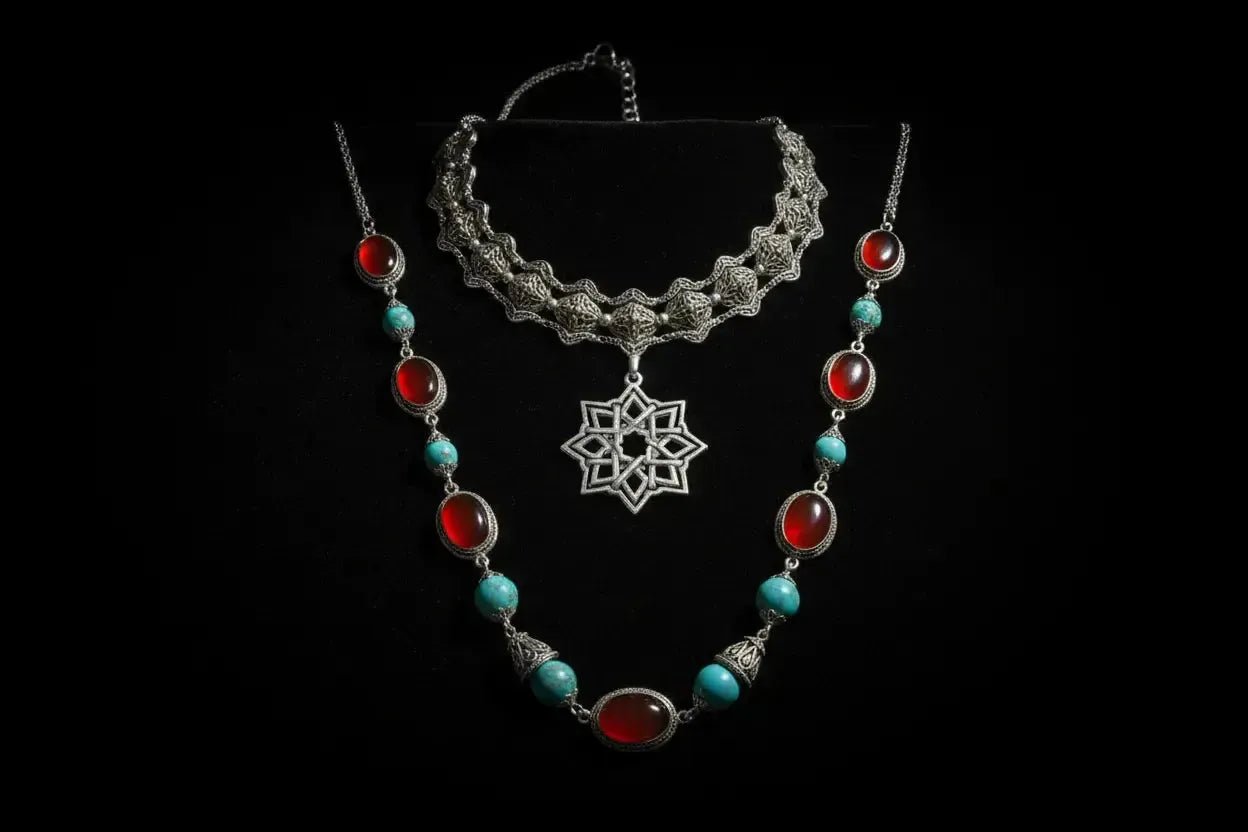
- Colored stones: Granada Garnet, Turquoise and Carnelian, Amethyst and Citrine—each stone carried a precise symbolism and an identifiable geographic origin.
- Arabesque motifs: infinite interlacing, eight-pointed stars, rosettes inspired by the mosaics of the Alhambra—a sacred geometry symbolizing the divine infinite.
- Pendant shape: long, structured, they framed the face like a halo of elegance, highlighting the neck and shoulders.
- Granulation: a technique of soldering tiny silver beads onto the surface of the jewelry to create textures and raised patterns.
Weight and Balance: an Artisan Science
Wearing pendant earrings several centimeters long all day without discomfort required precise craftsmanship that Andalusian goldsmiths had perfectly mastered. The clasp had to be sturdy enough to support the weight of the piece without ever pulling on the earlobe, and the jewelry's center of gravity was calculated so that the earring remained stable even in motion. This attention to ergonomics, often invisible to the eye, distinguished a high-quality piece from a less careful imitation—a criterion that remains just as relevant today when choosing a pair of pendant earrings.
The Essential Stones of Andalusian Earrings
Each stone used in Andalusian jewelry had a precise meaning:
- The Garnet: the quintessential stone of Granada, symbolizing passion, vitality, and love. Its deep red color contrasts beautifully with 925 sterling silver.
- The Turquoise: a stone of protection and wisdom, imported from Persia via Andalusian trade routes. Its blue-green evokes the sky and water.
- The Carnelian: red-orange, a stone of courage and vital impulse, widely used in protective jewelry.
- The Amethyst: royal purple, a stone of wisdom and spirituality, associated with Andalusian women of letters and mystics.
All these stones are available in our natural stone sterling silver jewelry collection.
Wearing Andalusian Earrings Today
The Andalusian heritage is not a costume—it is a timeless source of inspiration. Andalusian jewelry has influenced centuries of creation and continues to inspire contemporary designers. Here's how to integrate it into a current style:
- For everyday wear: discrete geometric 925 sterling silver earrings—an eight-pointed star, a simple interlace—that add character without ostentation. Pair with a minimalist 925 sterling silver necklace.
- For evenings: filigree pendants with Garnet or Amethyst for a strong presence. Complete with a women's 925 sterling silver bracelet.
- For a wedding: a complete set inspired by Andalusian tradition—pendant earrings, multi-strand necklace, stacked bracelets. See our article on Al-Andalus jewelry.
Caring for Your 925 Sterling Silver Earrings
925 sterling silver earrings, especially filigree ones, require proper care to maintain their shine. Consult our complete 925 sterling silver care guide for all practical tips.
To delve deeper into the Andalusian world, discover our articles on Mudejar jewelry and Andalusian Black Onyx jewelry.
All our jewelry is certified 925 solid sterling silver. Discover our commitments on our authenticity page.
✦ Vindicta — Solid 925 silver
The piece that makes the difference
Certified 925 silver · Free shipping from €69 · 10 years of excellence
Women's 925 Silver Rings →