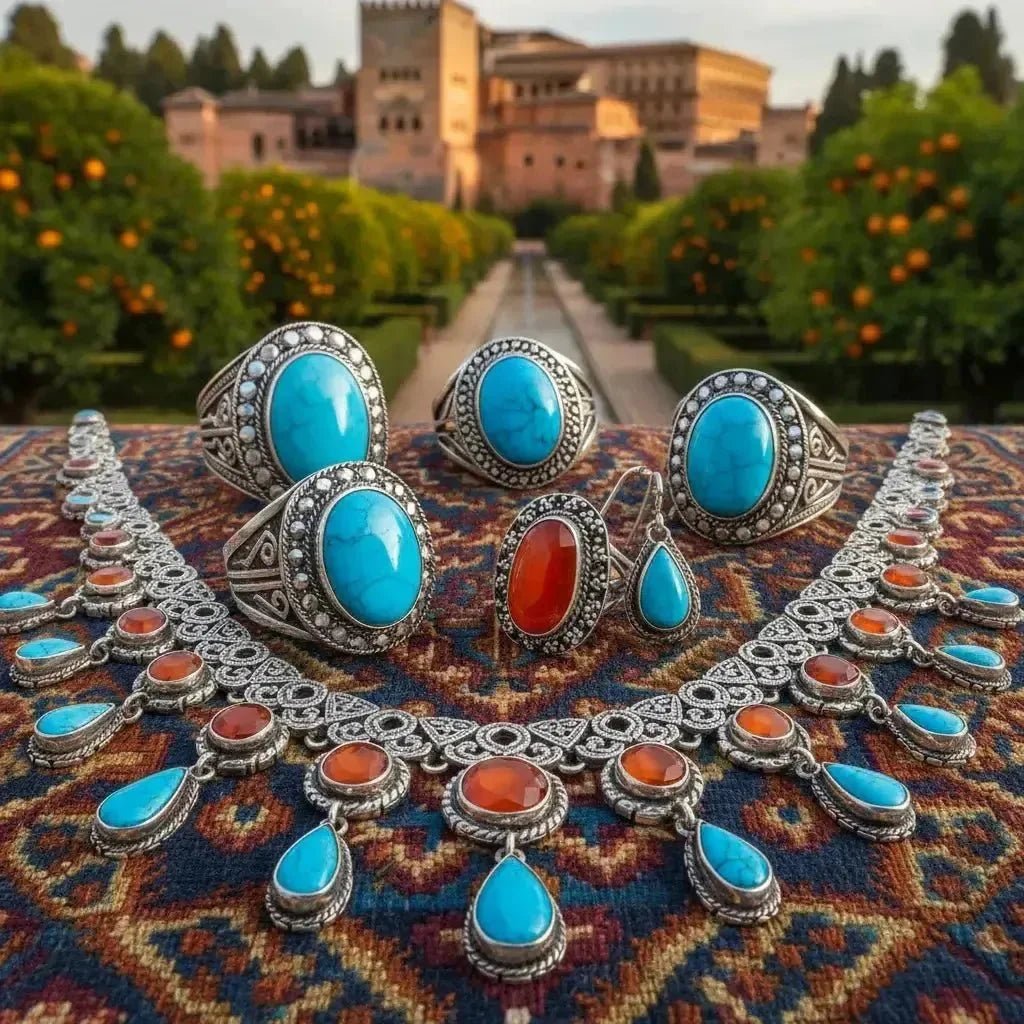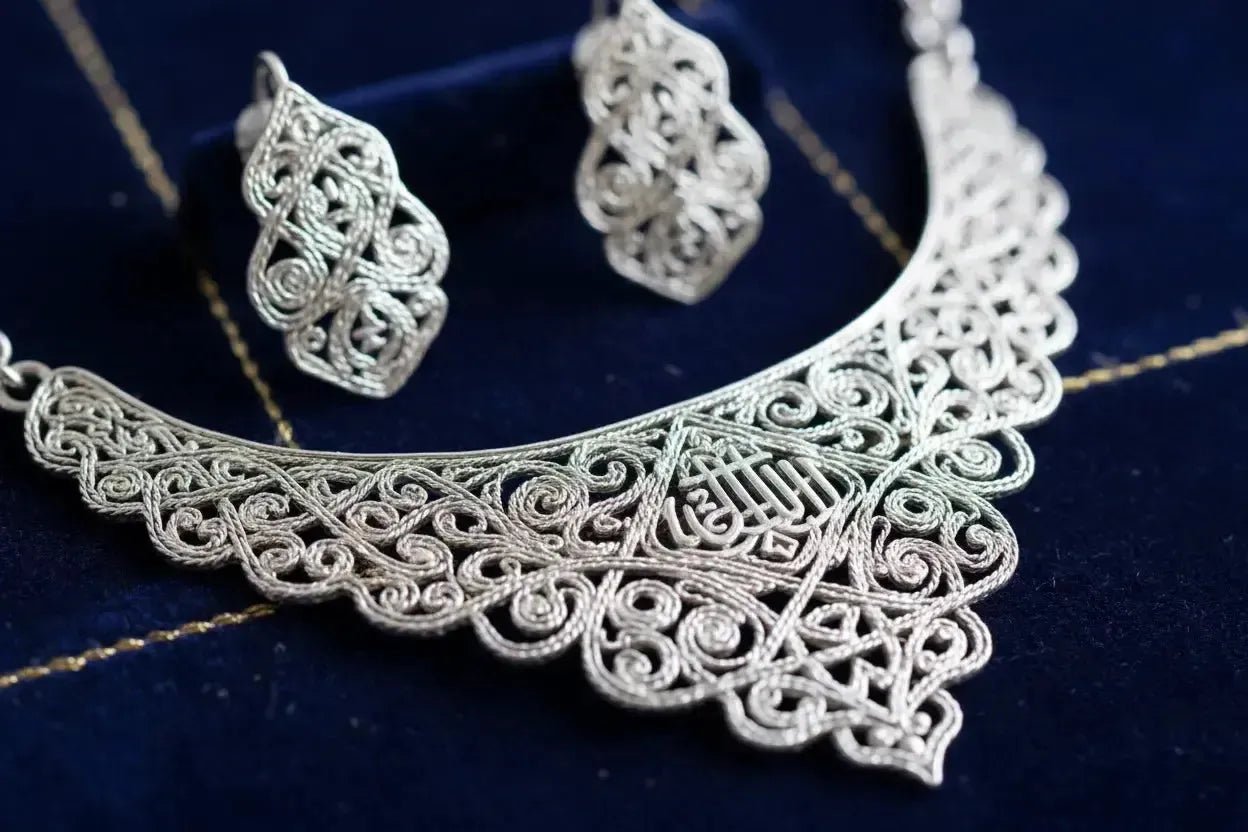
925 Silver Hispano-Moresque Style Rings
Arab chronicles from Cordoba report that in the 10th century, under the caliphate of Abd al-Rahman III, some court dignitaries possessed signet rings so personal that their owner could be identified without reading the engraved name — just by the way the stone was cut, or how the motif was organized around the bezel. In a civilization where the personal seal authenticated official acts, a man's ring was almost a handwritten signature — unique, recognizable, impossible to confuse.
Jewelry as an instrument, not an adornment
In Andalusian society, contrary to popular belief, men's jewelry was never conceived as mere decoration. The signet ring served as an official seal: pressed into the wax of a document, it authenticated a contract, a letter, an order. Losing one's signet ring was equivalent to losing part of one's legal identity — some great merchants and caliphate officials had duplicates engraved, kept in a safe place in anticipation of accidental loss.
Three motifs, three messages
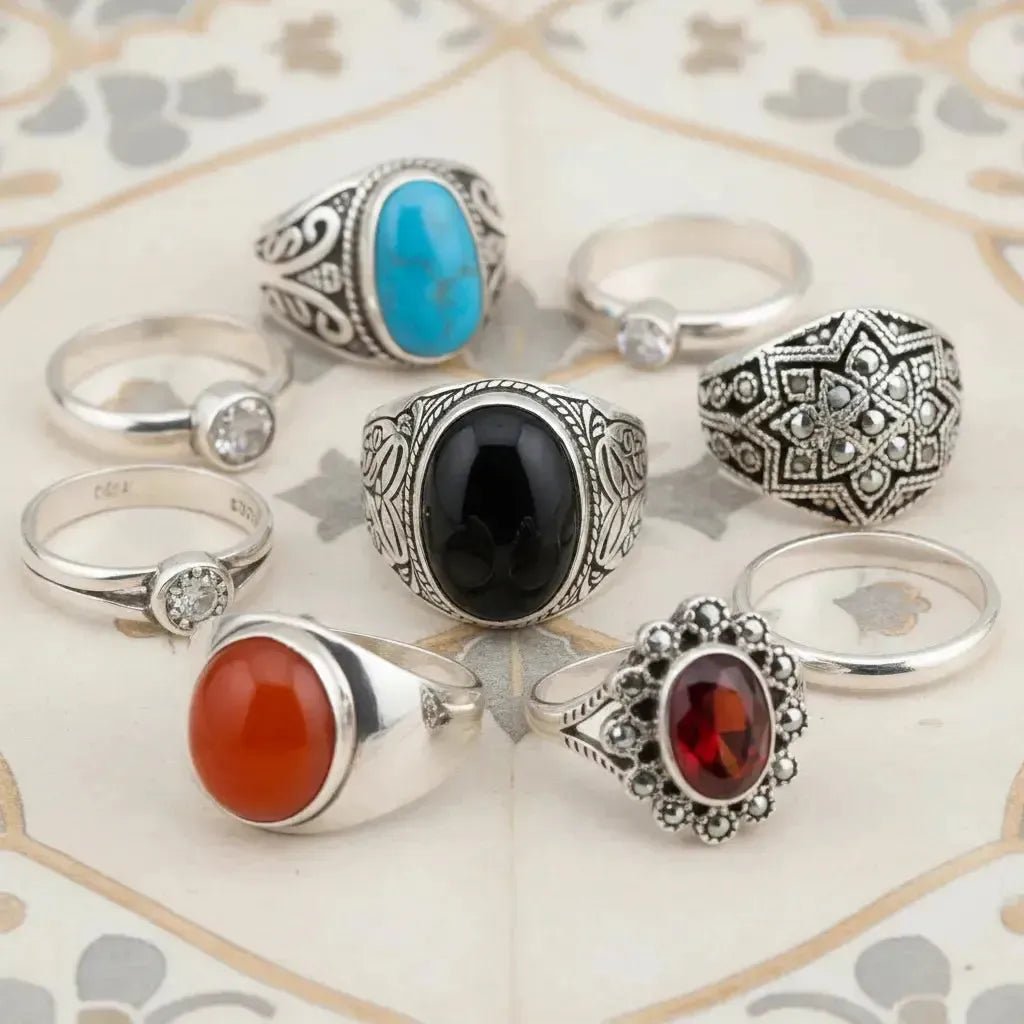
Andalusian signet rings were distinguished by their decoration. Arabesques — floral and geometric interlacings without beginning or end — signaled a refined culture, a knowledge of the arts. Eight-pointed stars, formed by superimposing two squares, evoked harmony and balance — a motif particularly prized by lawyers and scholars. Arabic calligraphy — a name, a verse, a formula of wisdom — was reserved for the most literate men, capable of appreciating the subtlety of a well-chosen verse engraved in a few square millimeters.
Onyx and garnet: the two stones of masculine power
Two stones dominated Andalusian men's jewelry, for opposing reasons. The opaque, uncompromising black onyx embodied self-mastery and quiet strength — the stone for men who didn't need to demonstrate their authority. The deep red garnet, conversely, symbolized an assumed and controlled passion — often worn by younger men, in the early years of their public life.
The bracelet, discreet signature of war
Unlike the signet ring, the Andalusian men's bracelet was rarely imbued with religious or administrative symbolism — it belonged more to the warrior realm. Solid silver bangles, often worn in pairs, were associated with men-at-arms: their sobriety stemmed from the absence of flourishes that would have seemed out of place on a soldier. The geometric patterns chiseled on these bracelets directly evoked the patterns of armor and shields of the time.
A tradition that survived the fall of Granada
After 1492, the techniques of the Andalusian seal-ring crossed the Mediterranean with exiled artisans. They are found, slightly transformed, in Ottoman jewelry as well as in the traditions of the Maghreb — a continuity rarely mentioned but perfectly documented by historians of Islamic art, who recognize in certain 16th-century Moroccan signet rings the same chiseling techniques as those practiced in Granada a century earlier.
The scholar, the merchant, and the warrior: three Andalusian portraits
One can almost reconstruct three social profiles from the signet rings found through archaeology. The scholar often wore a sober stone engraved with a verse of poetry, discreet and intended for a restricted circle of initiates capable of deciphering it. The merchant favored a clear, administrative seal, primarily functional, often in plain silver without a stone. The warrior, on the other hand, readily wore onyx or garnet, stones endowed with supposed protective virtues to accompany him in combat. Three uses, three aesthetics, for the same object.
The signet ring in Andalusian marriage contracts
Notarial records found in several Andalusian cities often mention a silver signet ring among the assets listed in marriage contracts — offered by the future husband as a tangible pledge of his financial commitment to his wife, independently of any other dowry. This legal practice, distinct from a simple symbolic offering, made the piece of jewelry an asset recorded in black and white, transferable and reclaimable in case of separation — a contractual dimension rarely associated today with this type of jewelry.
Merchant tokens, functional cousins of the signet ring
Beyond personal jewelry, large Andalusian trading houses sometimes used silver tokens sealed with a motif similar to that engraved on their signet rings — a cross-authentication system that allowed for quick verification of the origin of goods or payments in the markets of Cordoba and Granada, without having to consult a written register. This parallelism between personal jewelry and commercial tool illustrates how deeply Andalusian goldsmithing was integrated into daily economic life, far beyond its ornamental role.
Wearing this heritage today
A 925 silver signet ring with geometric patterns, set with onyx or garnet, associated or not with a solid bracelet — or, in a feminine version, a 925 silver women's ring with the same aesthetic codes — each piece continues to carry this simple but enduring idea: that a piece of jewelry does not need accumulation to assert a presence; it simply needs to be chosen with the same rigor as a seal placed on an important document.
✦ Vindicta — Solid 925 silver
The piece that makes the difference
Certified 925 silver · Free shipping from €69 · 10 years of excellence
Women's 925 Silver Rings →