Turquoise and Carnelian: Andalusian Stones in Sterling Silver
Two Colors for a Civilization
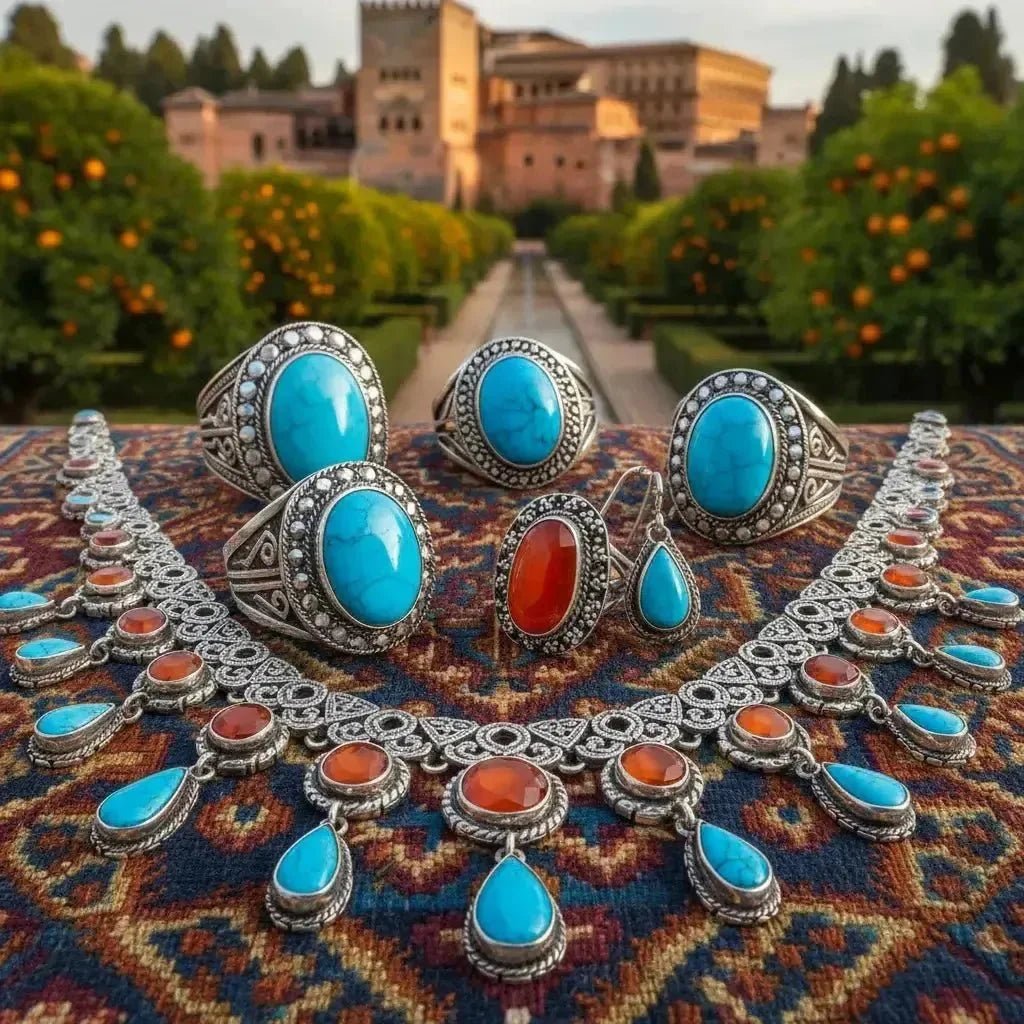
There are chromatic associations that encapsulate an entire era. The blue of turquoise and the orange of carnelian are ubiquitous in the art of Al-Andalus—in the zellige tiles of the Alhambra fountains, in the illuminations of Nasrid manuscripts, in the ceramics of Seville's palaces. This is no coincidence. These two colors form a perfect complementary contrast: coolness and warmth, sky and earth, water and fire. And the two stones that embody them each have their own deep history, rooted in Andalusian civilization.
Al-Andalus was not a homogenous entity. It was a space spanning several centuries and several dynasties—Umayyad, Almoravid, Almohad, Nasrid—each with its own tastes, influences, and trade routes. Turquoise arrived from Persia and Khorasan. Carnelian came from Arabia, Yemen, sometimes India. These stones traveled with merchants, scholars, and diplomats. They carried with them meanings that grew richer with each border crossed.
Turquoise: The Andalusian Sky in Stone
Turquoise is one of the oldest stones in human history. The Egyptians mined it in Sinai six thousand years ago. The Persians made it a symbol of the sky and divine protection. When it arrived in Al-Andalus via Mediterranean trade routes, it was already laden with centuries of meaning.
In Cordoba, Granada, and Seville, turquoise naturally integrated into Islamic aesthetics. Its color—that particular blue-green that changes with the light—recalls both the sky and water, two central elements in Andalusian architecture and spirituality. The fountains of the Alhambra, the pools of the Generalife, the turquoise mosaics of the mosques: everything contributes to making this color a symbol of serenity and divine presence.
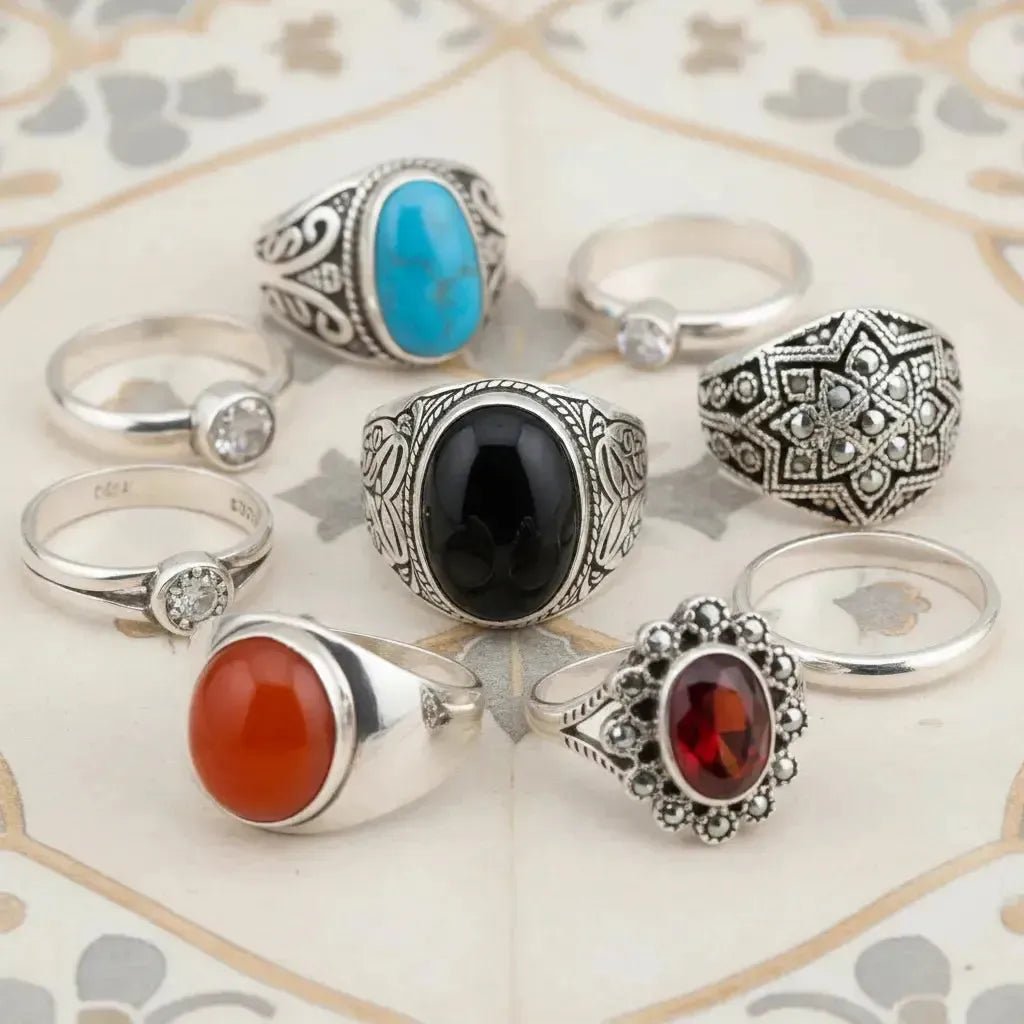
In lithotherapy, it is attributed with protective and calming virtues. Moorish warriors wore it as an amulet. Women in Nasrid palaces incorporated it into their adornments. Mounted in a men's 925 silver turquoise ring or a women's ring set with a turquoise cabochon, it retains this dual nature—ornament and talisman—which was at the heart of Andalusian jewelry.
Carnelian: The Sun of Granada in Stone
Carnelian holds a special place in Islamic tradition. Prophet Muhammad wore a carnelian ring, and this stone is mentioned in several hadiths as a blessed stone. In Al-Andalus, this spiritual dimension is superimposed on an aesthetic one: the orange of carnelian is the color of the sunset over the Sierra Nevada, the orange trees in the Generalife gardens, the red earth of the Vega de Granada.
It is a warm, almost living stone. Its translucency allows light to pass through in a particular way—it seems to burn from within. Andalusian artisans appreciated it for this quality: cut into a cabochon and mounted on chiseled silver, it captures light and reflects it with an intensity few other stones can match.
Carnelian symbolizes vitality, courage, and passion. In Nasrid courts, it adorned the signet rings of warriors and the jewelry of high-ranking women. Today, a 925 silver carnelian ring or a women's carnelian cabochon ring still carries this solar energy and historical depth.
Blue and Orange: A Thought-Out Harmony
In color theory, blue and orange are complementary—they strengthen each other rather than neutralizing. Andalusian artisans mastered this principle without having formally articulated it. In the zellige tiles of the Alhambra, in the embroidery of court attire, in the illuminations of manuscripts, blue and orange appear together with a regularity that betrays a conscious aesthetic intention.
Wearing turquoise and carnelian together means reproducing this harmony on oneself. Not necessarily in the same piece—two rings worn together, or a ring and earrings—but with the idea that these two stones converse, respond to each other, creating something greater than each individually.
The Alhambra: When Stone Becomes Palace
The Alhambra in Granada is the culmination of several centuries of Andalusian art. Begun in the 13th century by the Nasrids, enlarged and perfected until the Reconquista in 1492, it represents the most refined achievement of Al-Andalus civilization. Its turquoise mosaics, its orange groves, its white marble fountains—all form a coherent whole where every color, every material, every form has meaning.
The jewelry that circulated in these palaces followed the same logic. Turquoise and carnelian were not mere ornaments: they were fragments of this worldview, worn as one wears a conviction.
How to Wear These Stones Today
Turquoise naturally pairs with neutral tones—white, beige, linen—which allow the blue to express itself fully. It also works with navy blue or green for a more assertive effect. Carnelian, on the other hand, harmonizes with warm tones: terracotta, camel, ochre, burgundy. Together, they create a contrast that works particularly well with neutral outfits, where they become the sole point of color.
In solid 925 silver, these stones find a setting that respects their character: the sobriety of the metal enhances the color of the stone without competing with it. This is Andalusian aesthetics at its most enduring—refinement without ostentation.
Turquoise and Carnelian: The Legacy of Al-Andalus in 925 Silver
Al-Andalus disappeared in 1492 with the fall of Granada. But its legacy remained—in architecture, in language, in decorative arts, in these stones that continued to circulate long after the end of the caliphate. Turquoise and carnelian carry something of this extraordinary civilization: its ability to synthesize multiple influences—Persian, Arab, Berber, Byzantine—into something unique and coherent.
Discover our collection of women's rings and our men's turquoise ring collection in solid 925 silver—pieces that carry the Andalusian heritage in their very essence.
✦ Vindicta — Solid 925 silver
The piece that makes the difference
Certified 925 silver · Free shipping from €69 · 10 years of excellence
Women's 925 Silver Rings →