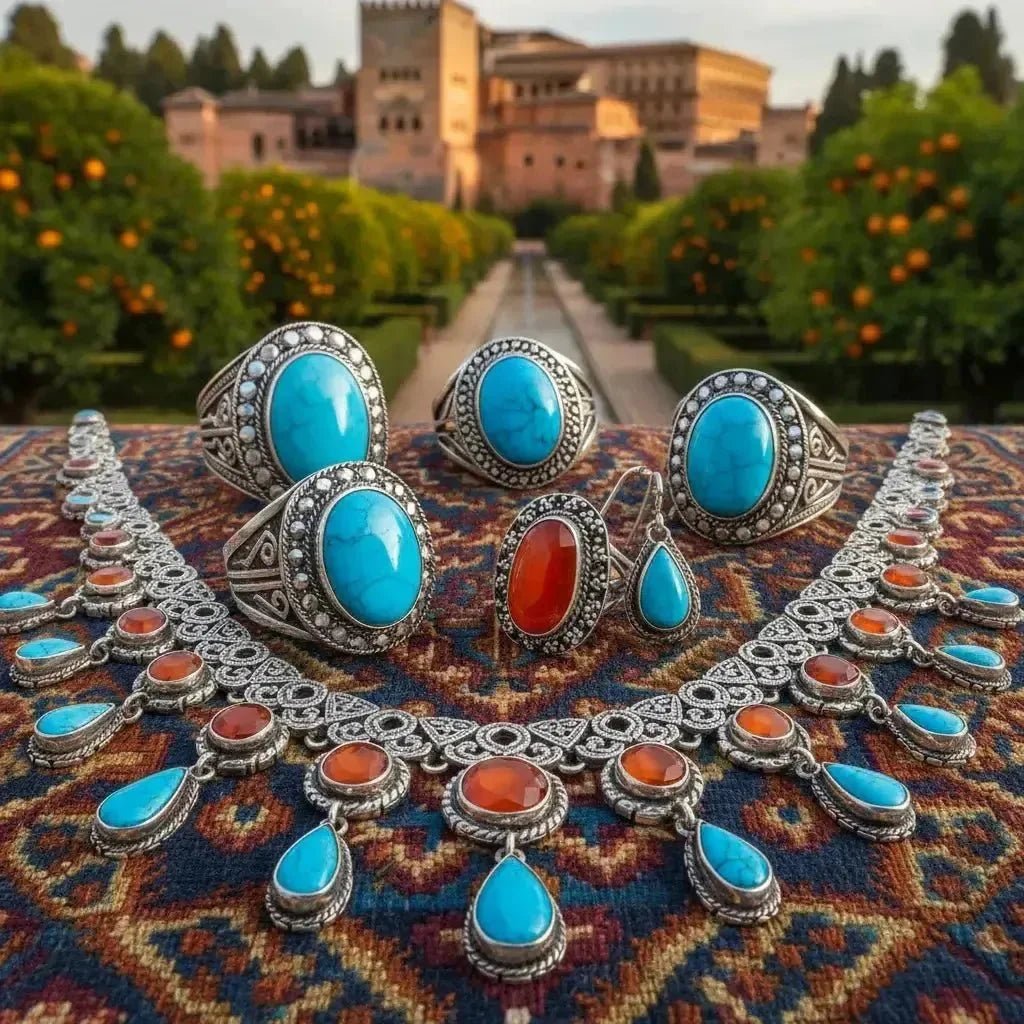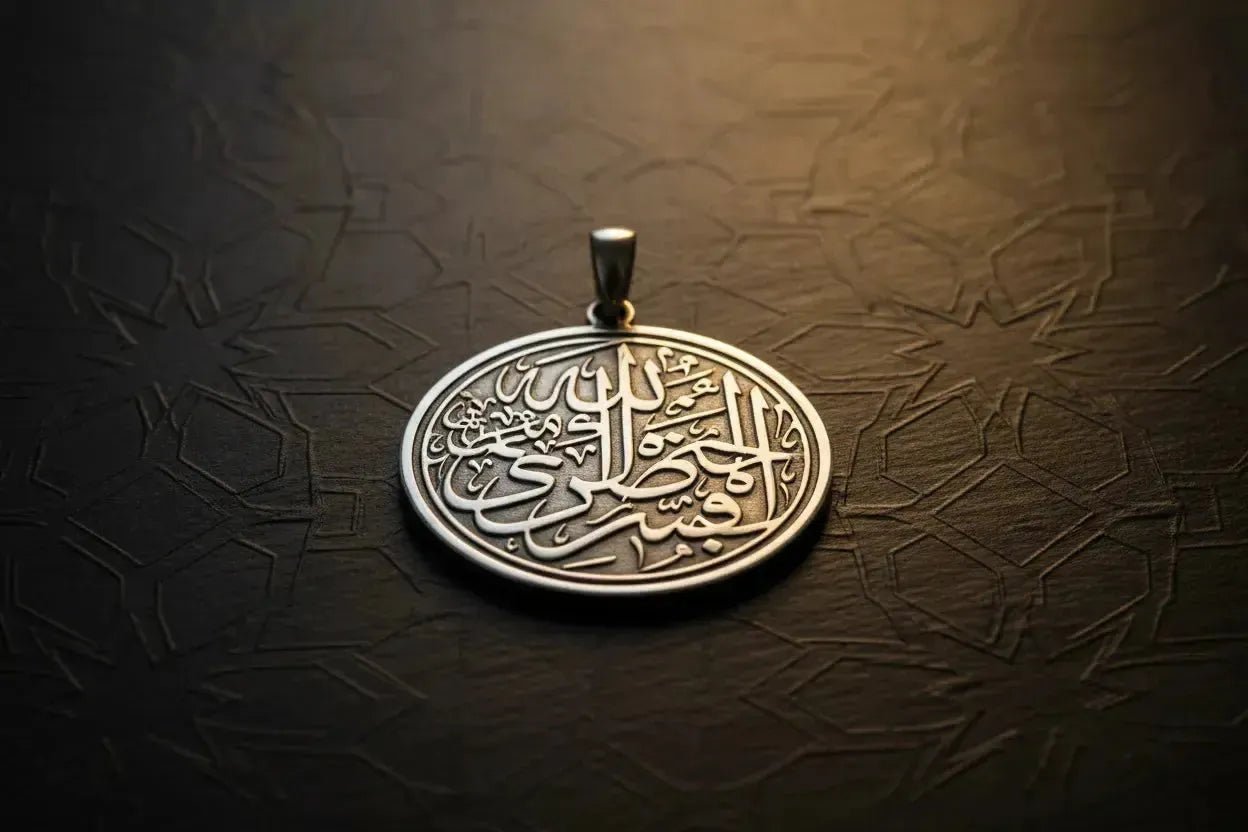
925 Sterling Silver Arabic Calligraphy: Andalusian Art
On the walls of the Hall of the Two Sisters, in the Alhambra, a phrase is engraved dozens of times in cursive calligraphy: "Wa la ghalib illa Allah" — "There is no victor but God." This was the motto of the Nasrid sultans, repeated on every wall, every arch, every fountain of the palace, as a constant reminder to rulers who knew their kingdom was under threat. Calligraphy, in Al-Andalus, was never a mere ornament: it was a thought made visible.
Writing as sacred art
In Islamic tradition, the representation of living beings is strictly limited in religious art. Deprived of figuration, artists turned to Arabic writing itself as artistic material — and in a few generations, transformed it into one of the most sophisticated forms of expression in the entire history of art. In Al-Andalus, this tradition reached a particular refinement, mingled with local Visigothic and Roman influences that had already permeated the Iberian Peninsula before the Muslim conquest.
Three styles for three uses
The Kufic style, the oldest, is recognizable by its angular and geometric letters — it adorned the coinage of the Caliphate of Cordoba and the pediments of the first mosques. The Naskhi style, rounder and more legible, was reserved for copying manuscripts and poetry — Cordoba in the 10th century had tens of thousands of manuscripts copied in this style, while the largest contemporary European libraries possessed only a few hundred. The Thuluth style, grander and more solemn, was reserved for monumental inscriptions such as those of the Alhambra.
Engraving writing in silver
Transposing calligraphy onto a silver jewel required a distinct skill from that of the calligrapher on paper. The graver forgives nothing: a poorly traced letter on metal cannot be corrected, it forces one to start over. The specialized engravers of Al-Andalus formed a separate corporation, distinct from generalist goldsmiths, so much did their calligraphic expertise demand specific training — sometimes passed down over several decades, from a master to a single carefully chosen apprentice.
Poetry and Quran, one and the same gesture
Contrary to what one might think, Andalusian calligraphy was not limited to Quranic verses. The Nasrid palaces are also covered with secular poems, signed by court poets like Ibn Zamrak, who celebrated the beauty of the gardens, the softness of the water in the fountains, the splendor of the architecture itself. An engraved jewel could thus bear both a religious protection formula and a verse of love poetry — the boundary between sacred and profane was, in this art, much more fluid than we imagine today.
The arabesque, a parallel language
Alongside calligraphy, geometric motifs and arabesques — these floral interlaces without beginning or end — completed the Andalusian visual vocabulary. On an engraved piece, calligraphy and geometry often combined: a verse framed by a border of arabesques, the word literally chained within the symbolic infinity of the endless curve.
Ibn al-Bawwab, model of Andalusian calligraphers
Although born in Baghdad in the 10th century, the calligrapher Ibn al-Bawwab exerted a decisive influence on all Western Islamic calligraphy, including Andalusian, by codifying the ideal proportions of each letter according to a system of measurement based on the dot — the mark left by the tip of the qalam on paper. This system, passed down from school to school all the way to Andalusia, guaranteed remarkable formal consistency: two calligraphers trained in different cities, at different times, produced letters almost identical in their proportions.
The contemporary renaissance of Andalusian calligraphy
Since the 2000s, an artistic movement called "calligraffiti," born in Morocco and Spain, has rediscovered and reinterpreted the codes of Andalusian calligraphy by mixing them with contemporary urban art. Artists like eL Seed have exhibited monumental works worldwide that directly adopt the codified proportions of previous centuries — proof that a know-how born over a thousand years ago can still fuel entirely contemporary creation.
The qalam, the calligrapher's primary tool
Even before touching metal, every Andalusian calligrapher learned to cut his own qalam, a reed cut at a bevel whose precise angle determined the thickness and character of each stroke on paper before transposition. This preparatory step, often neglected in popular accounts of calligraphy, nevertheless occupied entire years of apprenticeship — a master would judge a student worthy of engraving metal only after he had mastered the making of his own tool.
Wearing this heritage today
A 925 silver signet ring or a 925 silver women's ring engraved with a calligraphic or geometric motif continues to embody this same demand for precision that characterized the engravers of Cordoba and Granada — without ever seeking to slavishly imitate the past, but by inheriting its rules of rigor and its conviction that a well-traced letter can convey as much meaning as a long speech.
✦ Vindicta — Solid 925 silver
The piece that makes the difference
Certified 925 silver · Free shipping from €69 · 10 years of excellence
Women's 925 Silver Rings →