Article: 925 Silver Al-Andalus Jewelry: Andalusian Heritage
925 Silver Al-Andalus Jewelry: Andalusian Heritage
In 1492, when Boabdil surrendered the keys of Granada to the Catholic Monarchs, he brought to an end nearly eight centuries of Muslim presence in the Iberian Peninsula. The story goes that he turned back one last time to gaze upon the Alhambra from a mountain pass, and his mother uttered the famous words: "Weep like a woman for what you could not defend as a man." This moment, known as "The Moor's Last Sigh," marked the end of Al-Andalus — but not the end of its legacy.
Eight Centuries of Shared Civilization
From 711 to 1492, Al-Andalus was one of the most brilliant intellectual and artistic centers of the medieval world. Cordoba, under the Umayyad Caliphate, became the largest city in Western Europe in the 10th century — nearly half a million inhabitants, with libraries containing hundreds of thousands of volumes, while the largest contemporary European cities numbered only a few thousand inhabitants. Three communities coexisted and influenced each other there: Muslim, Jewish, and Christian, in a convivencia rarely equaled elsewhere in medieval Europe.
Cordoba, Granada, Seville: Three Cities, Three Styles
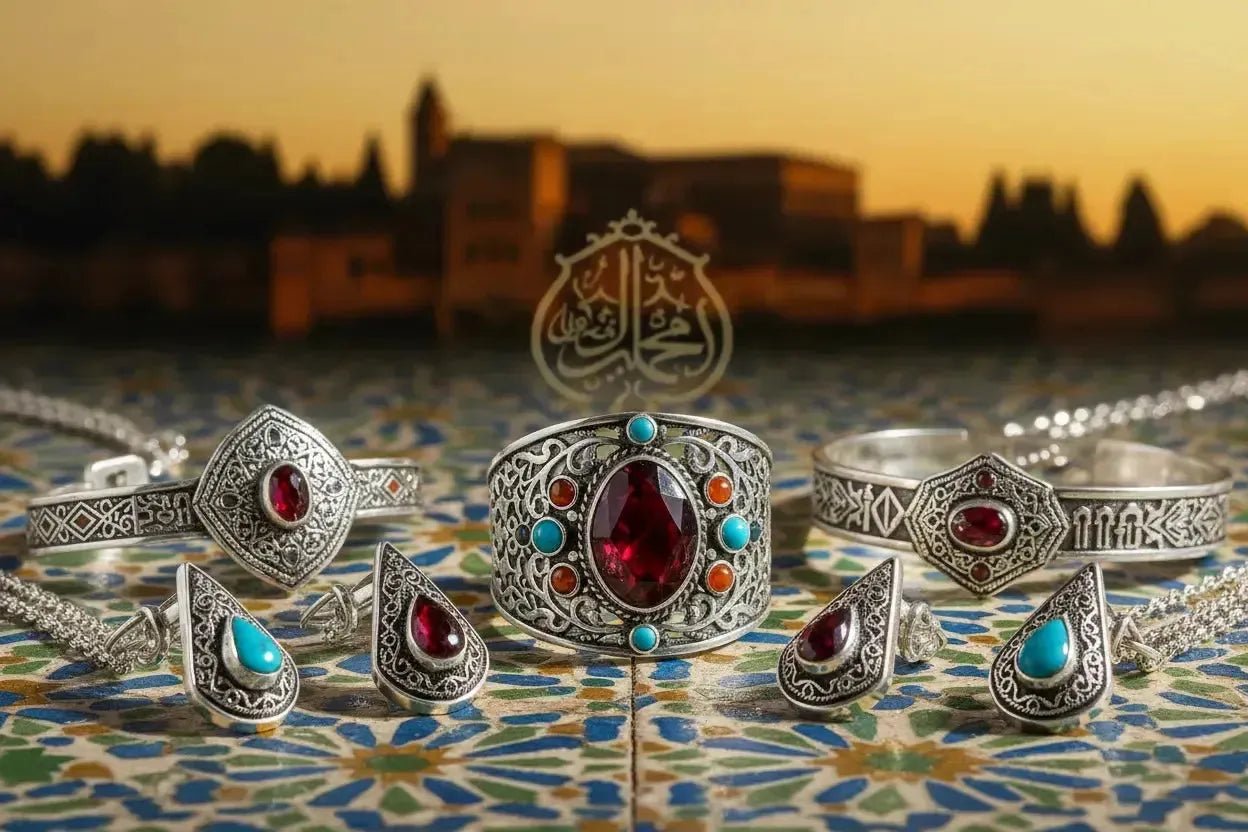
Each major city of Al-Andalus developed its own artistic signature. In Cordoba, the capital of the caliphate, goldsmiths excelled in filigree — the art of weaving silver threads to create patterns of almost ethereal lightness. In Granada, the last Nasrid capital, the emblematic stone was the garnet, whose deep red echoed the very name of the city. In Seville, under Almohad rule, the emphasis was on pure geometry, directly inherited from the architecture of the great mosques.
The Alhambra, the Sum of All This Art
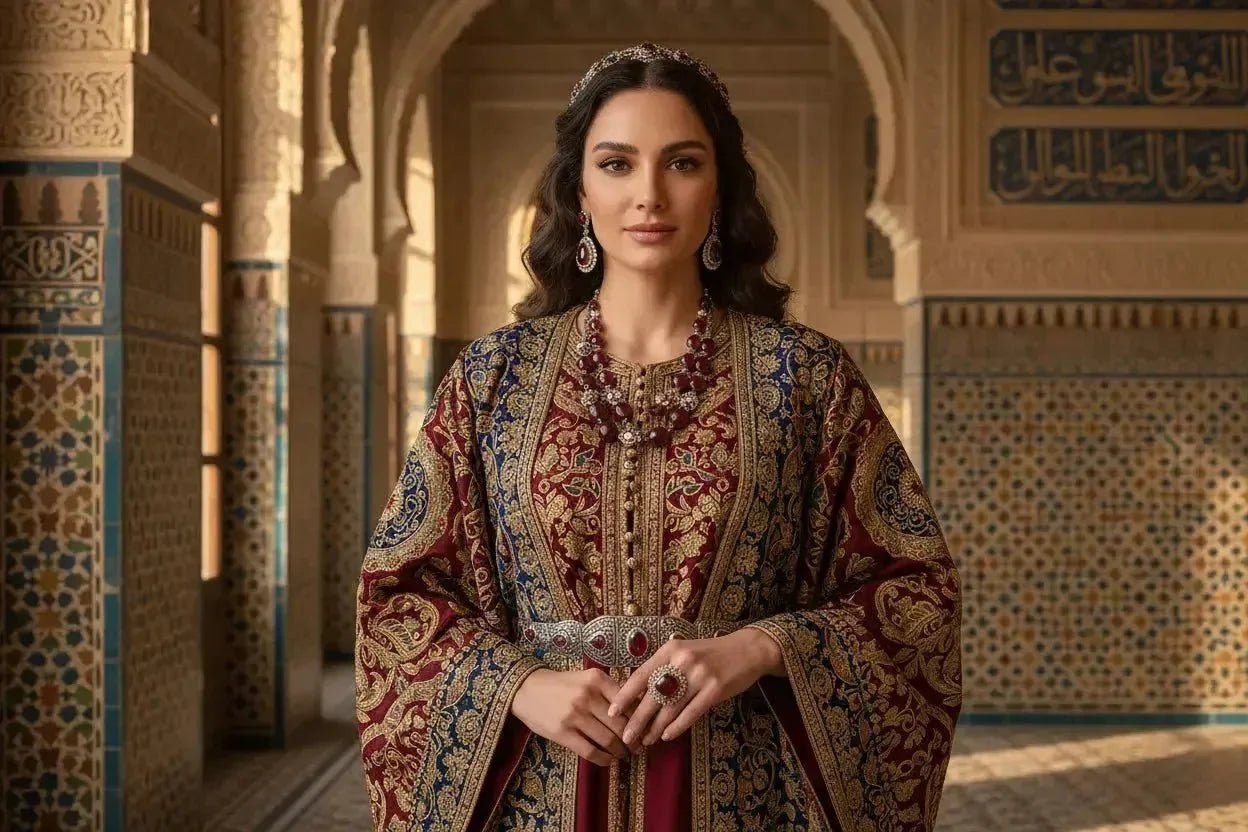
Built and embellished by the Nasrid sultans between the 13th and 15th centuries, the Alhambra in Granada remains the most complete testament to this civilization. Its walls of carved stucco, its sculpted wooden ceilings, its ceramic mosaics with infinite geometric patterns — everything tells the same story: that material beauty can be a form of meditation on divine order. Silver jewelry from the same period directly adopted this vocabulary, on the scale of a ring or a pendant.
The Stones of Al-Andalus
Andalusian jewelry drew from a repertoire of colored stones from across the Mediterranean basin and beyond. Garnet, locally extracted, symbolized passion and royal power. Turquoise, imported from Persia via trade routes, embodied protection and wisdom. Carnelian, from Arabia, carried a spiritual significance linked to Islamic tradition. Each of these stones circulated with merchants, scholars, and diplomats, gaining meaning with each border crossed.
1492 and the Diaspora of Know-How
When Granada fell, Jewish and Muslim artisans who did not convert were forced into exile. Many sought refuge in the Maghreb — in Fes, in Tlemcen — where they continued to practice the filigree and chasing learned in Cordoba and Granada. This is why today we find striking similarities between Andalusian jewelry and certain Maghrebi traditions: the same geometry, the same techniques, passed down by hands that had to leave everything but their knowledge.
The Most Enduring Product of Convivencia
Modern historiography has sometimes romanticized Al-Andalus as an unqualified golden age of tolerance — the reality was more complex, consisting of periods of genuine coexistence and others more tense depending on the ruling dynasties. But what remains undeniable is the artistic fertility of these centuries of contact: Andalusian jewelry itself is the product of constant exchanges between Arab goldsmiths, Jewish artisans specializing in precious metalwork, and know-how inherited from the Visigoths who occupied the peninsula before the Muslim conquest of 711. None of these traditions alone would have produced this result.
The Library of Cordoba, a Mirror of Jewelry
Under Caliph al-Hakam II in the 10th century, the library of Cordoba is said to have held up to 400,000 volumes, according to contemporary chronicles — a figure that illustrates the intellectual radiance of the city at its peak. This scholarly effervescence was not separate from craftsmanship: treatises on mineralogy and alchemy produced in Cordoba circulated directly in goldsmiths' workshops, fostering a scientific understanding of metals and precious stones unparalleled elsewhere in Europe at the same time.
The Mezquita, Mosque-Cathedral of a Dual Heritage
The Great Mosque of Cordoba, transformed into a cathedral after the Reconquista without ever being destroyed, remains today one of Spain's most visited monuments — an exceptional architectural symbol of this layering of historical strata that Andalusian jewelry also embodies on its own scale. Its marble and jasper columns, salvaged from ancient Roman and Visigothic buildings, remind us that even Spain's most emblematically Islamic architecture was already, from its construction, an object of reuse and material continuity.
Wearing This Heritage Today
A 925 silver ring crafted in filigree or set with garnet, a signet ring engraved with geometric motifs — each piece inspired by this era carries something of this vanished convivencia: proof that several traditions can meet and produce, together, a beauty that none would have achieved alone.
✦ Vindicta — Solid 925 silver
The piece that makes the difference
Certified 925 silver · Free shipping from €69 · 10 years of excellence
Women's 925 Silver Rings →