Amethyst and Citrine: Cordoba Sterling Silver 925 Stones
Two Stones, One City, One Empire
There are color associations that are not coincidental. The violet of amethyst and the golden yellow of citrine are found everywhere in Cordoba: in the mosaics of the Mezquita, in the illuminations of the caliphate's manuscripts, in the ceramics of the palaces of Medina Azahara. This is not a coincidence. These two stones embody something profound in the history of this city — the tension between wisdom and prosperity, between contemplation and abundance.
Cordoba in the 10th century was the largest city in Western Europe. Five hundred thousand inhabitants, libraries with hundreds of thousands of volumes, scholars translating Aristotle and inventing algebra. Caliph Abd al-Rahman III had an entire palace-city built — Medina Azahara — whose walls were inlaid with precious stones and colored marbles. In this universe where beauty was a form of power, amethyst and citrine held a special place.
Amethyst: The Stone of the Philosophers of Cordoba
Violet is not an ordinary color in the Mediterranean tradition. It is the color of imperial purple, reserved for sovereigns. In Cordoba, amethyst carries this symbolic charge: it is the stone of those who govern not by force, but by wisdom. Averroes, the great Cordoban philosopher of the 12th century, wrote that clarity of mind was the highest form of wealth. Amethyst, with its violet transparency and inner light, seems perfectly suited to illustrate this idea.
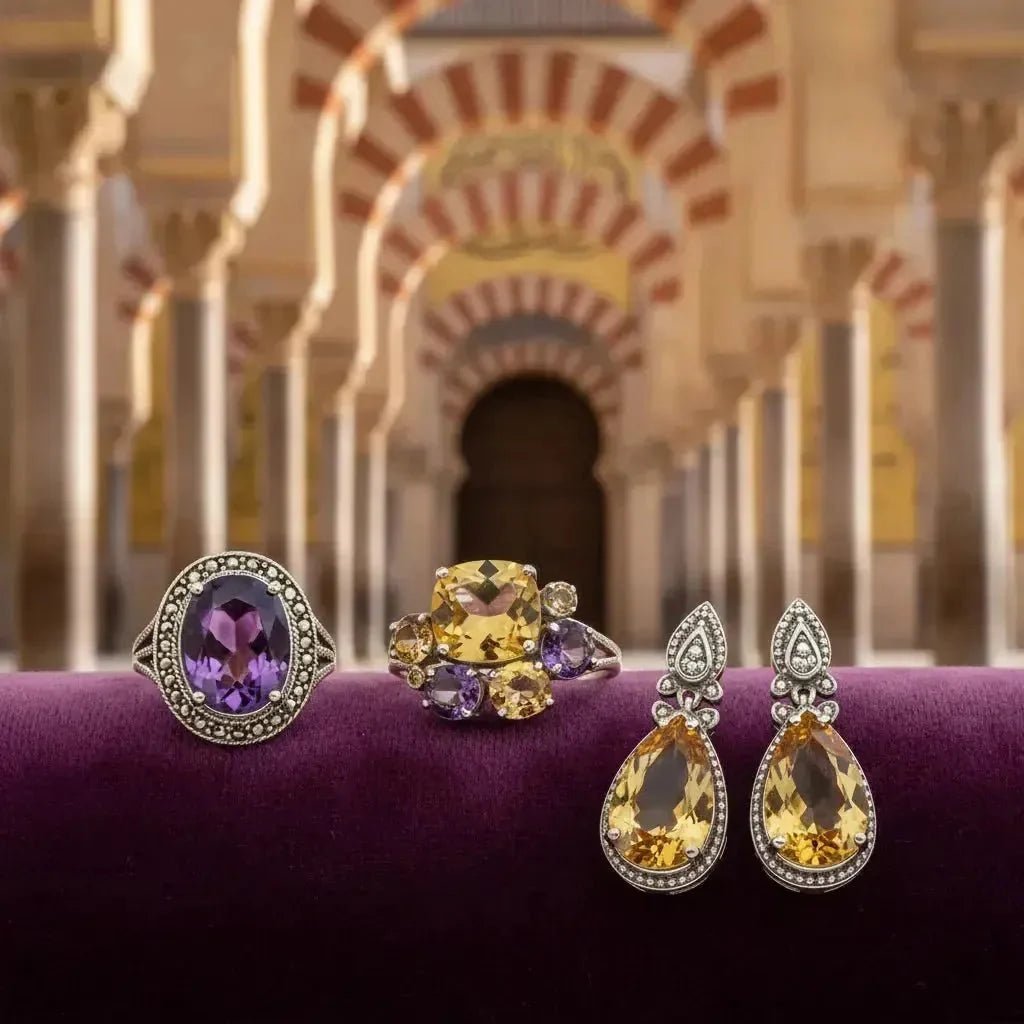
In lithotherapy, it is credited with virtues of serenity and mental clarity — qualities that Cordoban artisans seemed to intuit when they set it as a cabochon on carved silver rings. Worn as an amethyst cabochon ring in 925 silver, it retains that calm and regal presence that spans centuries.
Citrine: The Liquid Gold of the Andalusian Sun
If amethyst is the stone of wisdom, citrine is that of light. Its golden yellow — sometimes almost amber, sometimes a pale, almost solar yellow — recalls the particular light of Andalusia: intense, warm, making white facades and tiled roofs gleam. In the souks of Cordoba, merchants wore it as a talisman of prosperity. The caliphate was rich, and citrine was its mineral reflection.
It is rare in antique jewelry precisely because it was precious. Today, set in solid 925 silver, it regains this discreet nobility — a stone that doesn't need to shout to be noticed.
Violet and Yellow: A Harmony That Spans Centuries
In chromotherapy as in art, violet and yellow are complementary colors — they strengthen each other rather than neutralizing each other. The artisans of Cordoba knew this. In the zelliges of the palaces, in the embroideries of court garments, these two shades appear together with a regularity that is not accidental. It is a thoughtful, constructed harmony that says something about the caliphate's worldview: wisdom and prosperity are not opposed; they complement each other.
Wearing a ring combining amethyst and citrine in 925 silver is to carry this duality on oneself — clarity and light, royal violet and Andalusian gold.
The Mezquita: When Stone Becomes Architecture
One cannot speak of Cordoba without speaking of the Mezquita. This mosque-cathedral, begun in the 8th century and expanded over three centuries, is one of the most extraordinary buildings ever constructed. Its forest of marble columns, its red and white bicolor arches, its golden mosaics financed by the Byzantine emperor — all form a space where beauty is a form of prayer.
The precious stones that adorned the jewelry of Cordoba's inhabitants were part of the same logic: beauty as an expression of the divine, as an affirmation of a civilization at its zenith. Amethyst and citrine, in this context, are not mere ornaments. They are fragments of this worldview.
How to Wear These Stones Today
Amethyst naturally pairs with neutral tones — white, gray, black — that allow the violet to fully express itself. It suits both a sober everyday outfit and a more formal occasion. Citrine, on the other hand, combines well with warm tones: camel, terracotta, golden beige. Together, they work with bright colors or prints — the multi-gem ring then becomes the focal point of a look built around it.
In solid 925 silver, these stones find a setting that respects their character: no ostentation, no excessive gilding, just the quality of the metal and the beauty of the stone. This is the aesthetic of Cordoba — refined, scholarly, durable.
Amethyst and Citrine: The Legacy of Cordoba in 925 Silver
Cordoba ceased to be the capital of the caliphate in 1031, during the fitna — the civil war that fragmented Al-Andalus into small kingdoms. But its legacy remained: in architecture, in philosophy, in decorative arts. And in these two stones, violet and yellow, which continue to carry something of this extraordinary civilization.
Discover our collection of women's rings and our men's rings collection in solid 925 silver with amethyst and citrine — pieces designed to last, like the heritage they carry.
✦ Vindicta — Solid 925 silver
The piece that makes the difference
Certified 925 silver · Free shipping from €69 · 10 years of excellence
Women's 925 Silver Rings →