925 Silver Mudéjar Jewelry: Modern Heritage
The word "Mudéjar" comes from the Arabic mudajjan, meaning "one who is allowed to remain." It referred to Muslims who, after the conquest of a territory by Christian kingdoms, chose or were forced to remain there rather than go into exile. The term has remained to designate an artistic style born from this impossible situation: Muslim artisans continuing to practice their art in now Christian kingdoms, for Christian patrons.
A style born of contradiction
Hispano-Moorish art did not cease in 1492 with the fall of Granada. Long before this date, in territories reconquered by the Christian kingdoms of the north — Toledo from 1085, Seville from 1248 — Muslim artisans continued to work, employed by the new Christian rulers themselves, who were attracted by the technical sophistication of Andalusian art. The result is a hybrid style, neither entirely Islamic nor entirely Christian: the geometry and arabesques of the Muslim tradition applied to Christian buildings, noble coats of arms, and royal commissions.
The Alcázar of Seville, a monument to fruitful contradiction
The most spectacular example of this art is the Alcázar of Seville. Begun in 1364 for the Christian king Peter I of Castile, this palace was built by Muslim craftsmen from Granada — then still independent — using the techniques and aesthetic codes of the Alhambra itself. King Peter had inscriptions in Arabic calligraphy praising himself engraved on his own walls, in the exact style of the Nasrid palaces he admired. This mixture, which would seem strange today, was then a common practice between rival but mutually fascinated sovereigns.
A geometry that transcends religions
What makes the Mudéjar style possible is that Islamic geometry — stars, interlaces, polygons — has no explicit doctrinal content. It can adorn a mosque as well as a church, a Muslim palace as well as a Christian residence. It is this formal neutrality that allowed techniques born in a specific religious context to continue to be transmitted, from generation to generation of artisans, independently of the political and religious changes that convulsed the peninsula.
Bricks, azulejos, and carved wood
Mudéjar art is recognized by a few precise material signatures: exposed brick, left bare rather than covered, creating shadow play by its very texture; azulejo, the glazed ceramic tile directly inherited from the Andalusian tradition; and carved wooden ceilings in artesonado, a technique of assembling wooden pieces to create three-dimensional geometric patterns, still visible today in dozens of Spanish churches and palaces.
From architecture to jewelry
This same logic of technical continuity beyond political ruptures can be observed in jewelry. Goldsmiths who had learned their craft in Granada or Cordoba continued to work silver using the same processes — filigree, chasing, setting colored stones — for new patrons, Christian, Jewish, and Muslim alike. A piece of Mudéjar-era jewelry is often technically indistinguishable from a piece produced a century earlier under fully Islamic rule.
Toledo, silent capital of Mudéjar
While Seville concentrates the most monumental examples, it is Toledo that produced the largest number of durable Mudéjar pieces — the city, reconquered as early as 1085, saw four centuries of continuous production even before the fall of Granada. The synagogues of Toledo, built by Muslim artisans for Jewish patrons under Christian authority, illustrate on their own the complexity of this era: three religions, a single architectural vocabulary, the same ornate craftsmanship shared without apparent conflict.
A style classified as a World Heritage Site
UNESCO inscribed the Mudéjar architecture of Aragón as a World Heritage Site in 1986, officially recognizing this hybrid style as a unique contribution to art history — a late but significant recognition for an art long considered secondary, caught between two major traditions rather than recognized for its own value. This classification revived academic interest in the ornate techniques that accompanied it, including goldsmithing.
The Mudéjars, a population with varying statuses
The legal status of the Mudéjar populations varied considerably from one Christian kingdom to another — some enjoyed relative religious and fiscal autonomy negotiated during the capitulation of their city, others suffered increasing restrictions over the decades. Artisans, particularly goldsmiths whose expertise was rare and sought after, often benefited from special protection from Christian lords, aware of the irreplaceable economic value of their skills.
Carrying this heritage today
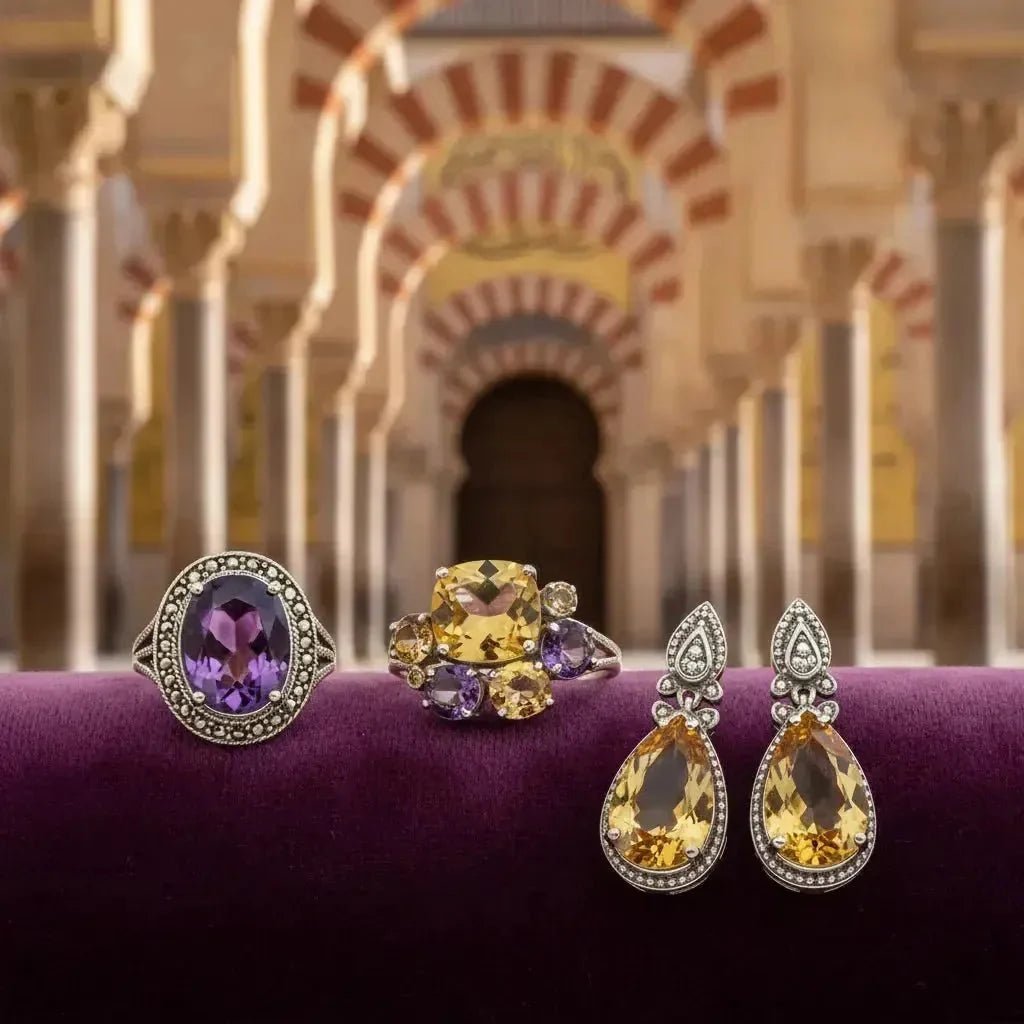
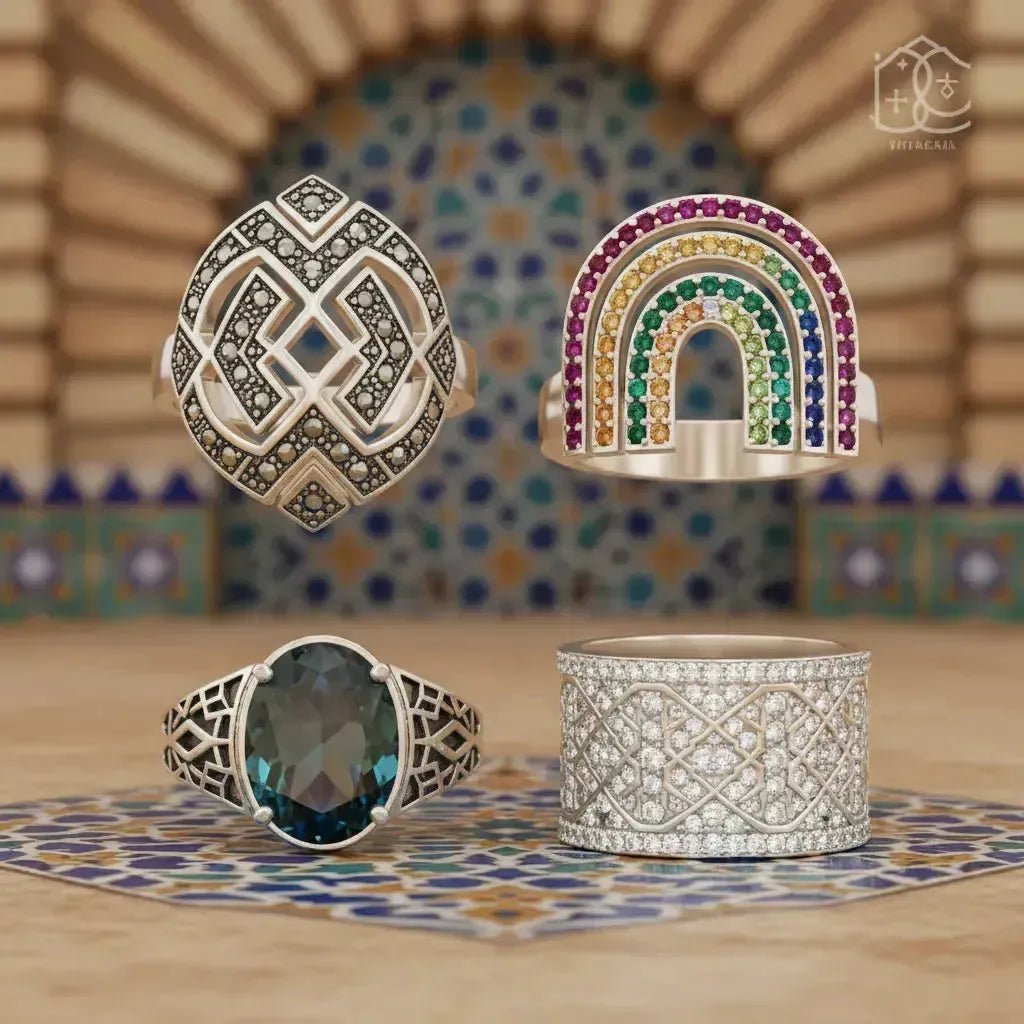
A 925 sterling silver ring with geometric patterns or a piece combining several colored stones unknowingly perpetuates this fundamental Mudéjar idea: that technical expertise and an aesthetic can survive their original context, transmit across religious and political boundaries, provided their value continues to be recognized.
✦ Vindicta — Solid 925 silver
The piece that makes the difference
Certified 925 silver · Free shipping from €69 · 10 years of excellence
Women's 925 Silver Rings →