Article: Napoleonic Empire Style: 925 Silver Jewelry and Symbols of Power
Napoleonic Empire Style: 925 Silver Jewelry and Symbols of Power
Napoleon and Jewelry: A Policy of Image
Napoleon Bonaparte understood the power of symbols better than anyone. From his accession to the Consulate in 1799, and then to the Empire in 1804, he set about creating a coherent visual style that would legitimize his power and inscribe his reign within the continuity of great civilizations — Rome, Greece, Egypt. Jewelry was at the heart of this strategy: worn by the Empress, the ladies of the court, and noble houses, it disseminated imperial symbols throughout French and European society.
Sterling silver — 925 silver — was the metal of choice for everyday jewelry at the imperial court, complementing gold which was reserved for grand occasions. Parisian goldsmiths — foremost among them Nitot, Napoleon's official jeweler — worked silver with a mastery inherited from the French tradition described in our article on French medieval goldsmithing.
Imperial Symbols in Jewelry
The Napoleonic Bee: Symbol of Work and Immortality
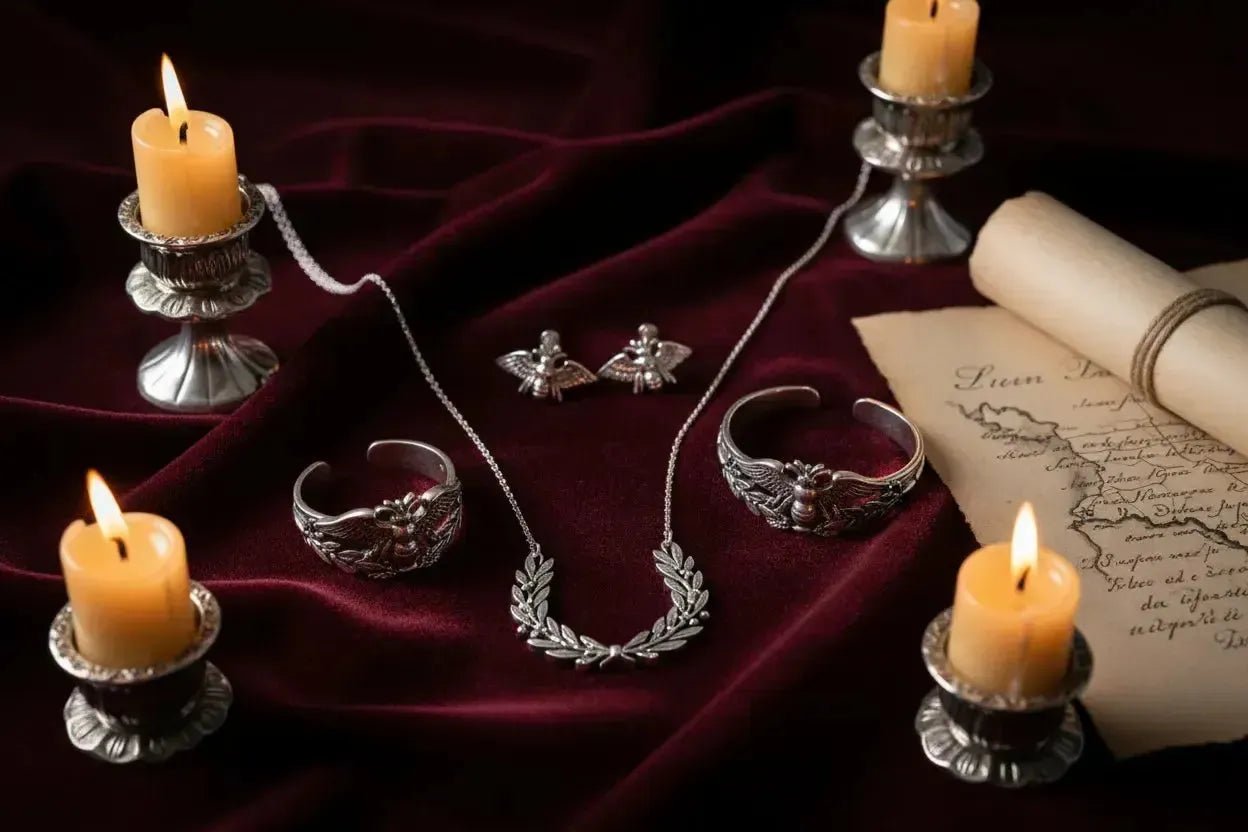
The bee is the most famous symbol of the Empire style. Napoleon adopted it as an imperial emblem in reference to the golden bees found in the tomb of Childeric I, King of the Franks in the 5th century — thus affirming the continuity between his empire and the origins of France. In jewelry, the bee was represented in silver and gold on brooches, tiaras, bracelets, and necklaces of the court. It symbolized work, order, immortality, and royalty.
Today, the Napoleonic bee remains one of the most popular motifs in French jewelry. As a 925 silver necklace or earrings, it embodies an immediately recognizable French heritage.
The Laurel: Roman Glory Reinterpreted
Napoleon constantly referred to Imperial Rome. The laurel wreath — a symbol of victory and glory in Antiquity — became one of the central motifs of the Empire style in jewelry. Sterling silver tiaras formed of intricately carved laurel leaves were worn by court ladies at grand ceremonies. This motif directly inspired the Art Nouveau style a century later.
The Cameo: Antiquity Worn Around the Neck
The Egyptian campaign (1798-1801) had reawakened a fascination for Antiquity in France. Cameos — carved stones depicting ancient profiles — became the absolute fashion at the imperial court. Josephine owned hundreds of them, mounted in complete sets of silver and gold. The 925 silver cameo remains a timeless piece of jewelry today, both discreet and rich in history.
The Imperial Eagle: Power Affirmed
The eagle — symbol of Jupiter and the Roman legions — was adopted by Napoleon as the emblem of the French Empire. In jewelry, it appeared on military brooches, uniform buttons, and court jewels made of sterling silver. Its representation in jewelry was reserved for the highest dignitaries of the Empire.
Josephine, Arbiter of Imperial Taste
While Napoleon defined the symbolic program of the Empire style, it was largely Josephine de Beauharnais who shaped its concrete taste. Passionate about cameos, pearls, and antique-inspired parures, the Empress received the greatest Parisian jewelers and personally approved creations destined for the court. Her collection of cameos — several hundred pieces at her death — directly influenced the fashion of an entire generation of women in European nobility, who sought to reproduce this style, which was both learned and sensual. Our article on the cameos and intaglios of the Empire period details this imperial passion for engraved stones and the techniques used by court engravers.
From the Directory to the Empire: An Asserted Aesthetic Break
The Empire style did not emerge from nowhere — it succeeded the lighter and more transparent Directory period, where flowing antique-style dresses were accompanied by discreet jewelry. The advent of the Empire in 1804 marked a deliberate hardening of this aesthetic: lines became more architectural, materials more massive, symbolism more explicitly political. This shift reflected Napoleon's clear ambition — to transform a fragile Republic into a lasting Empire, visually rooted in the continuity of great ancient civilizations rather than in the revolutionary rupture that preceded it. Each piece of jewelry worn at court thus participated, consciously or unconsciously, in this methodical construction of an imperial image.
The Eagle and Court Protocol
Unlike the bee, which was widely diffused among all strata of the imperial nobility, the Napoleonic eagle adhered to strict protocol. Only marshals, high dignitaries, and close members of the imperial family were authorized to wear this emblem on their jewelry and uniforms — a symbolic hierarchy that reproduced, through ornament, the very organization of imperial power. This precise codification of the right to wear a particular symbol is an often overlooked aspect of the Empire style, which was not only an aesthetic but also a true language of social status, as rigorous in its rules as the Versailles etiquette that preceded it a century earlier.
The Legacy of Empire Style in Contemporary Jewelry
The Empire style profoundly influenced French and global jewelry. Its codes — symmetry, antique references, stylized natural motifs, precisely worked sterling silver — influenced all the great jewelry houses of the 19th century, from Christofle to Cartier.
Today, Empire motifs — bees, laurels, cameos, eagles — are experiencing a resurgence in contemporary jewelry. Worn as a necklace, earrings, or a 925 silver ring, they embody an asserted French heritage and inexhaustible elegance.
To delve deeper into the history of French goldsmithing, discover our articles on the Renaissance and goldsmithing, the 19th century, and medieval French goldsmithing.
All our jewelry is certified sterling 925 silver. Discover our commitments on our authenticity page.
✦ Vindicta — Solid 925 silver
The piece that makes the difference
Certified 925 silver · Free shipping from €69 · 10 years of excellence
Women's 925 Silver Rings →