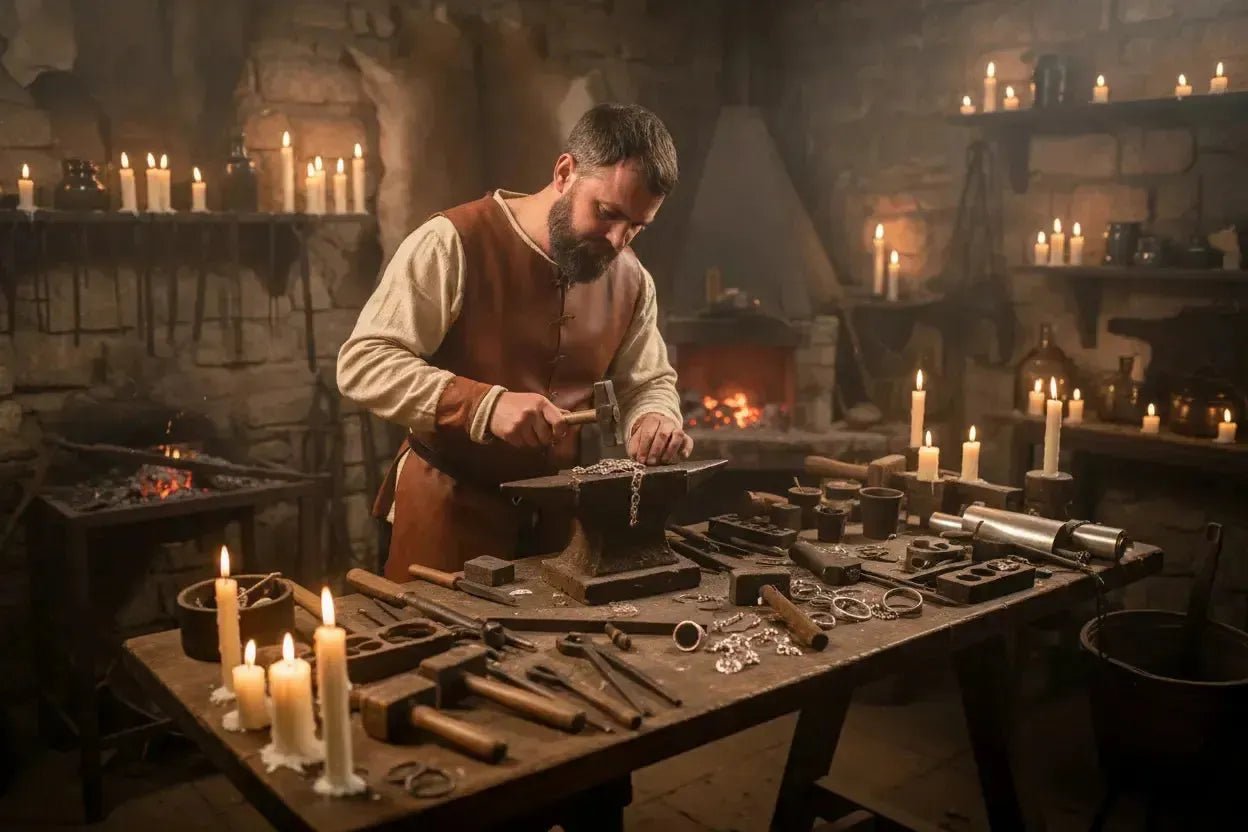
The Renaissance: The Golden Age of Sterling Silver Jewelry
Between the 15th and 16th centuries, the European Renaissance elevated silver goldsmithing to the status of fine art. This was the golden age of master craftsmen, royal courts, and spectacular pieces that still defy imagination.
The Context: Silver from Potosí
The Renaissance coincided with a massive influx of American silver into Europe. The mines of Potosí (discovered in 1545) flooded royal courts with precious metal. Patrons — kings, popes, bankers — had the means to finance masterpieces, in a context where silver suddenly became more abundant than ever before. To discover this mining history: Potosí, the silver mountain that changed the world.
Benvenuto Cellini — The Florentine Genius
Benvenuto Cellini (1500-1571) is the emblematic figure of Renaissance goldsmithing. Goldsmith, sculptor, memoirist, he worked for the Medicis in Florence, for Pope Clement VII in Rome, and for Francis I in Fontainebleau.
His most famous piece — Francis I's Salt Cellar (1543) — is made of enameled gold, but his silver works are equally remarkable. Cellini wrote in his memoirs: "The goldsmith is the first of artists, for he masters both matter and form."
A High-Risk Profession: The Sack of Rome
Cellini's career illustrates how inseparable Renaissance goldsmithing was from the tumultuous political context of the time. In 1527, during the Sack of Rome by Charles V's troops, Cellini was enlisted as an artilleryman to defend Castel Sant'Angelo — he would later claim, in his memoirs, to have personally shot down the Constable of Bourbon with an arquebus. Between royal commissions, he also melted down Vatican silver pieces to finance the city's defense. This episode reminds us that Renaissance goldsmiths were not mere workshop artisans, but figures often involved in the intrigues and wars of their time.
The Great Centers of Renaissance Goldsmithing
Florence — The Medicis and Excellence
Florence under the Medicis was the world center of goldsmithing. Florentine workshops mastered repoussé, chasing, cloisonné enamel, and granulation. Pieces produced in Florence circulated in all European courts, driven by constant demand from great merchant families as well as the papacy itself.
Nuremberg — German Precision
Nuremberg was the center of German goldsmithing. Nuremberg goldsmiths were renowned for their technical precision and their architectural pieces — cups, ewers, and solid silver reliquaries of remarkable complexity.
Antwerp — The Commercial Crossroads
Antwerp, the commercial capital of 16th-century Europe, was the meeting point for Northern and Southern goldsmiths. Flemish engraving and niello techniques mingled there with Italian influences, creating a hybrid style particularly sought after by collectors of the era.
Paris — The French Court
Francis I attracted the best European goldsmiths to his court, including Cellini himself for several years. France became a global reference in goldsmithing — a tradition that would culminate with Christofle in the 19th century: Christofle — The Excellence of French Goldsmithing.
Renaissance Techniques
Repoussé consists of working silver by hammering from the inside to create reliefs on the surface. Chasing then refines these reliefs through fine and meticulous engraving. Niello inlays a black alloy into the engravings to create striking contrasts. Granulation, a technique directly inherited from antiquity, consists of soldering tiny silver beads onto the surface to form raised patterns. Finally, filigree weaves silver threads into extremely fine patterns — a technique that endures today in Asian craftsmanship: Asian Craftsmanship — Ancestral Techniques.
The Status of the Goldsmith in the Renaissance
Unlike the Middle Ages where the artisan remained largely anonymous, the Renaissance saw the emergence of the goldsmith-artist, signed and recognized during his lifetime. Great courts competed for the best talents, princely commissions sometimes involved real competitions between rival workshops, and some goldsmiths accumulated fortunes and political influence comparable to those of the most famous painters or sculptors of their time. This elevation of the goldsmith's social status partly explains why so many pieces from this era have survived to us, preserved precisely because they were recognized as works of art in their own right, and not simple utilitarian objects to be melted down according to changing fashions.
A Style That Crosses Borders
The movement of goldsmiths between European courts during the Renaissance created a common aesthetic language, despite the sometimes fierce political rivalries between these same kingdoms. A master trained in Florence could well end his career at the court of France or England, bringing with him techniques and motifs that spread from workshop to workshop across the entire continent. This circulation of know-how explains the remarkable stylistic coherence observed in 16th-century European goldsmithing, despite very distinct national identities in other artistic fields of the same period.
The Renaissance Legacy in Contemporary Jewelry
The Art Deco of the 20th century reconnected with the formal rigor of the Renaissance — geometry, symmetry, technical excellence. Marcasite, an emblematic stone of Art Deco, was already used in Renaissance jewelry. Discover: Art Nouveau and Art Deco — Two Aesthetic Revolutions and our marcasite jewelry collection. Also discover our men's 925 silver rings and our women's 925 silver rings crafted in this spirit of technical excellence.
Vindicta jewelry is part of this tradition — elaborate pieces, natural stones, certified solid 925 silver. Each piece of jewelry is verifiable on our authenticity page.
✦ Vindicta — Solid 925 silver
The piece that makes the difference
Certified 925 silver · Free shipping from €69 · 10 years of excellence
Men's 925 Silver Signet Rings →