
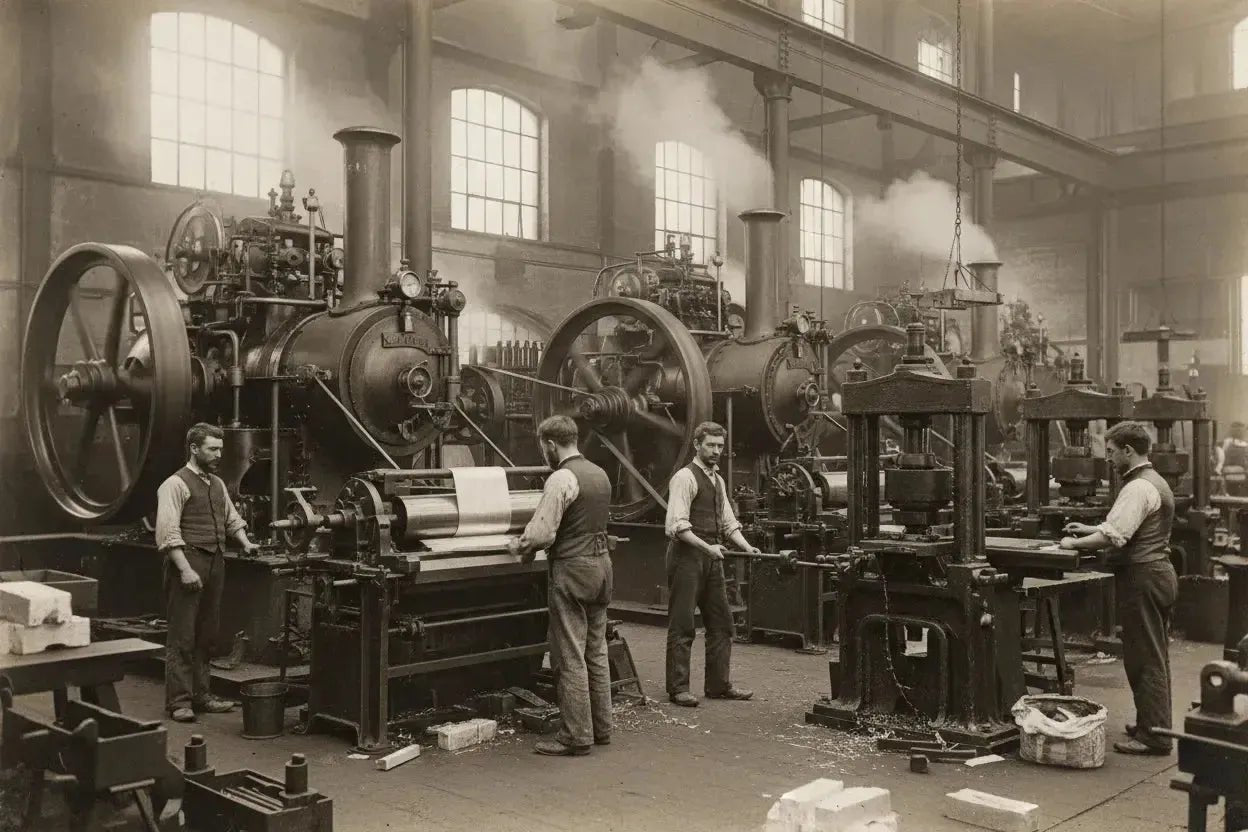
19th Century: The Industrial Revolution and the Standardization of Sterling Silver
The 19th century was the century of standardization. The Industrial Revolution transformed the production of silver, standardized alloys, and established the 925 standard as the global benchmark. This was the birth of sterling silver as we know it today.
To place this period in chronological order: The History of 925 Silver from Antiquity to Today. And for the preceding era: The Colonial Era — New World Silver.
The Industrial Revolution and Silver
The Industrial Revolution (1760-1850) radically transformed silver production. New metallurgical techniques made it possible to process lower-grade ores, refine silver with unprecedented precision, and standardize alloys on a large scale.
Global silver production exploded: mines in Nevada (discovered in 1859), Mexico, and Australia were added to the historic mines of South America. Silver became more accessible than ever, paving the way for increasingly democratized jewelry throughout Europe.
1851: The Birth of the 925 Standard
In 1851, the United Kingdom officially recognized the 925 standard (92.5% pure silver) as the standard for sterling silver. This decision was based on a tradition dating back to the 12th century — the term "sterling" has designated high-quality silver since medieval times.
Why 92.5%? It is the ideal compromise between:
- Purity: 92.5% pure silver guarantees value and brilliance
- Hardness: 7.5% copper provides the necessary resistance for jewelry
- Workability: The alloy can be melted, rolled, drawn, chiseled
This same 925 standard is what we use today in our entire collection of 925 silver jewelry. To understand the hallmarks that certify this standard: Silver Hallmarks — Complete Guide.
The Great Exhibition of London (1851): The Showcase of the New Standard
The timing is no coincidence: the same year the United Kingdom officially established the 925 standard, London hosted the first Universal Exhibition at the Crystal Palace. More than six million visitors discovered silverware from the greatest European houses, displayed side-by-side according to quality criteria that were now comparable thanks to standardization. This event significantly accelerated the international adoption of 925: foreign buyers and silversmiths left convinced of the commercial superiority of a single, verifiable standard, whereas previously each country applied its own silver standards, making international trade difficult and prone to fraud.
Christofle: The Electroplating Revolution
In 1842, Charles Christofle acquired electroplating patents and revolutionized French silversmithing. Electroplating allowed for a layer of silver to be deposited on less noble metals — democratizing tableware. Discover the full article: Christofle — The Excellence of French Silversmithing Since 1830.
The International Spread of the 925 Standard
After the United Kingdom, the 925 standard gradually spread:
- 1866: The United States adopted 925 sterling as its legal standard
- 1880s: France, Germany, and Austria harmonized their standards
- 1900s: The Vienna Convention created a common internationally recognized hallmark
- Today: 925 is recognized in more than 50 countries as the standard for sterling silver
Victorian Silversmithing
The Victorian era (1837-1901) was the golden age of mass silversmithing. Major houses — Mappin & Webb, Garrard, Tiffany — produced 925 silver jewelry and tableware for a rapidly expanding middle class. The Victorian style blended Gothic, Oriental, and naturalistic influences, reflecting the era's fascination with distant civilizations rediscovered by nascent archaeology.
The Peculiar Case of the American Silver Rush
In the United States, the discovery of the Comstock Lode in Nevada in 1859 triggered a veritable silver rush, mirroring the Californian gold rush a decade earlier. Entire cities sprang up in a few months around the mines, such as Virginia City, which had up to 25,000 inhabitants at its peak before shrinking to a few hundred today. This massive American production directly contributed to the global silver price drop in the last decades of the century, forcing several countries to reconsider their monetary policy based on the white metal — an economic episode known as the "silver question" that dominated American political debate until the end of the century.
The Great Universal Exhibitions and the Spread of Taste
Beyond London in 1851, the universal exhibitions that followed throughout the century — Paris in 1855, 1867, 1878, and 1889, Vienna in 1873, Philadelphia in 1876 — played a decisive role in the global circulation of silversmithing styles and techniques. French, English, and German houses showcased their latest innovations to an international public who compared, judged, and then brought these trends back to their own countries. This accelerated circulation of ideas explains why Victorian taste, although born in England, is found with so few variations in silversmithing catalogs across Europe at the end of the century.
The Preparation for Art Nouveau
In reaction to mass industrial production, an artistic movement emerged at the end of the 19th century. The Arts & Crafts (William Morris, 1880s) advocated a return to craftsmanship. This movement directly prepared the way for Art Nouveau, which would revolutionize silver jewelry at the turn of the century. Discover: Art Nouveau and Art Deco — Two Aesthetic Revolutions.
The Legacy of the 19th Century
The 19th century bequeathed us the 925 standard that structures all contemporary jewelry. Every Vindicta piece of jewelry bears this hallmark — a direct heir to Victorian standardization. Discover our men's rings and our women's 925 silver rings, all certified according to this same standard.
Every Vindicta piece of jewelry is certified solid 925 silver, verifiable on our authenticity page.
Discover our complete collection of certified 925 silver jewelry.
✦ Vindicta — Solid 925 silver
The piece that makes the difference
Certified 925 silver · Free shipping from €69 · 10 years of excellence
Men's 925 Silver Signet Rings →


