French Goldsmithing in the Middle Ages: Abbeys, Reliquaries, and Sterling Silver
Money in the Service of the Sacred: The Birth of French Silversmithing
Before becoming jewelry, solid silver in France was a sacred material. From the 5th to the 15th century, the greatest silversmiths in the kingdom worked not for merchants or nobles, but for the Church. Abbeys were the first silversmithing workshops in France — places where specialized monks passed down their knowledge from generation to generation, perfecting techniques that would lay the foundation for the entire French silversmithing tradition.
It was in this context that solid 925 silver established itself as the noble metal par excellence — pure, durable, capable of receiving the finest engravings and the most brilliant enamels. A legacy that Vindicta perpetuates today in every selected piece.
The Great Centers of Medieval French Silversmithing
The Abbey of Saint-Denis: The Royal Treasure
Founded in the 7th century and the necropolis of the Kings of France, the Abbey of Saint-Denis housed one of Europe's most fabulous treasures. Under the impetus of Abbot Suger in the 12th century, it became a center of silversmithing excellence: chalices, reliquaries, crowns, and scepters in solid silver and gold were made there by the best craftsmen in the kingdom. Suger was convinced that the beauty of materials elevated the soul to God — a philosophy that profoundly marked French silversmithing.
The Conques Treasure: A Romanesque Masterpiece
The Abbey of Sainte-Foy de Conques, in Aveyron, preserves one of the best-preserved medieval silversmithing treasures in the world. The Majesty of Sainte-Foy — a 9th-century statue-shaped reliquary — is entirely covered with gold and silver plates, inlaid with precious stones and ancient cameos. It testifies to extraordinary technical mastery and an artistic vision that rivals the greatest achievements of Antiquity.
The Silversmiths of Paris: Birth of a Corporation
From the 12th century, Paris established itself as the capital of French silversmithing. The silversmiths' corporation — one of the most powerful in the city — established strict rules of quality and certification. It was at this time that the system of silver hallmarks was born — marks engraved on each piece to guarantee the purity of the metal and the identity of the craftsman. A certification system that continues to this day in the form of the 925 hallmark.
Medieval Techniques That Shaped French Silversmithing
Medieval French silversmiths developed and perfected several techniques that are still used today:
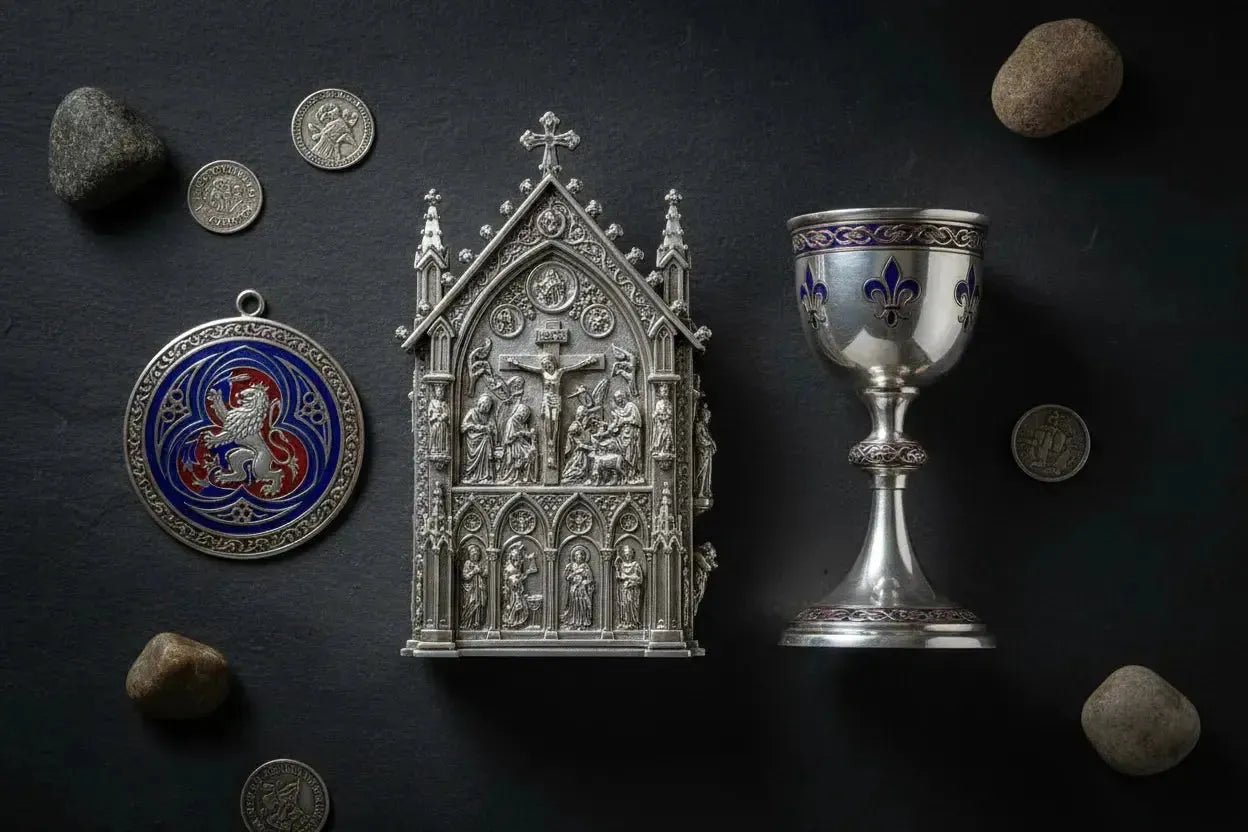
- Repoussé: a technique consisting of working the silver from the back to create reliefs on the surface. Used for large liturgical pieces such as reliquaries and processional crosses.
- Chasing: detailed work using chisels to refine and define relief motifs. Parisian silversmiths were renowned for the delicacy of their chasing.
- Cloisonné enamel: a technique inherited from Byzantium, consisting of creating compartments with soldered silver wires, filled with colored enamels. The enamels of Limoges, developed in the 12th century, represent the pinnacle of this art.
- Niello: the inlay of a black alloy into silver engravings to create striking contrasts. A technique widely used in medieval jewelry and liturgical objects.
Profane Jewelry in the Middle Ages: The Signet Ring and the Fermail
While abbeys concentrated most of the silversmithing expertise, the Middle Ages were not exclusively focused on the sacred. The nobility also wore solid silver jewelry, foremost among which was the signet ring — a seal ring engraved with family coats of arms, used to authenticate official documents by pressing the motif into hot wax. Owning one's own signet ring was a seigneurial privilege, a sign of legal authority as much as an ornament. The fermail, an ornamental clasp used to fasten cloaks and capes, completed this profane jewelry: often circular, finely engraved, it already foreshadowed the large decorative fibulae that would later be found in other European traditions.
This dual life of medieval silver — sacred in abbeys, profane at court and among lords — laid the foundations for a versatility that is still found today in French jewelry: the same technical mastery could produce a reliquary for the altar and a signet ring for a knight's finger. Our article on royal insignia in solid silver extends this history to the crowns and scepters that directly inherited the techniques developed in medieval monastic workshops.
From Abbey to Jewelry: A Living Heritage
Medieval French silversmithing is not a dead art. It has passed on to all subsequent French jewelry — from the Renaissance to the 20th century — a demand for quality, technical mastery, and attention to detail that remain the hallmarks of French silversmithing. The excellence of Christofle in the 19th century or the revolution of Puiforcat in the 20th century are direct heirs to this medieval tradition.
At Vindicta, we follow in this lineage: every piece of solid 925 silver jewelry we select is chosen for its manufacturing quality, durability, and character. Like medieval silversmiths, we believe that lasting beauty is better than ephemeral brilliance. Discover our commitments on our authenticity page.
To delve deeper into the history of silver, discover our articles on the history of 925 silver from antiquity to today, the Renaissance and silversmithing, and silver hallmarks.
✦ Vindicta — Solid 925 silver
The piece that makes the difference
Certified 925 silver · Free shipping from €69 · 10 years of excellence
Women's 925 Silver Rings →