Potosí: The Silver Mountain that Changed the World
In 1545, indigenous shepherds discovered a mountain in Bolivia whose depths were rich in silver. Potosí became the richest city in the world, produced 80% of the world's silver for two centuries, and forever transformed the global economy — and jewelry along with it.
The Discovery — 1545
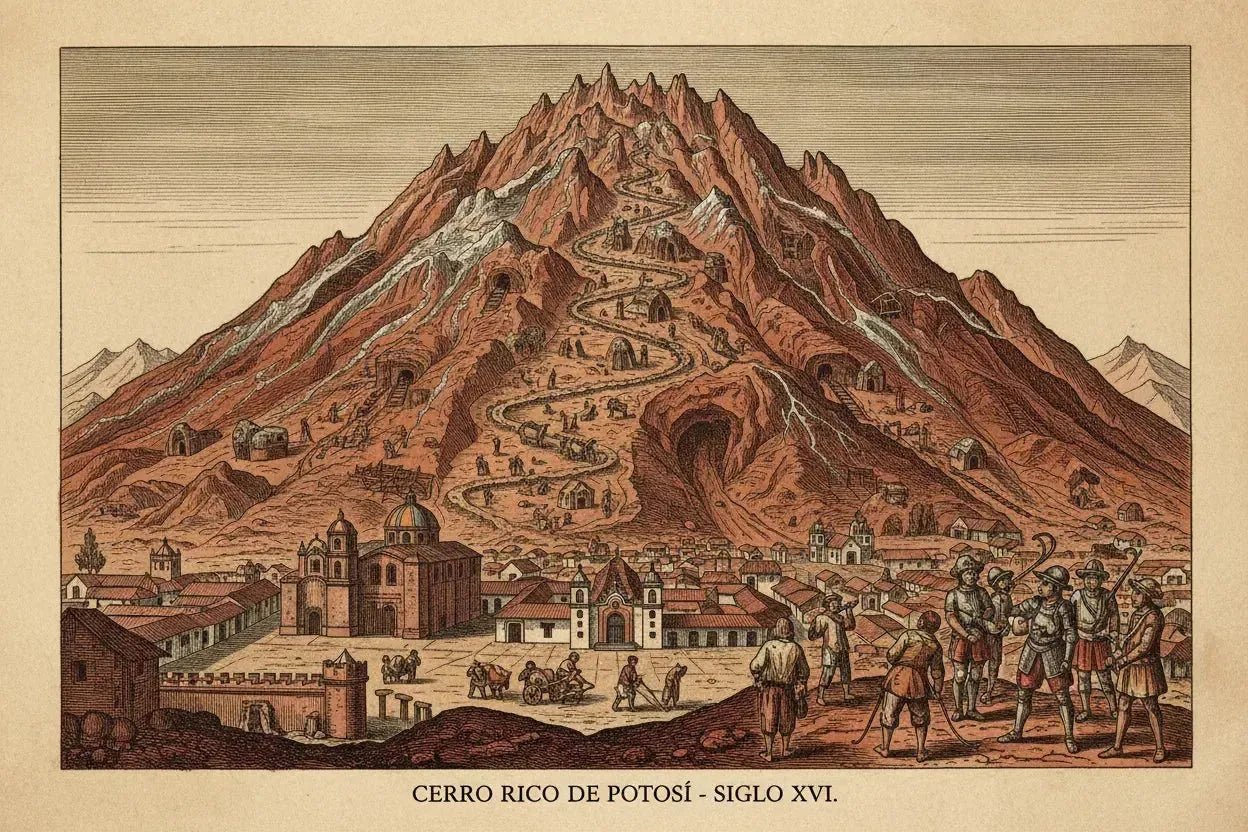
On April 1, 1545, an indigenous shepherd named Diego Huallpa lit a fire on the slopes of Cerro Rico (“the rich mountain”) to warm himself. The next morning, he discovered that the fire had melted pure silver, which had flowed down the rock. The news spread like wildfire.
Within weeks, thousands of people converged on Cerro Rico. Within years, Potosí — located at 4090 meters (13,420 feet) above sea level in the Bolivian Andes — became the largest city in the Americas and one of the largest in the world.
Staggering Figures
- Population: 160,000 inhabitants in 1650 — more than London or Paris at the time
- Production: More than 45,000 tons of silver extracted between 1545 and 1800
- Global Share: 80% of the world's silver produced in Potosí in the 16th century
- Price Impact: The price of silver in Europe fell by 50% between 1550 and 1650
- Expression: “Vale un Potosí” (worth a Potosí) — Spanish expression for immense wealth, still used today
The Patio Process: Revolutionizing Extraction
Potosí's production would never have reached such a scale without a major technical innovation: the "patio process," invented in 1554 by the Spanish merchant Bartolomé de Medina. This method uses mercury to extract silver from low-grade ores, where simple fire smelting was insufficient. The crushed ore is spread in large circles directly on the ground — the "patios" — mixed with mercury, salt, and water, then trampled for weeks by mules or workers to release the silver. The process is effective but appallingly toxic: constant exposure to mercury vapors decimated miners, poisoned surrounding waterways, and left measurable traces of contamination in the region's soils even today, nearly five centuries later.
A City at 4000 Meters: Living to the Extreme
Beyond its wealth, Potosí impressed with the extreme conditions of its very existence. At 4090 meters (13,420 feet) above sea level, the thin air and the glacial cold of the Andean nights made daily life grueling for the thousands of newcomers from the coastal plains. The city had to import almost all of its food, firewood, and even some of its drinking water by mule trains, in an almost sterile mineral landscape. Yet, this total dependence on the outside never prevented the city from reaching, at its peak, a level of architectural and religious splendor comparable to that of the largest European capitals of the time — baroque churches, richly decorated convents, private mansions financed directly by the silver extracted a few kilometers higher up.
Impact on the Global Economy
The Price Revolution
The massive influx of American silver triggered the first global inflation in modern history. Prices in Europe doubled or tripled between 1550 and 1650. Economists call this phenomenon the “Price Revolution” — the first example of economic globalization.
The First Global Monetary System
Potosí's silver circulated worldwide. Via the Manila galleon (Philippines), it reached China, which used it as a medium of exchange. This was the first truly global monetary system in history.
The Democratization of Silver
Before Potosí, silver was reserved for the elite. Afterward, it became accessible to European middle classes. Silver jewelry became democratized — paving the way for the standardization of 925 silver in the 19th century: 19th Century — Standardization of 925 Silver.
The Human Cost
Potosí's wealth came at an enormous human cost. Millions of indigenous laborers and African slaves perished in the mines. The "mita" — forced labor imposed by the Spanish — decimated Andean populations. It is estimated that 8 million people died in Potosí between 1545 and 1825, a figure that reminds us that behind every historic silver jewel lies a human chain too often silenced.
The Artistic Legacy
Potosí's silver funded the greatest artistic achievements of the European Renaissance and Baroque periods. Spanish churches, royal palaces, the goldsmithery of great courts — all of this was financed by Bolivian silver. To discover Renaissance goldsmithery: The Renaissance — The Golden Age of Goldsmithery.
Potosí Today
Cerro Rico is still being exploited today — by cooperatives of Bolivian miners. The mountain has been a UNESCO World Heritage site since 1987. But it is slowly collapsing — emptied of its entrails after 500 years of exploitation.
A Legacy That Endures in Today's Certified Silver
While the circumstances of extraction have radically changed, the lesson of Potosí remains relevant: the traceability and authenticity of precious metal are issues that have never disappeared. This is why every Vindicta piece is certified solid 925 silver, with verifiable origin and composition — a demand for transparency that the troubled history of colonial silver makes all the more necessary today. Discover our men's rings and our women's rings in certified 925 silver.
Every Vindicta jewel is certified solid 925 silver, verifiable on our authenticity page.
✦ Vindicta — Solid 925 silver
The piece that makes the difference
Certified 925 silver · Free shipping from €69 · 10 years of excellence
Men's 925 Silver Signet Rings →