
925 Sterling Silver Jewelry and Senegalese Culture — Signet Rings, Jewelry Sets, and Wolof Heritage
In Senegal, jewelry is not a frivolous adornment. It is a language. Each piece worn—whether on a man's finger or a woman's wrist—says something about the wearer: their family, their faith, their rank, their affiliation. And in this silent language, silver is one of the most widely spoken dialects.
The Senegalese community in France—estimated at over 150,000 people, concentrated in Paris, Marseille, Lyon, and Bordeaux—remarkably maintains these sartorial and jewelry codes inherited from their homeland. Understanding the place of silver jewelry in Senegalese culture means understanding a part of what these men and women wear every day, far from Dakar.
The signet ring, a Senegalese man's jewel
In Wolof culture—the majority ethnic group in Senegal—as in the Fulani, Toucouleur, and Mandinka cultures that coexist in the country, the signet ring is a masculine jewel of considerable importance. It is not a fashion accessory: it is an identity marker, a sign of social maturity, and very often, an object with a spiritual dimension.
Among men of Islamic tradition—who represent over 95% of the Senegalese population—the silver signet ring is directly linked to the Sunnah, the prophetic tradition. Prophet Muhammad wore a silver ring on his finger, and this practice is followed by millions of Muslim men around the world. In Senegal, this religious dimension overlaps with a cultural dimension: the signet ring is also the jewel of the family head, the notable, the man who has accomplished something in his life.
The men's 925 silver rings worn by Senegalese men are often wide, sober, sometimes adorned with a black stone—onyx or carnelian—which reinforces the protective dimension of the jewel. No unnecessary embellishments: a massive, assertive piece that says what's essential without overdoing it.
Carnelian and onyx, preferred stones
Two stones consistently appear in Senegalese and West African jewelry tradition: carnelian and black onyx. Carnelian—an orange-red stone—is mentioned in the hadiths as the stone worn by the Prophet. It is renowned for its protective virtues, its ability to strengthen confidence, and to ward off the evil eye. Black onyx, for its part, is associated with strength, protection, and grounding—central values in Senegalese male culture.
These two stones mounted on solid 925 silver constitute pieces that speak directly to a Senegalese man or a man of Senegalese origin: they combine aesthetics, spirituality, and cultural identity in a single piece.
The Senegalese feminine adornment
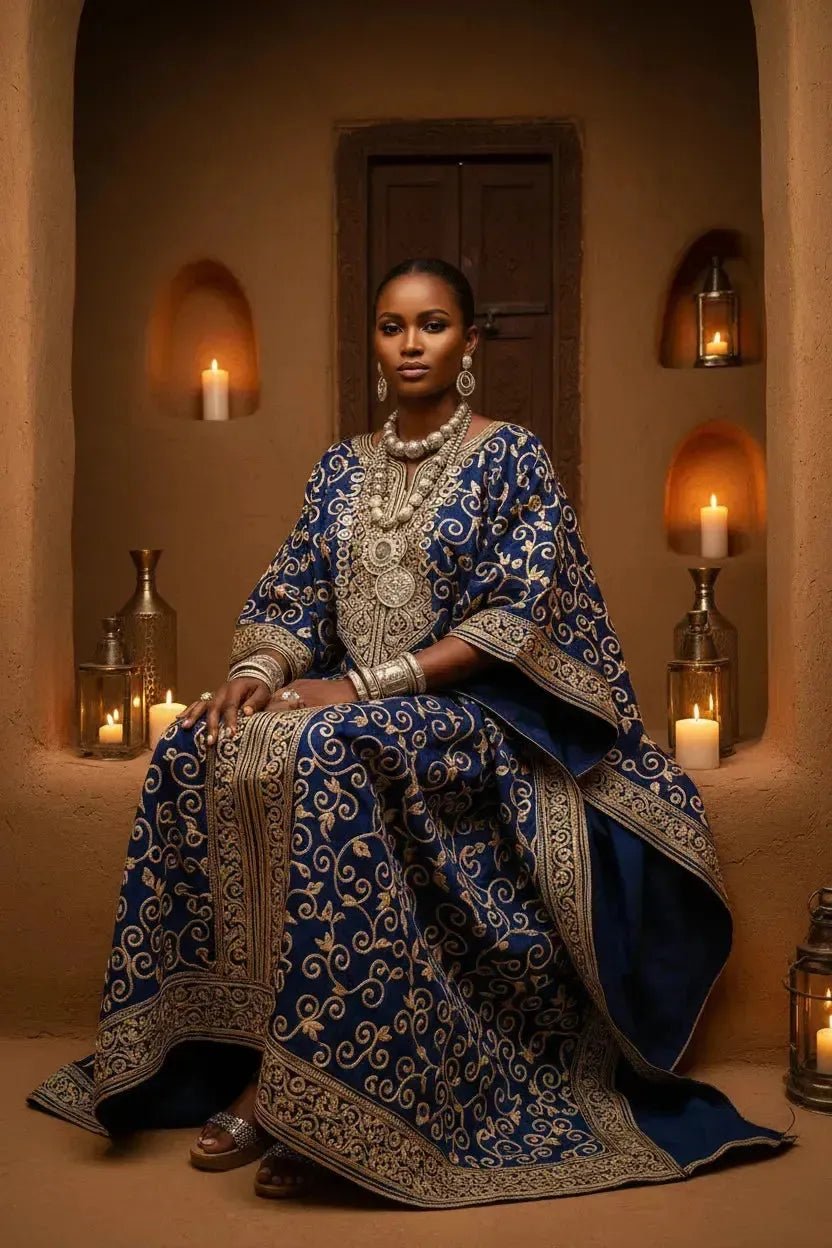
For women, Senegalese adornment is a serious matter. Major occasions—baptisms, weddings, Tabaski, Korité—are moments when Senegalese women bring out their finest adornments and where jewelry becomes a public declaration of family status.
Silver necklaces are worn layered, often associated with colorful glass beads or natural stones. Earrings are large, dangling, elaborate—they frame the face with authority. Bracelets are stacked on wrists, rigid bangles or wide chains, and rings complete an adornment that aims to be comprehensive.
What is striking about Senegalese feminine adornment is its relationship with color. Silver is never alone—it always dialogues with the fabric of the boubou, the beads, the stones. It is an aesthetic of layering and contrast, where each element reinforces the others.
Tabaski, a highlight for Senegalese jewelry
Tabaski—Eid al-Adha—is the most important holiday of the year for Senegalese families, both in France and in Senegal. It is a time when one wears their finest clothes, exchanges gifts, and visits elders. And it is, invariably, a time when jewelry plays a central role.
Offering a silver signet ring to a son, brother, or father for Tabaski is a gesture laden with meaning. Offering a necklace or earrings to a woman in the family is telling her that you care about her, that you recognize her worth. These gifts are not forgotten—they are worn, they are passed down.
Why solid 925 silver is essential
In Senegalese culture, as in all West African cultures, the quality of jewelry is immediately apparent. Plated jewelry that tarnishes after a few weeks is a shame—it suggests that the giver did not put in the effort. Solid 925 silver, for its part, keeps its promises over time. It shines, it resists, it is passed down.
At Vindicta, we select men's signet rings and women's rings in solid 925 silver, pieces with carnelian and black onyx that are directly in line with this tradition. Jewelry that has weight, character, and says something—exactly as Senegalese culture dictates.
A proudly worn heritage
In Paris, Marseille, Lyon, men and women of Senegalese origin wear their jewelry with the same pride as in Dakar. The signet ring on a man's finger, the earrings on a woman's ears—these signs do not disappear with exile. They adapt, sometimes, but they persist. Because a silver jewel is more than just a jewel. It's a way of staying true to oneself, wherever one goes.
✦ Vindicta — Argent 925 Massif
La pièce qui fait la différence
Certifié argent 925 · Livraison offerte dès 69€ · 10 ans d'excellence
Découvrir nos Bijoux →