Sterling Silver Jewelry and Malian Culture — Signet Rings, Dogon Sets, and Manding Heritage
Mali is one of the West African countries where the tradition of silver jewelry is the oldest and most vibrant. Heir to the great Sahelian empires — the Mali Empire, the Songhai Empire, the Bambara Kingdom of Ségou — this country carries in its ornaments a memory of several centuries of trans-Saharan trade, exchanges with the Arab world, and remarkably sophisticated local goldsmithing. And within the Malian diaspora in France — estimated at over 120,000 people, with a strong presence in Île-de-France — this tradition has not died out. It has adapted, but it persists, carried by men and women who know exactly what it means to wear silver jewelry.
The empire of jewelry: a thousand-year history
To understand the place of jewelry in Malian culture, one must go back to the great trade routes of the Sahara. For centuries, Timbuktu and Djenné were global crossroads where gold, silver, salt, and spices were exchanged between sub-Saharan Africa, the Maghreb, and the Middle East. Malian jewelry artisans — often from the caste of blacksmiths, custodians of know-how passed down from father to son — developed exceptionally fine silver goldsmithing techniques: filigree, granulation, chasing.
This history explains why silver jewelry in Mali is not merely an ornament. It is an object imbued with history, status, and spirituality — exactly like the solid 925 silver pieces we select at Vindicta.
The signet ring, symbol of the Malian man
As in Senegal and throughout Islamic West Africa, the silver signet ring is the quintessential male jewel in Mali. It is worn by men of all ethnic groups — Bambara, Manding, Soninke, Fulani, Dogon — with meanings that vary according to traditions but all converge on the same values: faith, status, protection.
Among men of Muslim tradition — who are the majority in Mali — the silver signet ring directly refers to the prophetic Sunnah. But beyond the religious dimension, it is also the jewel of the chief, the family patriarch, the accomplished man. The 925 silver men's rings worn by Malians are generally wide, sober, sometimes adorned with a red carnelian or a black onyx — two stones deeply rooted in Islamic and West African tradition.
The Dogon universe: symbols and silver
The Dogon — an animist people from the Bandiagara plateau in central Mali — have developed one of the richest and most studied material cultures in Africa. Their silver jewelry is marked by complex cosmological symbolism: the serpent, the star, the spiral, the crescent — all motifs that tell their vision of the world and the universe.
While the Dogon are less represented in the Malian diaspora in France than the Bambara or Soninke, their jewelry aesthetics have profoundly influenced Malian craftsmanship as a whole. The silver jewelry with geometric patterns found in Malian tradition often bears this Dogon imprint — a sacred geometry that gives the jewel a dimension far beyond the decorative.
The Malian feminine adornment
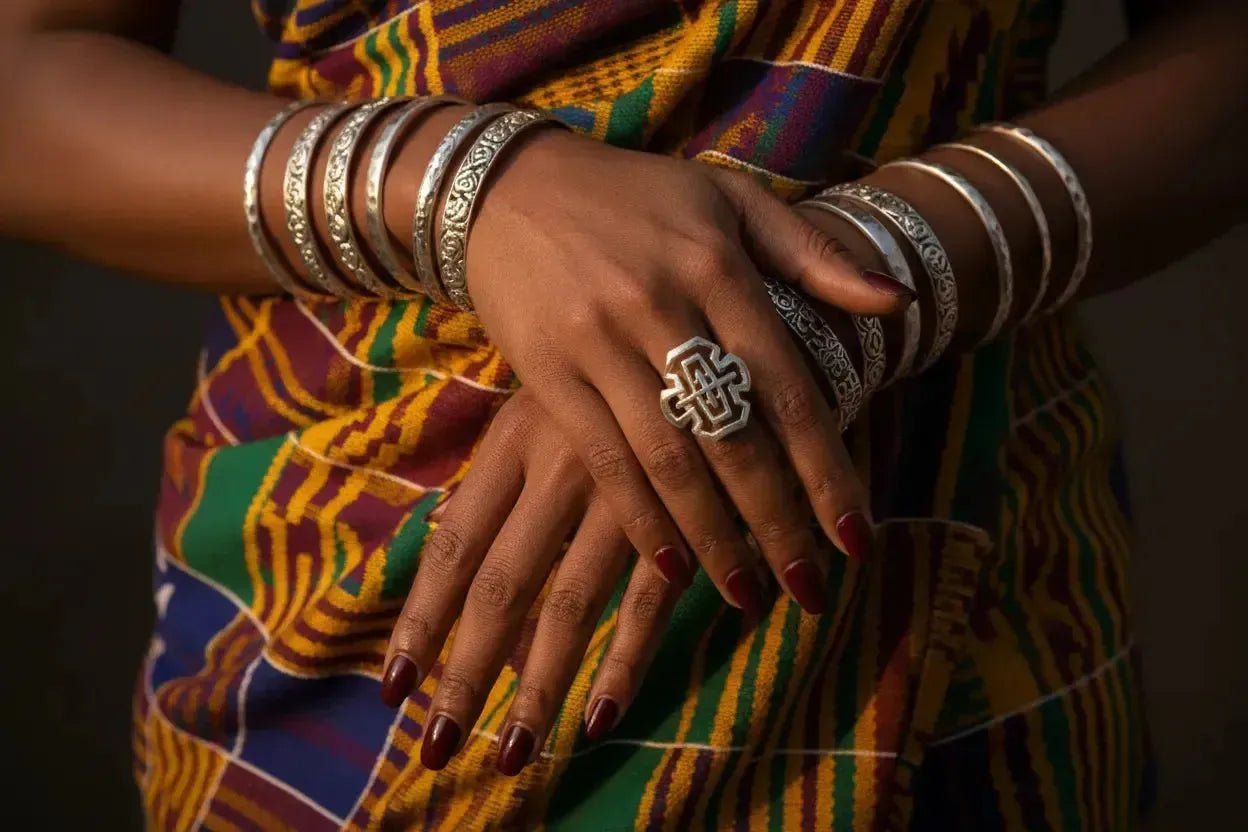
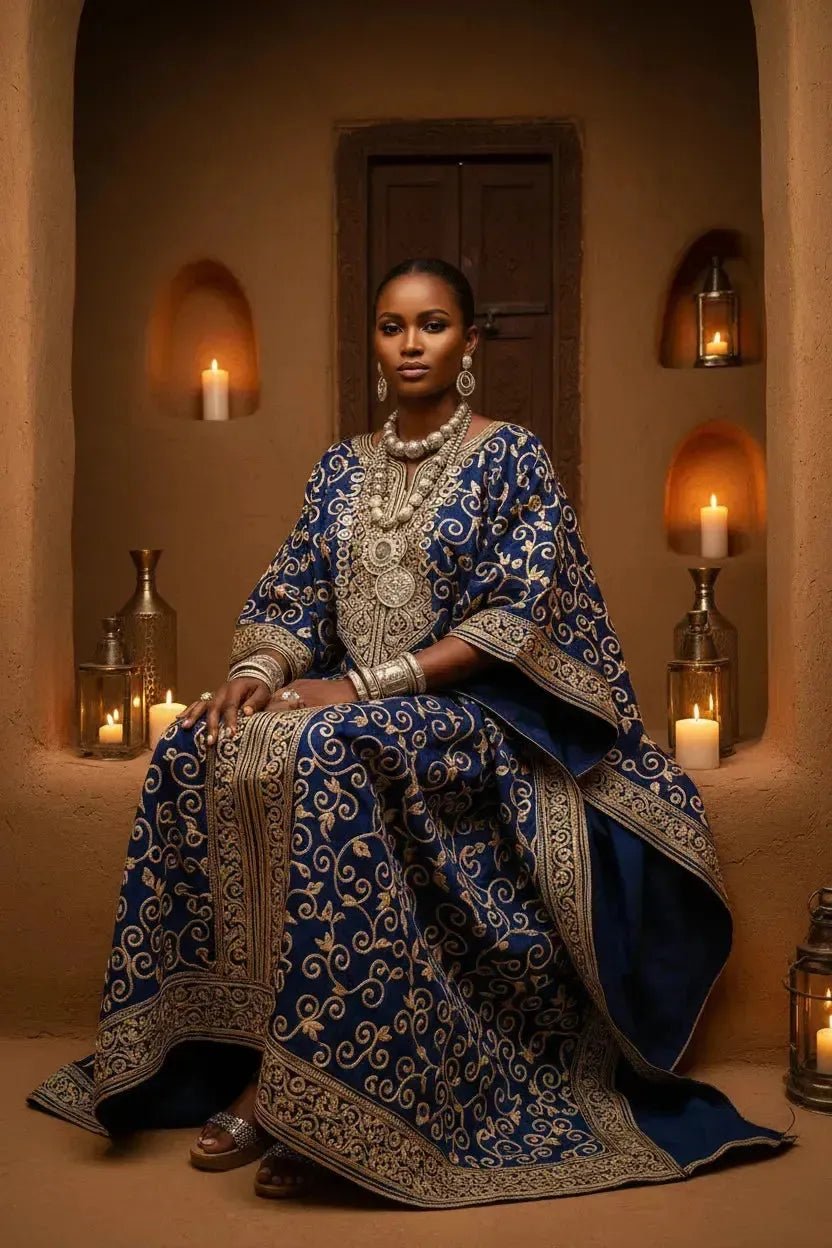
The Malian woman in full attire is a striking sight. The large embroidered boubou, the carefully tied gele, and the silver adornment that completes the ensemble — layered necklaces, elaborate dangling earrings, bracelets stacked on both wrists, assertive rings. It is a total adornment, conceived as a whole, where each piece dialogues with the others.
Grand occasions — weddings, baptisms, Tabaski and Korité festivities — are the moments when this adornment expresses itself fully. In the Malian diaspora in France, these ceremonies are maintained with remarkable fidelity, and jewelry plays the same role there as in Bamako: it tells who one is, where one comes from, and what one is worth.
The Malian diaspora in France and jewelry as an anchor
The Malian community in France is one of the oldest African diasporas in the country — the first Malian workers arrived as early as the 1960s. This seniority has produced an rooted, organized community, with associations, mosques, and strong solidarity networks. And in this community, silver jewelry remains a strong identity marker, passed down from generation to generation.
Buying a 925 silver signet ring for a son entering adulthood, offering a necklace to a daughter for her wedding, wearing inherited bracelets from one's mother during celebrations — these gestures are not trivial. They are acts of transmission, ways of saying that despite the distance, despite the years, one has not forgotten.
Why solid 925 silver meets this requirement
The Malian jewelry tradition values weight, material, and durability. A piece of jewelry that wears out, tarnishes, or deforms has no value — neither symbolic nor practical. Solid 925 silver meets exactly this requirement: it is dense, resistant, and ages with dignity. It can be passed down as is to the next generation without losing its shine or its value.
At Vindicta, we select men's signet rings and women's adornments in solid 925 silver that naturally fit into this Malian tradition of serious jewelry, jewelry that lasts, jewelry that says something. Pieces with carnelian, onyx, geometric patterns — for men and women who know exactly what they are wearing.
A heritage that spans generations
From Bamako to Paris, from Ségou to Lyon, from Mopti to Marseille — Malians in France wear their history on them. The signet ring on the finger, the earrings in the ears, the bracelets on the wrist: these jewels are not souvenirs. They are presences. Ways to stay connected to something greater than oneself, to a lineage, to a land, to a way of being in the world.
It is this vision of jewelry — as a living link between the past and the present — that Vindicta has championed for over 10 years. We do not sell objects. We select pieces that have a memory.
✦ Vindicta — Argent 925 Massif
La pièce qui fait la différence
Certifié argent 925 · Livraison offerte dès 69€ · 10 ans d'excellence
Découvrir nos Bijoux →