
925 Sterling Silver Jewelry and Ivorian Culture — Akan Adornments, Status, and Heritage
In Côte d'Ivoire, jewelry is not merely an ornament—it's an institution. In a country with over sixty ethnic groups, each with its own dress codes and jewelers, jewelry is one of the few universal languages: that of status, celebration, and belonging. And in this language, sterling silver holds a place that few materials can claim.
The Ivorian community in France—estimated at over 300,000 people, with a strong presence in Île-de-France, Lyon, and Bordeaux—is one of the most economically dynamic African diasporas. These are successful men and women who celebrate, give, and transmit. And for all this, they seek jewelry that matches their ambitions.
Status Jewelry in Akan Culture
The Akan people—which include the Baoulé, Agni, Abron, and several other ethnic groups from central and eastern Côte d'Ivoire—have developed one of West Africa's most sophisticated jewelry cultures. Historically, the Akan were major gold producers, and their solid gold jewelry is world-renowned. But silver plays an essential complementary role: it is the metal of purity, spiritual protection, and family transmission.
In Akan tradition, jewelry is not bought—it is earned. It is received during an initiation, a marriage, an enthronement. It marks a passage, an elevation. Wearing a sterling silver signet ring or an elaborate necklace is a way of telling one's community that a threshold has been crossed—that one has become someone of significance.
The Bété, the Dioula, and Ivorian Jewelry Diversity
Beyond the Akan, Côte d'Ivoire is a crossroads of jewelry traditions. The Dioula—Muslim traders present throughout the north of the country—share with Senegalese and Malian communities a deep attachment to the silver signet ring as a masculine jewel of faith and status. Carnelian and black onyx, prophetic stones, adorn their rings with the same significance as in Senegal or Mali.
Bété and Guéré women, on the other hand, wear massive bracelets and large earrings during funeral ceremonies and generational festivals—moments when jewelry expresses clan belonging and respect due to ancestors.
Major Ivorian Ceremonies and Jewelry
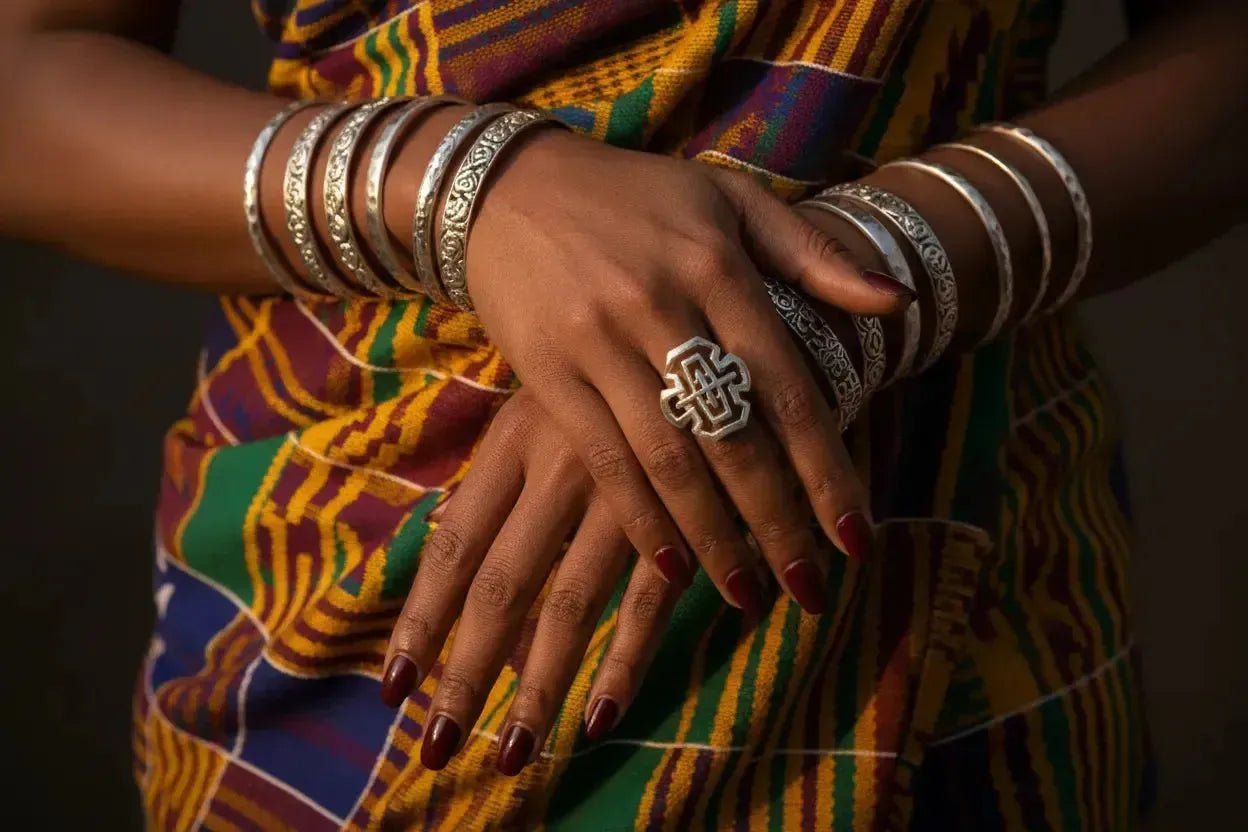
In Côte d'Ivoire, as in the diaspora, grand occasions are moments when jewelry fully expresses itself. Ivorian weddings—often organized in several stages, with dowry, civil ceremony, and community celebration—are events where the bride's adornment is scrutinized by the entire assembly. Layered silver necklaces, dangling earrings, and stacked bracelets form an adornment that speaks to the family's seriousness and the value placed on the union.
Baptisms—called "presentations" in some Ivorian communities—are also major occasions. Offering a silver jewel to the mother or child is a gesture full of meaning: it protects, it blesses, it inscribes the newborn into a lineage.