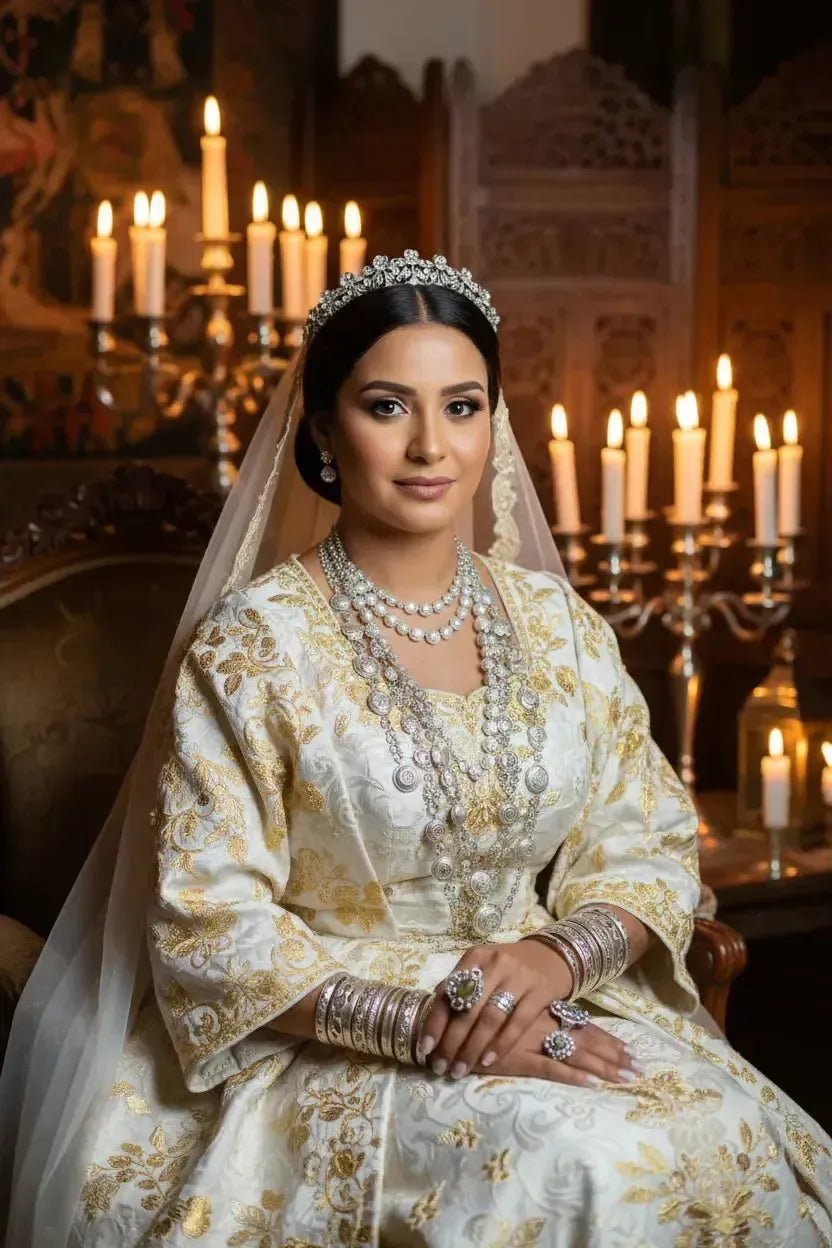

Fulani Women and their Silver Jewelry — Identity, Pride, and Nomadic Heritage
There are peoples whose women are recognizable even before they speak. Among the Fula people—also known as Fulani, Fulɓe, or Peuls depending on the region—it is the jewelry that speaks first. Before clothing, before a glance, before a gesture: the large earrings, the stacked necklaces, the bracelets that reach up to the elbow. A bedecked Fula woman is a living declaration—of beauty, certainly, but above all, of belonging, status, and dignity.
This people of nomadic pastoralists, dispersed across some twenty countries in West and Central Africa—from Senegal to Cameroon, Mali to Guinea, Ivory Coast to Niger—has developed over centuries a culture of jewelry of exceptional richness. And in this culture, silver holds a place that few other metals can claim.
One People, One Adornment
The Fula people are the largest nomadic group in the world. Their geographical dispersion, far from diluting their identity, has instead crystallized it around strong cultural markers—of which jewelry is one of the most visible. Where other peoples have lost their sartorial traditions through contact with cities and modernity, Fula women have maintained their adornment with remarkable constancy. To wear one's jewelry is to affirm that one is Fula—everywhere, always.
This identity through jewelry is all the stronger because the Fula have historically lived in societies where wealth was not stored in houses or land, but was worn on the person. The herd and the jewelry: these were the two forms of capital for a traditional Fula family. A woman's jewelry represented the family's liquid wealth, transferable, visible, inaccessible to creditors.
Silver in Fula Tradition
While gold is present in Fula adornment—particularly the famous large earrings often associated with this culture—silver plays an equally fundamental role, especially in Sahelian regions and among families of strict Islamic tradition. Silver is the metal of purity, of protection against the evil eye, of divine blessing. It is also, practically, more accessible than gold while offering the same visual prestige when it is massive, well-crafted, and worn in quantity.
Sterling silver (925 silver) jewelry fits perfectly into this logic: a noble, certified metal that has weight and presence, that does not tarnish easily, and that passes through generations without losing its value. This is exactly what a Fula family looks for when honoring its tradition without compromising on quality.
Emblematic Pieces of Fula Adornment
Fula adornment is recognizable among all. Earrings are the central piece—large, round, or crescent-shaped, they can weigh several tens of grams and reach the shoulders. They are so characteristic that they have become a symbol of Fula identity throughout West Africa and in the global diaspora.
Necklaces follow—layered, of different lengths, sometimes adorned with natural stones that contrast with the sparkle of silver. Bracelets are worn in series on both arms, rigid bangles or wide cuffs that sometimes extend up to the elbow. Rings, finally, complete the adornment—often simple, wide, assertive.
What characterizes Fula adornment is its relationship to abundance. One does not wear a piece of jewelry—one wears an adornment. Accumulation is not ostentation: it is a visual grammar, a language that every Fula woman knows how to read and that every community knows how to interpret.
The Fula Diaspora in France and the Preservation of Tradition
In France, the Fula community is present in all major cities, mainly from Guinea, Senegal, Mali, and Mauritania. As with the Comorians, distance from the country of origin has not weakened attachment to traditions—it has often strengthened it. Baptism, wedding, and engagement ceremonies are occasions where Fula adornment is fully expressed, where women bring out their finest pieces, and where younger generations learn, by example, what it means to be Fula.
It is in this context that the search for quality sterling silver jewelry becomes a serious and thoughtful endeavor. Not an impulsive purchase—a decision that commits one's identity.
Why 925 Sterling Silver Meets This Requirement
Fula adornment is not meant to be worn once and put away. It accompanies the woman in her daily life, in ceremonies, in travels. It must resist, shine, endure. Plated jewelry does not keep this promise—it wears out, scratches, loses its luster at the first prolonged contact with the skin.
925 sterling silver is a direct answer to this demand for durability. It ages with dignity, cleans easily, and retains its value over time. At Vindicta, we select large earrings, stackable bracelets, and intricately linked necklaces that naturally fit into this tradition—pieces that have character, weight, and presence.
A Heritage That Travels
What is remarkable about Fula culture is its ability to travel without losing itself. From Conakry to Paris, Bamako to Marseille, Dakar to Lyon—the Fula woman carries her identity with her. Her jewelry is not a costume to be taken out for celebrations: it is a second skin, a permanent affirmation of who she is and where she comes from.
This self-fidelity, this elegance that asks no permission, is also what Vindicta has championed for over 10 years. We do not sell trends. We select pieces with soul—for women who know exactly what they wear and why.
✦ Vindicta — Argent 925 Massif
La pièce qui fait la différence
Certifié argent 925 · Livraison offerte dès 69€ · 10 ans d'excellence
Découvrir nos Bijoux →