
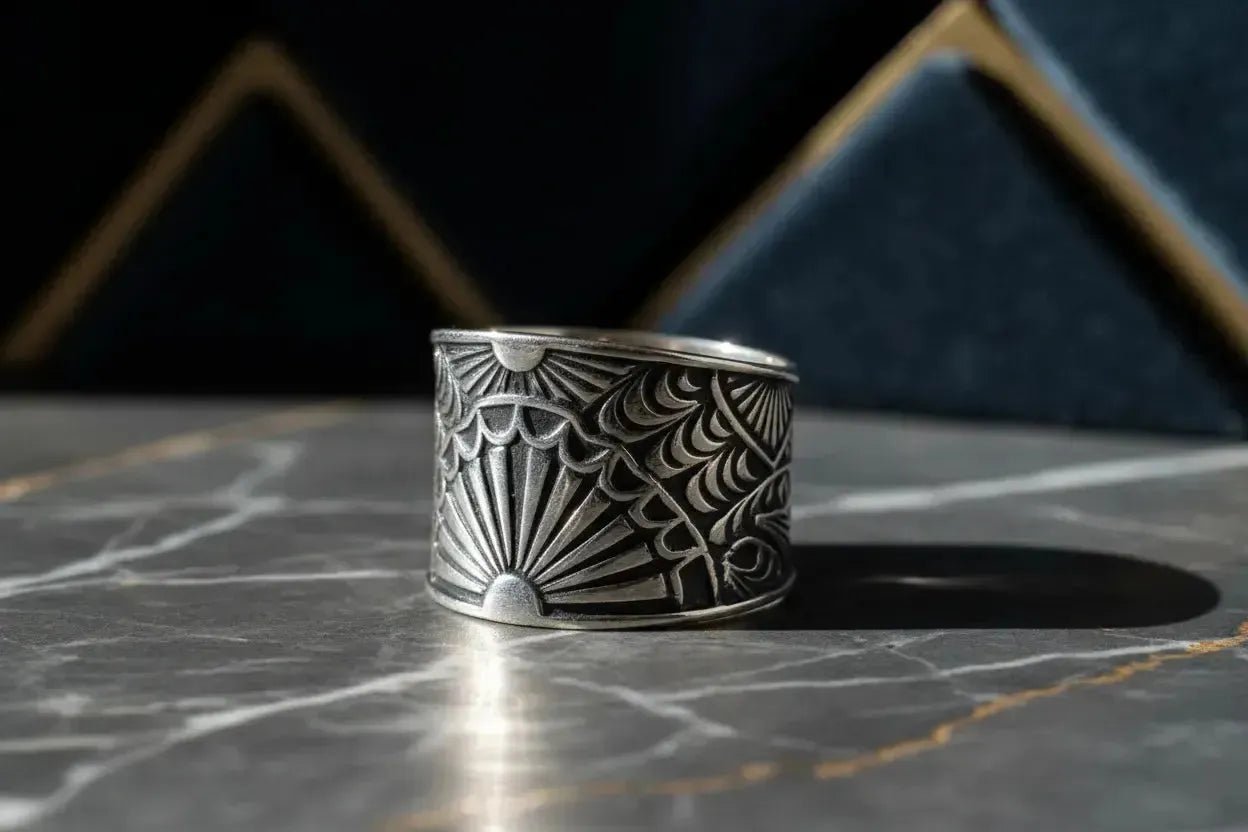
Why Is My Silver Ring Turning Black? Causes and Solutions
You've invested in a beautiful solid 925 silver ring and notice that it's gradually turning black? Don't panic — this is a natural, perfectly normal phenomenon, and most importantly, entirely reversible. At Vindicta, a solid 925 silver jewelry house for over 10 years, we explain in this comprehensive guide why your ring tarnishes, what it says about your jewelry, and how to restore its original shine with a few simple steps.
Silver tarnishing: a natural chemical phenomenon
925 silver is composed of 92.5% pure silver and 7.5% other metals, usually copper. It is precisely this composition that gives it its strength and durability — 100% pure silver would be too soft to be worked into jewelry. But this same composition makes it susceptible to oxidation.
The tarnishing of silver is called sulfidation. It occurs when silver comes into contact with sulfur compounds present in the air, on the skin, or in certain everyday products. The chemical reaction forms silver sulfide (Ag₂S), a dark layer that deposits on the metal's surface. It is not rust — silver does not rust — it is a superficial oxidation patina.
Good news: unlike rust which deeply corrodes the metal, silver sulfidation remains on the surface and can be easily removed.
The main causes of your silver ring turning black
1. Perspiration and your skin's pH
This is the number one cause. Human perspiration contains sulfur amino acids, mineral salts, and acids that react directly with silver. Each person has a different skin pH: some people cause their silver jewelry to tarnish very quickly, others almost never. This is not a defect in the jewelry — it's simply your skin's chemistry.
If your ring tarnishes very quickly, it can also indicate a hormonal change, high stress, a diet rich in sulfur (garlic, onions, eggs) or certain medications that alter the composition of your perspiration.
2. Cosmetics and perfumes
Moisturizers, perfumes, shower gels, deodorants, hairsprays, and styling products all contain chemical compounds that accelerate the oxidation of silver. The golden rule: put your jewelry on last, after your beauty routine.
3. Air and ambient humidity
Even without skin contact, silver oxidizes when exposed to air, especially in humid environments. A ring left on the edge of a sink, in a steamy bathroom, or in an open drawer will gradually tarnish. This is why storage in a closed jewelry box is essential.
4. Water and household products
Tap water contains chlorine and limescale. Pool water is particularly aggressive with its concentrated chlorine. Household products, bleach, and detergents can cause immediate and irreversible chemical reactions on certain natural stones. Always remove your ring before washing dishes, cleaning, or swimming.
5. Contact with other metals
Storing your silver jewelry in contact with other metals (steel, brass, copper) can accelerate their oxidation through electrochemical reaction. Each piece of jewelry should be stored separately.
6. Oxidized silver: an aesthetic choice
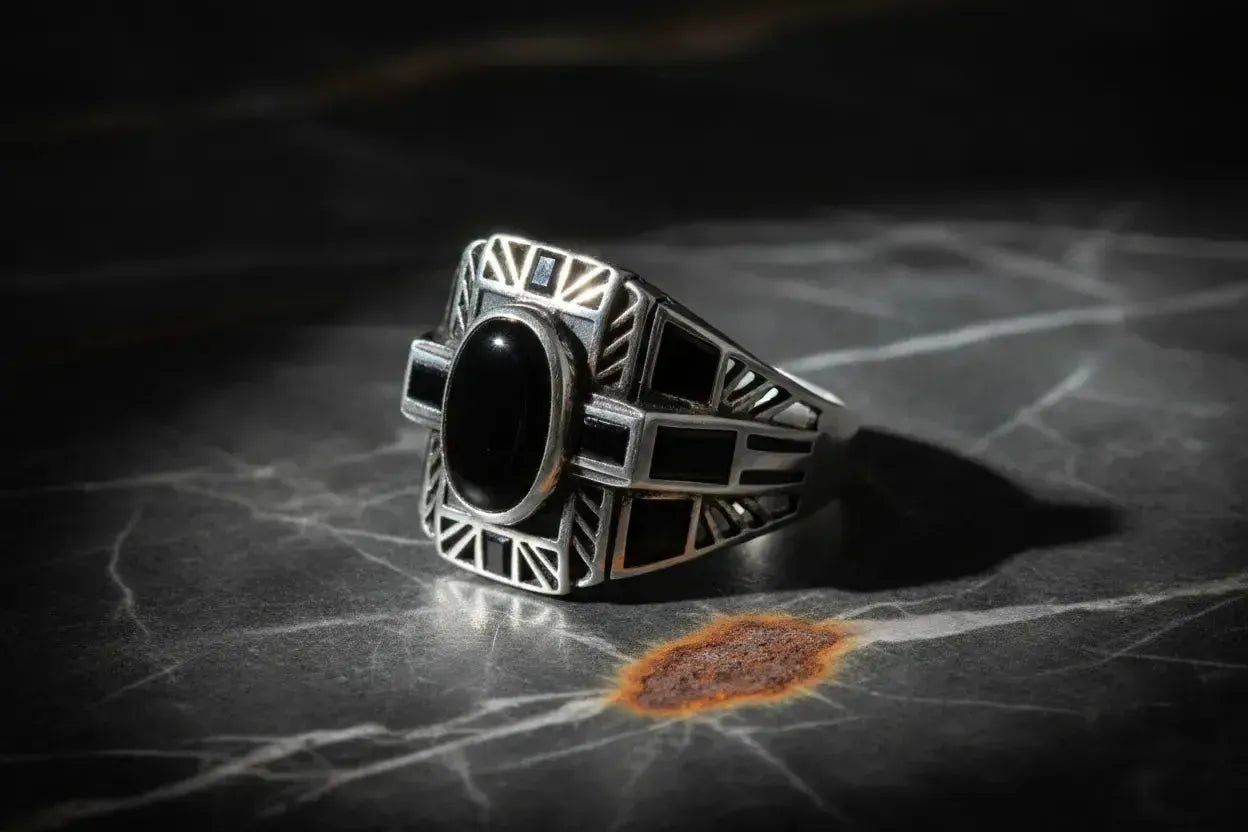
Be careful not to confuse unwanted tarnishing with intentional oxidized silver. Some of our Vindicta pieces are deliberately treated with a black patina to enhance reliefs and patterns — this is an artisanal process that gives character and depth to the jewelry. In this case, the tarnishing is part of the piece's aesthetic.
How to clean a tarnished silver ring?
Several simple methods can restore the shine of your 925 silver ring:
Method 1: the microfiber cloth
For light tarnishing, a simple microfiber cloth is sufficient. Rub gently in circular motions. This is the gentlest and safest method for rings with natural stones.
Method 2: lukewarm water and mild soap
For moderate tarnishing, dilute a few drops of Marseille soap in lukewarm water. Soak your ring for 2 to 3 minutes, gently scrub with a soft-bristled toothbrush, rinse with clear water, and dry immediately with a soft cloth. Caution: this method is not recommended for rings with porous stones like turquoise or carnelian.
Method 3: baking soda
For more pronounced tarnishing, make a paste with baking soda and a few drops of water. Apply to the ring with a soft cloth, rub lightly, rinse, and dry. Baking soda is slightly abrasive — use sparingly and only on silver, not on stones.
Method 4: the anti-tarnish cloth
Special silver cloths, impregnated with anti-oxidation products, are very effective in quickly restoring shine. Available at jewelers or online, they are essential in your care kit.
What to absolutely avoid
- Aluminum foil with salt — effective but too aggressive for natural stones.
- Ultrasonic cleaners — can destabilize settings and crack certain stones.
- Steel wool or abrasive sponges — irreparably scratch the silver surface.
- Bleach — a violent chemical reaction that can destroy the jewelry's surface.
How to prevent your 925 silver ring from tarnishing?
Prevention is always more effective than cleaning. Here are the habits to adopt to significantly slow down the oxidation of your ring:
- Remove your ring before sleeping, showering, swimming, and exercising.
- Store it in a closed jewelry box or a soft, anti-tarnish pouch.
- Put it on last in your routine, after perfume and creams.
- Clean it regularly with a microfiber cloth, even without visible tarnishing.
- Store it separately from other jewelry and metals.
For a complete guide on how to care for all your silver jewelry, consult our 925 silver care guide. And if you're wondering if you can clean your ring with water, also read: 925 silver and water: can you shower with your jewelry?
Is tarnishing a sign of poor quality?
Absolutely not. It's quite the opposite: only genuine solid silver tarnishes in this way. Silver-plated or stainless steel jewelry does not tarnish — but it degrades differently, losing its surface layer irreversibly. Solid 925 silver, however, can be cleaned and restored indefinitely.
To understand all the differences between the metals used in jewelry, read our guide: 925 silver, gold plated, steel: what are the differences?
Conclusion
The tarnishing of your 925 silver ring is a natural, inevitable, and entirely reversible phenomenon. It testifies to the authenticity of your jewelry and its genuine solid silver composition. With the right care and a few simple habits, your ring will maintain its shine for years — even decades.
At Vindicta, every piece we select is certified solid 925 silver, designed to last and driven by a clear vision: to offer you jewelry with character, without compromising on quality or identity. By choosing Vindicta, you wear a legacy — not an accessory.
Discover our collections: Women's 925 silver rings — Men's 925 silver rings — Natural stone jewelry — Our commitment to quality and authenticity.
✦ Vindicta — Solid 925 silver
The piece that makes the difference
Certified 925 silver · Free shipping from €69 · 10 years of excellence
Natural Stone Jewellery →



Leave a comment
This site is protected by hCaptcha and the hCaptcha Privacy Policy and Terms of Service apply.