Sterling Silver, Gold Plated, or Stainless Steel: Which to Choose?
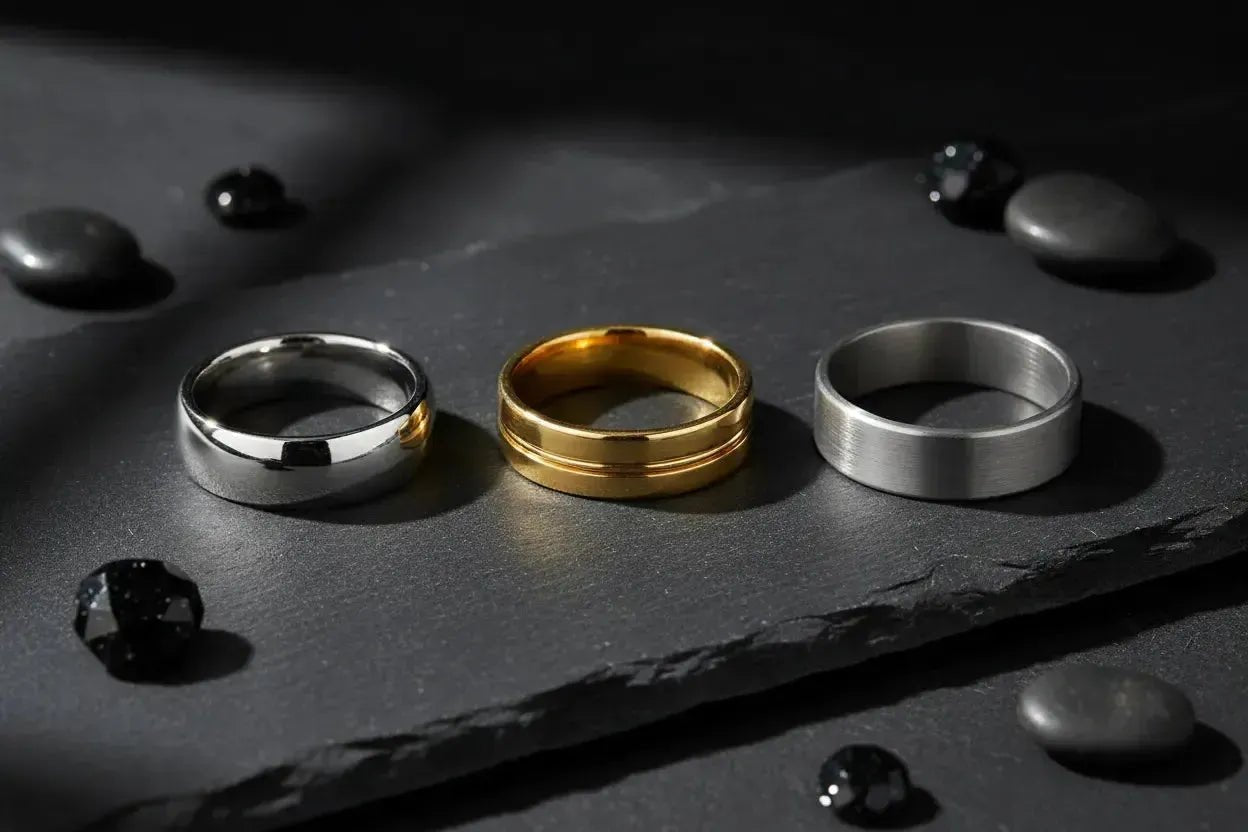
Solid 925 silver, gold-plated, stainless steel: three ubiquitous options in jewelry, three radically different realities. Here's a complete comparison to help you make the right choice.
To understand why 925 silver is the standard, read our article Why Choose 925 Silver Jewelry?
Quick Comparison Chart
| Criterion | 925 Silver | Gold Plated | Stainless Steel |
|---|---|---|---|
| Precious metal | ✅ Yes | ⚠️ Partially | ❌ No |
| Durability | ✅ Lifetime | ❌ 1-3 years | ✅ Very long |
| Hypoallergenic | ✅ Generally | ⚠️ Variable | ✅ Yes |
| Maintenance | ⚠️ Needs care | ❌ Delicate | ✅ Minimal |
| Intrinsic value | ✅ Real | ⚠️ Low | ❌ None |
| Restorable | ✅ Yes | ❌ No | ✅ Yes |
| Price | Medium-high | Low-medium | Low |
Solid 925 Silver
What it is
925 silver (or sterling silver) contains 92.5% pure silver and 7.5% other metals (copper, zinc). The "925" hallmark is engraved on each piece and guarantees this composition. It is a certified precious metal, not a coating.
Advantages
- Real value: Precious metal with intrinsic value
- Durability: A well-maintained 925 silver piece of jewelry lasts for generations
- Restorable: Tarnish can be treated, luster can be restored
- Workable: Allows for fine details, settings, engravings
- Authenticity: Verifiable, certifiable hallmark
Disadvantages
- Tarnishes over time (natural and reversible phenomenon)
- Requires regular maintenance — see our 925 silver care guide
- Higher price than steel or plated jewelry
Gold Plated (and Silver Plated)
What it is
Gold plating is jewelry made of a base metal (brass, copper, steel) covered with a thin layer of gold by electrolysis. The thickness of this layer is measured in microns (typically 0.5 to 3 microns). There is no precious metal underneath.
Advantages
- Affordable price
- Luxurious appearance in the short term
- Wide choice of colors (yellow gold, rose gold, white gold)
Disadvantages
- Ephemeral coating: Wears off in 6 months to 3 years depending on thickness and use
- Not restorable: Once the coating wears off, the base metal appears
- Possible allergies: The base metal (brass, nickel) can cause reactions
- No value: No intrinsic value
- Ultra-delicate maintenance: Any rubbing accelerates wear
Stainless Steel
What it is
Stainless steel (316L in jewelry) is an alloy of iron, chromium, and nickel. It is not a precious metal, but a very resistant industrial metal.
Advantages
- Very resistant: Does not tarnish, resistant to water and perspiration
- Minimal maintenance: Almost no care needed
- Low price: Accessible for all budgets
- Hypoallergenic (316L steel): Suitable for sensitive skin
Disadvantages
- No precious value: Industrial metal, no hallmark
- Cold appearance: Uniform metallic gray, less character
- Limited workability: Less suitable for fine details and settings
- Not certifiable: Impossible to verify composition without analysis
Why Choose 925 Silver?
925 silver is the only one of the three to simultaneously offer:
- Real value (certified precious metal)
- Generational durability (infinitely restorable)
- Jewelry craftsmanship (settings, engravings, fine details)
- Verifiable authenticity (925 hallmark)
Each Vindicta jewel is certified solid 925 silver, verifiable on our authenticity page.
Our 925 Silver Collections
- Marcasite and 925 Silver Jewelry
- Black Onyx 925 Silver Jewelry
- Men's 925 Silver Rings
- Tiger's Eye 925 Silver Jewelry
Additional Guides
- Why Choose 925 Silver Jewelry?
- 925 Silver Care Guide
- 925 Silver and Water — Can You Shower with Your Jewelry?
- Timeless 925 Silver Jewelry
- Colloidal Silver vs 925 Silver Jewelry
Discover our complete collection of certified 925 silver jewelry.
✦ Vindicta — Argent 925 Massif
La pièce qui fait la différence
Certifié argent 925 · Livraison offerte dès 69€ · 10 ans d'excellence
Bijoux Pierres Naturelles →



Leave a comment
This site is protected by hCaptcha and the hCaptcha Privacy Policy and Terms of Service apply.