
Amber: Origins, Virtues and Properties
Focus on Amber
Summary
- Introduction
- Characteristics of Amber
- History and Symbolism
- Varieties of Amber
- Meaning and Virtues
- Deposits Around the World
- Amber Jewelry at Vindicta
- The Vindicta Perspective
- Care and Advice
- Stones to Discover
- Frequently Asked Questions
- Conclusion
Introduction
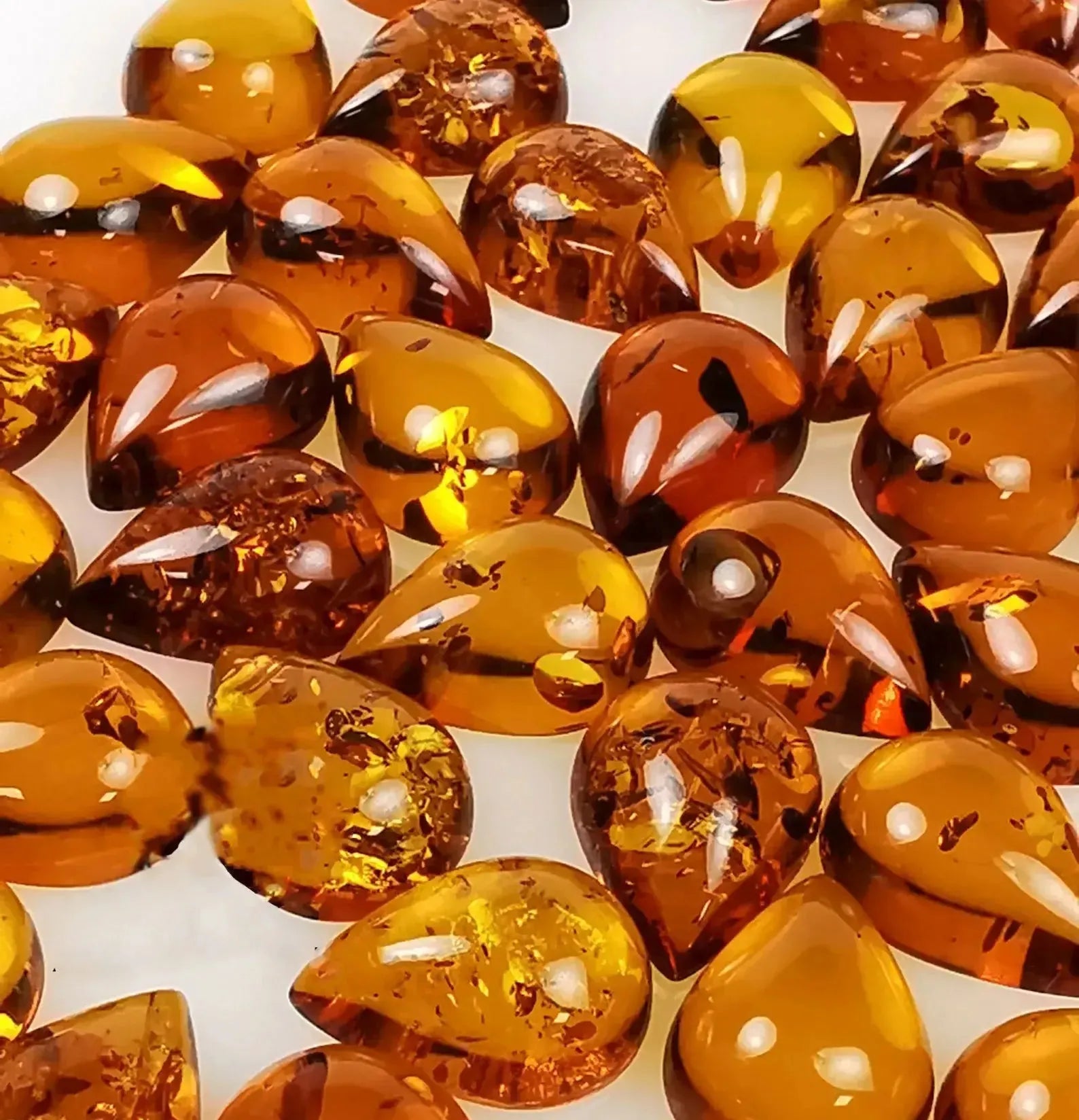
Amber is one of the oldest and most fascinating materials used by humanity in jewelry. It's not a stone — it's fossilized resin, from coniferous trees that disappeared millions of years ago. Its warm, translucent golden-yellow color, sometimes with inclusions of prehistoric insects or plants trapped in the resin, makes it a material of absolutely unique beauty and temporal dimension.
Amber is literally solidified time — a window into ecosystems that disappeared 40 to 300 million years ago. When you wear amber jewelry, you are wearing something that existed before the dinosaurs for the oldest specimens. This unique temporal dimension gives it a depth that few other materials can match. Combined with solid 925 silver, it creates jewelry of unparalleled warmth and historical depth.
Characteristics of Amber
Composition and Structure
- Type: Fossilized resin (not a mineral) — mainly hydrocarbons (C₁₀H₁₆O)
- Color: Pale yellow to deep orange-brown, sometimes red, green, blue or black depending on origin
- Appearance: Translucent to opaque, warm resinous luster
- Structure: Amorphous (no crystalline structure)
- Age: 40 to 300 million years old depending on deposits
Hardness and Resistance
- 2 to 2.5 on the Mohs scale — very soft material, to be handled with care
- Sensitive to solvents (alcohol, acetone, perfumes)
- Sensitive to acids and chemicals
- Can crack under intense heat or UV exposure
Physical Properties
- Density: 1.05 to 1.10 (very light — floats in salt water)
- Transparency: Translucent to opaque
- Static electricity: Rubbed amber attracts small light objects — this is where the word "electricity" comes from (from Greek _elektron_, amber)
History and Symbolism of Amber
Amber is one of the first materials used by humanity in jewelry. Amber beads have been found in archaeological sites dating back to 13,000 BC — among the oldest jewelry ever discovered. Amber was already an object of trade and prestige in the Stone Age.
In ancient Greece, amber was called _elektron_ — hence the word "electricity". The Greeks had observed that rubbed amber attracts small light objects — the first observation of static electricity in history. They believed that amber was the tears of Phaeton's sisters, transformed into poplars after their brother's death. This legend gave amber a unique poetic and tragic dimension.
In ancient Rome, amber was more precious than gold for certain uses. Emperor Nero was famous for his passion for amber — he sent special expeditions to the Baltic coasts to bring it back. Gladiators wore amber amulets to protect themselves in combat.
The "Amber Road" was one of the great trade routes of antiquity — connecting the coasts of the Baltic Sea (main deposit) to the Mediterranean over thousands of kilometers. Amber was exchanged for gold, silver, and spices — a trade that helped structure prehistoric and ancient Europe.
In Islamic and Ottoman tradition, amber (كهرمان, kahraman) was highly prized. Ottoman rosaries (subha) were often made of Baltic amber — its warmth to the touch, its slightly resinous scent, and its lightness made it the ideal material for devotional objects. Ottoman sultans owned valuable amber collections.
The famous "Amber Room" of the Tsarskoye Selo Palace (Russia), built in the 18th century, was entirely covered with panels of Baltic amber — considered the "8th wonder of the world" before its disappearance during World War II.
Varieties of Amber
- Baltic Amber (succinite): The most famous and abundant, golden-yellow to orange-brown, 40-50 million years old
- Dominican Amber (ambrite): Very clear and translucent, often with exceptionally well-preserved insect inclusions, 15-40 million years old
- Myanmar Amber (burmite): The oldest (90-100 million years old), deep reddish-brown, inclusions of dinosaurs and prehistoric birds
- Blue Dominican Amber: Rare and spectacular, blue fluorescence under UV light, one of the most sought-after varieties
- Green Amber: Rare, natural green color due to plant inclusions
- Red Amber (cherry): Deep red, highly prized in oriental jewelry
- White Amber (bone): Opaque and white, bone-like appearance, used in traditional Baltic jewelry
Meaning and Virtues of Amber
Emotional & Spiritual Level
- Warmth & protection 🟠: Material of the sun and warmth, universal protective talisman for millennia
- Temporal anchoring: Connection with deep past, ancestral memory, and the wisdom of ages
- Purification: Considered a purifying material in many traditions — when burned, it produces an aromatic smoke used in rituals
- Optimism: Its golden-yellow color is associated with the sun, joy, and positive energy
- Ancestral wisdom: Material of accumulated memory and wisdom, associated with the knowledge of the ancients
Physical Level (beliefs in lithotherapy)
- Associated with relief from joint and rheumatic pains in popular tradition
- Used to strengthen the immune system and general vitality
- Amber necklaces for babies are a popular tradition to relieve teething pain — caution: this practice is not recommended by pediatricians for safety reasons
Note: The virtues of lithotherapy are not scientifically proven and do not replace medical advice.
Amber Deposits Around the World
- Baltic Sea (Poland, Russia, Lithuania, Latvia): Main global deposit, Baltic amber (succinite), 40-50 million years old, exceptional jewelry quality
- Dominican Republic: Very clear amber with exceptional inclusions, unique fluorescent blue amber in the world
- Myanmar (Burma): Oldest amber (90-100 million years old), inclusions of dinosaurs and prehistoric birds, exceptional scientific and collection value
- Mexico (Chiapas): Gem-quality amber, often with insect inclusions
- Romania, Ukraine: Amber of varying quality, secondary production
Amber Jewelry at Vindicta
Amber, with its warm, translucent golden-yellow color, naturally pairs with solid 925 silver to create jewelry of unparalleled warmth and historical depth. The contrast between the organic warmth of amber and the cool luster of silver is immediately elegant — two noble materials that complement each other perfectly.
At Vindicta, we work exclusively with natural Baltic amber — unpressed, unreconstituted, undyed. Transparency about the nature of amber is essential in a market where imitations (plastic, copal, pressed amber) are very common.
Our amber creations:
- Men's 925 Silver Ring – Oval Yellow Amber Cabochon — Warmth and character, daily wear
- Men's 925 Silver Ring with Yellow Amber — Sober and timeless elegance
- Men's 925 Silver Ring Yellow Amber – Authentic Elegance — Prestige and authenticity
- Amber 925 Silver Necklace – Golden Honey Natural Stone Pendant — Softness and light for everyday
Also discover our 925 silver natural stone jewelry collection.
The Vindicta Perspective
Amber is the material that presents us with the most authenticity challenges. The amber market is one of the most falsified in jewelry — plastic, copal (young unfossilized resin), and pressed amber (heated and compressed amber fragments) are sold as natural amber at an alarming rate. Distinguishing real amber from an imitation requires specific tests that we systematically perform.
What deeply attracts us to amber is its unique temporal dimension. When we work with a piece of Baltic amber, we hold in our hands something that existed 40 million years before the appearance of man. Inclusions — insects, plants, air bubbles — are direct witnesses of disappeared ecosystems. It is the only jewelry material that literally contains time.
Amber is also the material that brings us closest to Vindicta's Ottoman heritage. Ottoman rosaries made of Baltic amber were objects of prestige and devotion — the warmth of amber to the touch, its slightly resinous scent, its exceptional lightness made it the ideal material for permanently worn objects. This tradition of Ottoman amber is directly rooted in Vindicta's identity.
Finally, amber is the only material in our selection that floats in salt water — its density of 1.05-1.10 is lower than that of seawater. This is one of the simplest authenticity tests, and one of the most astonishing properties of a jewelry material.
Care and Advice for your Amber Jewelry
- Solvents: absolutely avoid alcohol, acetone, and perfumes — they dissolve amber and can irreparably destroy it
- Heat: avoid intense heat sources and prolonged exposure to the sun — amber can crack or tarnish
- UV: avoid prolonged UV exposure — the color can alter over time
- Cleaning: soft, slightly damp cloth only. Dry immediately. Never immerse
- Chemicals: avoid perfumes, creams, detergents, and hairspray
- Storage: soft fabric pouch, away from light and heat, separate from other jewelry
- Scratches: amber is very soft (2-2.5/10) — avoid any contact with hard surfaces or harder stones
To go further: Complete care guide for your 925 silver jewelry.
Stones to Discover
- 🟡 Citrine — crystalline golden-yellow, same warm and luminous palette
- 🔴 Carnelian — fiery orange-red, same warmth and historical antiquity
- 🟠 Tiger's Eye — shimmering golden, same earthy and protective energy
- 🖤 Onyx — deep black, striking contrast with the golden-yellow of amber
- 📖 Complete Guide to Natural Stones 2026 — everything you need to know about stones in jewelry
Frequently Asked Questions about Amber
How to distinguish real amber from an imitation?
Saltwater test: Natural amber floats in a concentrated saltwater solution (4 tablespoons of salt in a glass of water) — plastic sinks. Heat test: Heated amber gives off a pleasant resinous smell — plastic gives off a chemical smell. UV test: Natural amber fluoresces blue-green under UV light — plastic does not fluoresce or fluoresces differently.
What is copal and why is it often sold as amber?
Copal is young fossilized resin — a few hundred to a few thousand years old, compared to 40-300 million for genuine amber. It resembles amber but is much less stable — it cracks and degrades faster. Copal is often sold as "amber" at lower prices, which constitutes fraud.
Is amber with inclusions more precious?
Yes — inclusions (insects, plants, air bubbles) significantly increase the value of amber, especially if they are well-preserved and identifiable. A complete insect in Baltic amber can be worth hundreds to thousands of euros depending on the species and state of preservation.
Is amber suitable for daily wear?
With caution. Its softness (2-2.5/10) makes it vulnerable to scratches and impacts. For daily wear, prefer a pendant or earrings. If you choose a ring, avoid physical activities and contact with hard surfaces. Amber develops a patina over time — a natural patina that bears witness to its history and wear.
Why does the word "electricity" come from amber?
The word "electricity" comes from the Greek _elektron_, which meant "amber". The ancient Greeks had observed that amber rubbed with a cloth attracts small light objects — the first observation of static electricity in history.
Conclusion
Amber is an exceptional material — the only one in our selection that is literally solidified time. From the prehistoric Amber Road to the Ottoman rosaries of the sultans, through the Amber Room of the tsars and contemporary paleontology laboratories, amber has always been associated with warmth, protection, and the memory of ages.
Combined with solid 925 silver in the tradition of Ottoman silversmithing, amber creates jewelry of unparalleled warmth and historical depth — pieces that carry 40 million years of Earth's history and millennia of human history.
✦ Vindicta — Solid 925 silver
The piece that makes the difference
Certified 925 silver · Free shipping from €69 · 10 years of excellence
Natural Stone Jewellery →



Leave a comment
This site is protected by hCaptcha and the hCaptcha Privacy Policy and Terms of Service apply.