How is a 925 Sterling Silver Jewel Made? Behind the Scenes in the Workshop
From metal casting to stone setting, the creation of a 925 sterling silver piece of jewelry is a complex artisanal process that blends age-old tradition with contemporary techniques. Here's a behind-the-scenes look at the workshop.
Step 1: Conception and Design
It all begins with a drawing. The designer creates sketches by hand or on a computer (CAD — Computer-Aided Design). Proportions, volumes, and stone placements are precisely defined before any metal manipulation.
For complex jewelry, a wax or resin prototype is made to validate the 3D shapes. This step can take several weeks for a unique piece.
Step 2: Casting and Shaping
Casting
925 sterling silver is melted at 961°C (the melting point of pure silver). The alloy — 92.5% silver + 7.5% copper — is precisely prepared. The molten metal is poured into molds or rolled into sheets, wires, or tubes depending on the piece to be made.
Rolling
Silver sheets are passed through a rolling mill to achieve the desired thickness. This operation can be repeated several times, with intermediate annealing to prevent the metal from becoming brittle.
Wire Drawing
For chains and filigree, silver is drawn into wires of various diameters through dies. Filigree — an ancient technique inherited from antiquity — uses silver wires braided into delicate patterns.
Step 3: Handcrafting
Repoussé
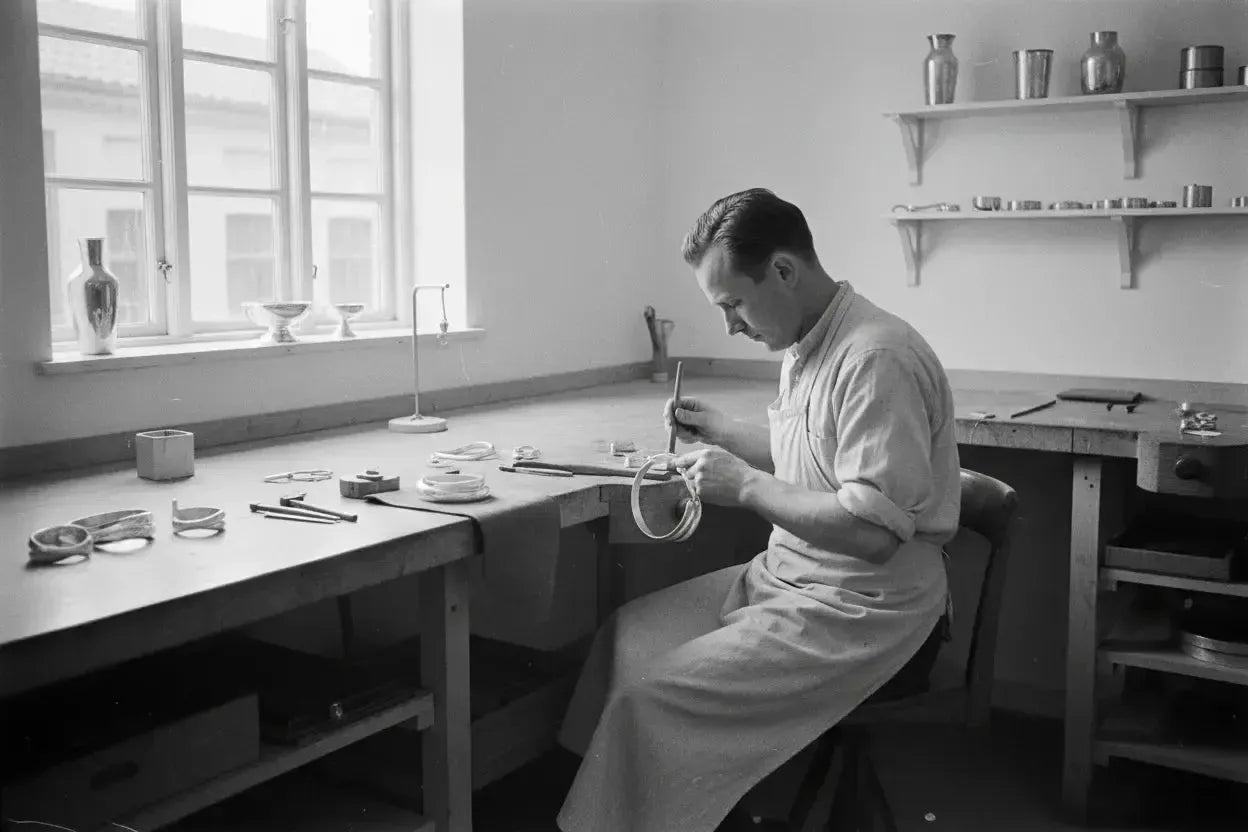
A technique inherited from the Renaissance, repoussé involves hammering silver from the inside to create reliefs. The silversmith uses punches of various shapes and a special anvil. It's a slow, precise, and irreplaceable process.
Chasing
After repoussé, chasing refines the details from the outside. The silversmith uses precision chisels to create textures, patterns, and finishes. This is the longest and most skilled step.
Soldering
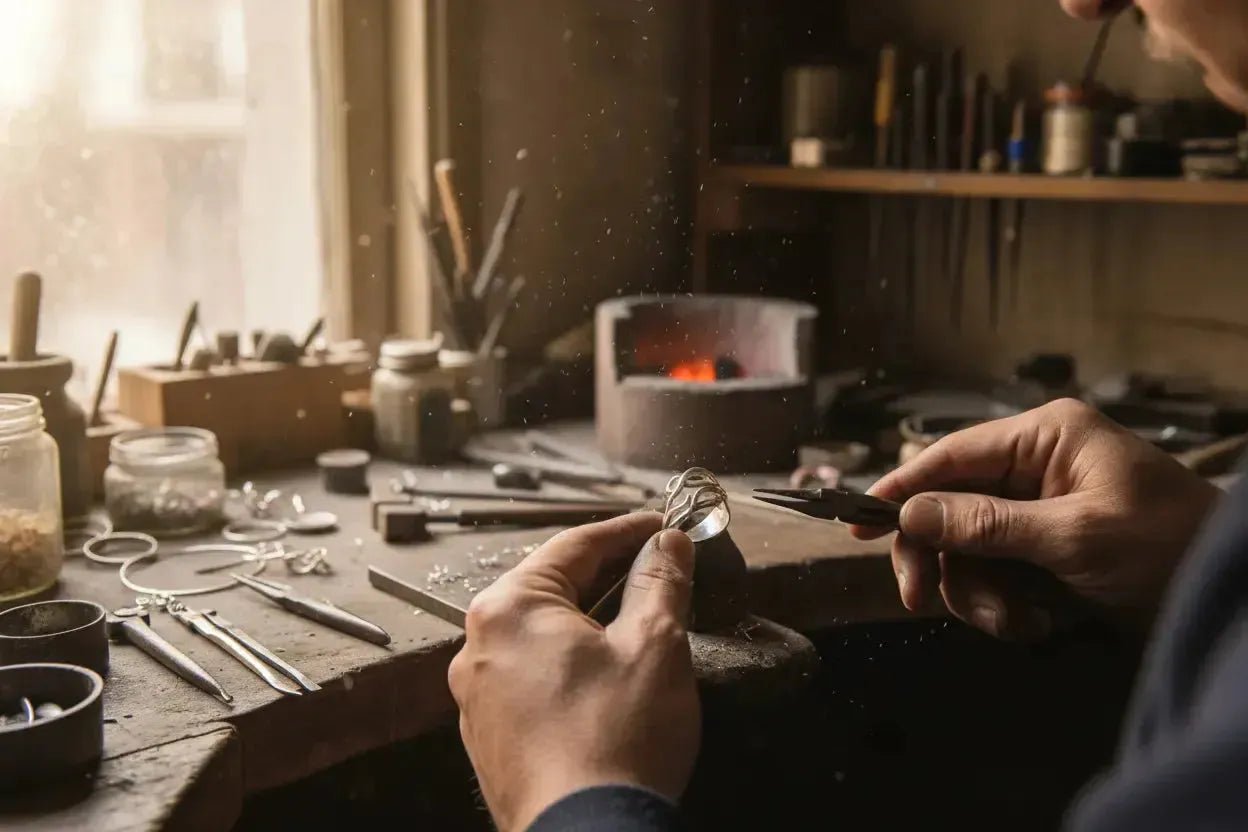
The different parts of the jewelry are assembled by silver soldering. The solder must be invisible and perfectly strong. A well-soldered piece of jewelry lasts for generations.
Step 4: Stone Setting
Setting
Setting natural stones is a critical step. The stone setter creates a precise housing for each stone, then folds the silver around it to hold it in place. Techniques vary:
- Prong setting: Silver prongs hold the stone — allows light to pass through
- Bezel setting: The silver completely surrounds the stone — maximum protection
- Pave setting: Multiple small stones set side by side
- Bezel setting: Silver ring surrounding the stone — vintage style
Step 5: Finishing
Polishing
The jewelry is machine-polished and then hand-polished to achieve the characteristic shine of 925 sterling silver. Several successive steps — roughing, polishing, buffing — give the final finish.
Rhodium Plating (optional)
Some jewelry pieces receive a rhodium bath — a platinum group metal — to delay tarnishing. At Vindicta, we prefer solid 925 sterling silver without rhodium plating — more authentic, easier to restore.
Hallmarking
Final step: the application of the 925 hallmark which certifies the metal's composition. In France, this hallmark is controlled by guarantee offices.
How Long Does It Take to Make a Piece of Jewelry?
Manufacturing time varies enormously depending on the complexity of the piece. A simple ring, cast and then polished, can be completed in one day's work. A piece crafted with repoussé-chasing and complex setting of several stones often requires one to two weeks of actual work, distributed among the various specialized artisans — founder, chaser, setter, polisher — who each intervene at their stage. It is this succession of expert hands, each mastering a single gesture to perfection, that distinguishes a traditional workshop from an automated production line.
Workshop Tools: Simplicity and Precision
Contrary to the clichéd image of a workshop overloaded with complex machines, silversmithing still largely relies on a limited number of perfectly mastered hand tools: the blowtorch for soldering and localized casting, the workbench with various shaped stakes for hammering, precision files for final adjustment, and a collection of chisels, each corresponding to a very specific type of line. An experienced silversmith intimately knows each of his tools, often shaped or adapted by himself over the years to meet very specific needs — an almost intimate relationship between the artisan and his material that explains why training a good silversmith takes years, far beyond the simple theoretical mastery of techniques.
Artisan vs. Industrial Production
An artisanal 925 sterling silver piece of jewelry differs from an industrial piece by:
- Slight surface irregularities — a sign of handcraftsmanship
- The quality of the setting — each stone is set individually
- The thickness of the metal — a solid piece of jewelry weighs more than a hollow one
- Durability — a well-made piece of jewelry lasts for generations
For the care of your jewelry: 925 Sterling Silver Care Guide.
Each Vindicta piece of jewelry is certified solid 925 sterling silver, verifiable on our authenticity page.
Discover our complete collection of handcrafted 925 sterling silver jewelry.
✦ Vindicta — Solid 925 silver
The piece that makes the difference
Certified 925 silver · Free shipping from €69 · 10 years of excellence
Men's 925 Silver Signet Rings →