Scandinavian Minimalism: Georg Jensen and the Modern Design Revolution
In 1904, a Danish silversmith opened a small shop in Copenhagen and revolutionized silver design forever. Georg Jensen invented Scandinavian minimalism — clean lines, simplified organic forms, a rejection of excessive ornamentation. A legacy that still shapes contemporary design.
Georg Jensen — The Man
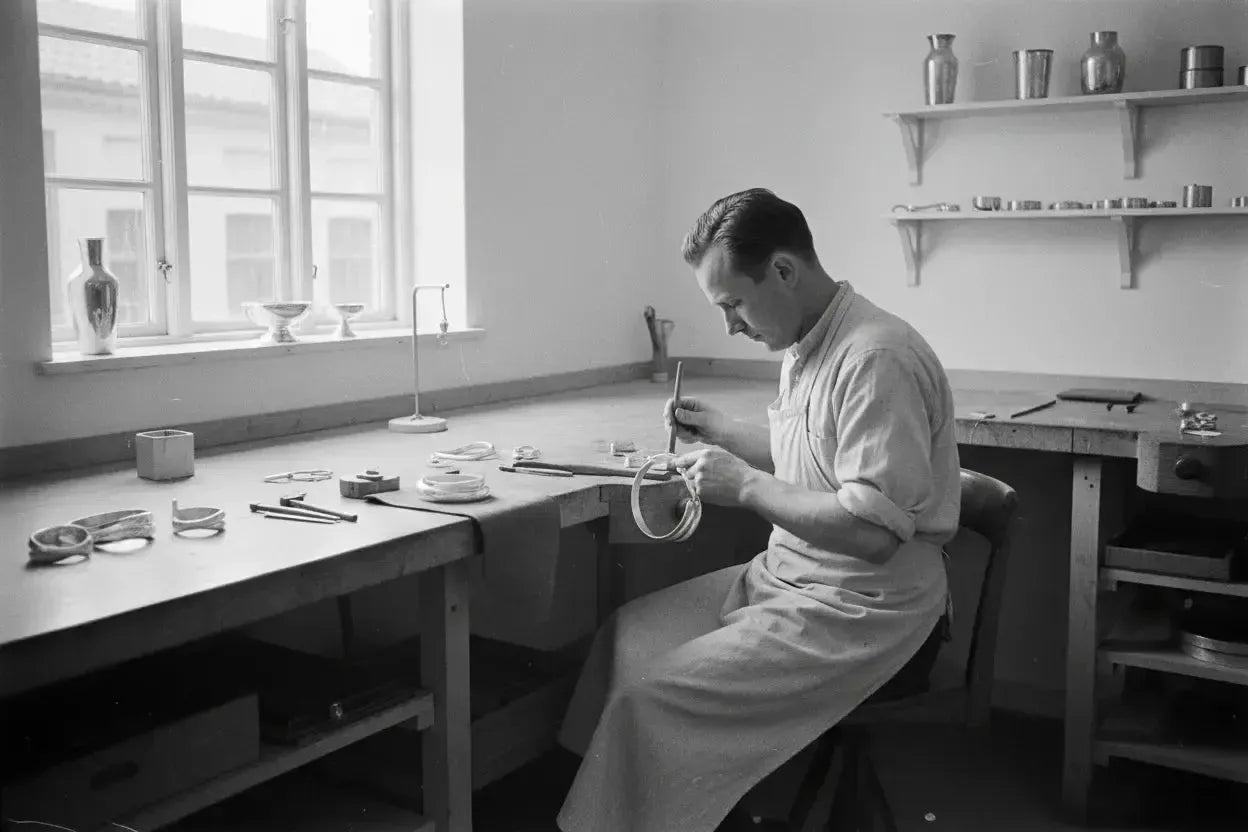
Georg Jensen (1866-1935) was born into a humble family near Copenhagen. Apprenticed as a silversmith at 14, he later studied sculpture at the Royal Danish Academy of Fine Arts. This dual training — craftsmanship and fine arts — was the key to his genius.
In 1904, at 38, he opened his first shop in Copenhagen with minimal capital. Within a few years, his reputation extended beyond Danish borders. By 1935, at his death, he was recognized by his peers as the greatest living silversmith.
Difficult Beginnings
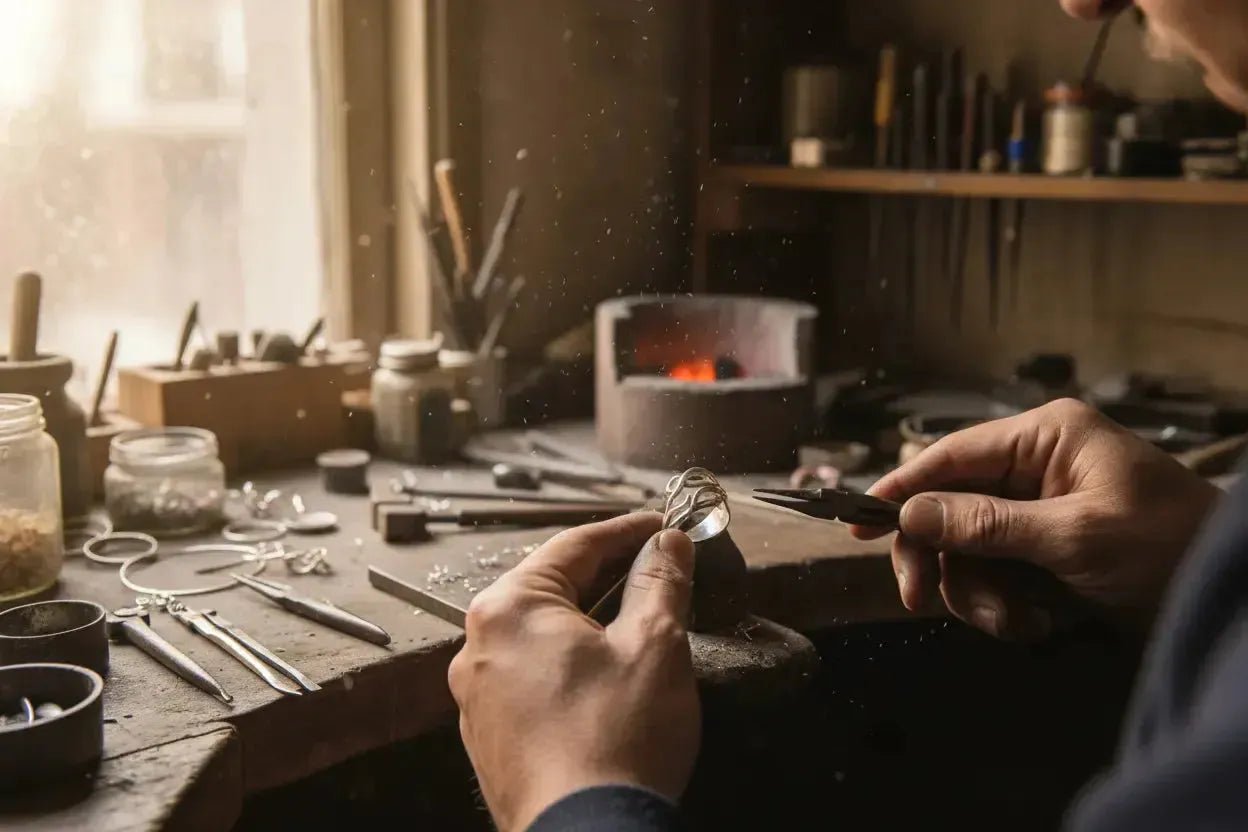
Jensen's success was not obvious from the start. Before opening his own shop, he first tried a career as a sculptor — without commercial success. He then worked as an employee for several Copenhagen silversmiths, accumulating technique and frustration with the decorative overload of the then-dominant Victorian era. It was only after briefly partnering with ceramicist Christian Joachim Petersen, and then finding his own workshop, that he could finally apply his vision: to strip jewelry of all superfluous elements to retain only the essential.
The Aesthetic Revolution
Jensen operated at the crossroads of Art Nouveau and Art Deco. He borrowed from both — the organic forms of the former, the simplification of the latter — to create something unique: Scandinavian minimalism.
Jensen's Principles
- Form follows function: Every decorative element must have a reason for being
- Simplicity is sophistication: Remove the unnecessary to reveal the essential
- Silver as a living material: The surface of hammered silver catches light differently depending on the angle
- Craftsmanship against mass production: Each piece is handcrafted, even in production
Iconic Pieces
The Blossom Bracelet (1904)
Jensen's first iconic piece. Simplified floral motifs, hammered silver, semi-precious stones. Still produced today, it is one of the best-selling pieces of jewelry in the world.
The Blossom Bowl (1919)
A masterpiece of Scandinavian silversmithing. Organic forms, hammered surface, perfect balance between decoration and sobriety.
The Acorn Cutlery (1915)
Designed by Johan Rohde, Jensen's collaborator. Still produced today, they are a symbol of timeless Scandinavian design.
Jensen's Heirs: Henning Koppel and the Second Generation
After Jensen's death in 1935, the house bearing his name continued to attract the greatest Scandinavian designers. Henning Koppel, who arrived in 1945, pushed minimalism even further with fluid, almost liquid forms, inspired by natural curves rather than Jensen's literal floral motifs. His famous "fish" pitcher (1952) is now exhibited in the world's leading design museums, including MoMA in New York. This continuity — different designers, the same demand for formal purity — is precisely what made Scandinavian minimalism an enduring language rather than a passing trend.
A Philosophy Born of Climate and Territory
Scandinavian minimalism is not just due to individual aesthetic choices: it also draws from a particular relationship of the Nordic countries to light and material. In regions where natural light is scarce for much of the year, every polished or hammered surface becomes precious for what it reflects and amplifies. This sensitivity to rare light partly explains why Scandinavian designers have always favored forms that capture and reflect, rather than cluttered surfaces that absorb it. Jensen's stripped-down style is therefore not just a reaction to Victorian style: it is also a profound response to a demanding natural environment, where every unnecessary gesture is a luxury that cannot always be afforded.
Jensen in the Museum: Rare Institutional Recognition
Few silversmiths have seen their work enter the permanent collections of major museums as quickly as Georg Jensen. As early as the 1920s, his pieces were acquired by the Metropolitan Museum in New York and the Victoria and Albert Museum in London — unusual recognition for a silversmith still active. This early legitimization by cultural institutions played a decisive role in the international dissemination of the Scandinavian style, transforming what could have remained a Danish specificity into a truly global design language, still studied today in art and design schools around the world.
The Scandinavian Heritage in Contemporary Design
Jensen's Scandinavian minimalism directly influenced the clean and functional Bauhaus movement (1919-1933); contemporary Scandinavian design (IKEA, Muuto, HAY); current minimalist jewelry, made of fine jewelry without excessive ornamentation; and the "slow jewelry" movement, which favors timeless pieces over fast fashion.
Jensen and Vindicta — Two Complementary Visions
Vindicta is rooted in a different tradition than Jensen — Ottoman, Andalusian, Art Deco heritage — but shares his fundamental values: certified solid 925 silver, quality craftsmanship, pieces designed to last. Two visions of elegance, the same demand for quality. Discover our minimalist 925 silver jewelry, in a spirit close to this Scandinavian purity.
To discover our 925 silver jewelry with natural stones: Complete Guide to Natural Stones 2026. And to understand why solid 925 silver is a choice of lasting elegance: Why Choose 925 Silver Jewelry?
Every Vindicta jewel is certified solid 925 silver, verifiable on our authenticity page.
✦ Vindicta — Solid 925 silver
The piece that makes the difference
Certified 925 silver · Free shipping from €69 · 10 years of excellence
Men's 925 Silver Signet Rings →