Multicolored Gemstones: Oriental Palette and Colorful Opulence
In 1633, a European ambassador received at the court of the Grand Mogul in Agra described in his notebooks a spectacle beyond his understanding: entire carpets embroidered with rubies, emeralds, and pearls, a throne — the famous Peacock Throne — encrusted with more precious stones than all the courts of Europe combined. This display was not a mere aesthetic whim: each colored stone recounted a conquest, an alliance, a secured trade route.
The stone as a map of power
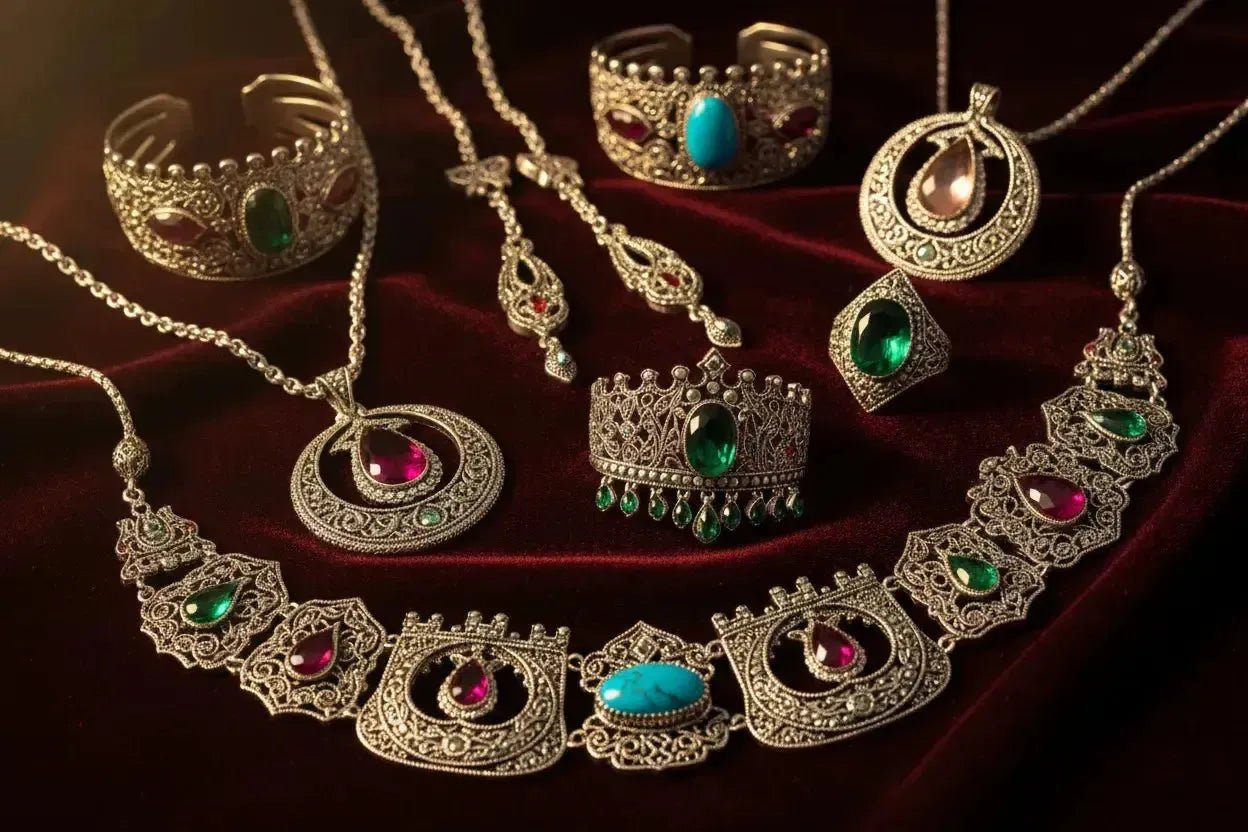
In the Eastern imagination — Ottoman, Persian, or Mogul — the richness of a jewel was not measured by the size of a single stone, but by the diversity of colors assembled on a single piece. The ruby came from Burma, the emerald from Colombia via complex trade routes, lapis lazuli from the only mines in Afghanistan, and turquoise from Persia. To wear five colors at once was, therefore, to display, without a word, the extent of one's commercial network — a geopolitical map worn on oneself.
Persian gardens, the model for all color compositions
The aesthetic of accumulation finds its source in a precise cultural reference: the Persian garden, or tchahar bagh, a landscape design born in ancient Persia and disseminated throughout the Islamic world to Mogul India. This garden, structured into four quarters around a central water feature, deliberately blends the colors of flowers, fruits, and mosaics — a controlled profusion intended to evoke the Quranic Paradise. Multicolored jewels reproduce, on the scale of a ring or a pendant, this same logic of a condensed garden.
The arabesque, invisible structure of every composition
Beneath this explosion of colors always lies a rigorous structure: the arabesque, this geometric interlace born in the 7th century from a religious prohibition against representing living beings. The curve that composes it has neither beginning nor end, symbolizing infinity and divine unity. It is this invisible architecture that prevents the colorful profusion from falling into visual chaos: each stone occupies a calculated place in a network of lines designed with a compass, never haphazardly arranged.
Garnet, the pivotal stone of every oriental palette
Among colored stones, the garnet occupies a special place. Ancient Persians believed it could illuminate the night; Ottoman sultans inlaid it in their swords as a sign of absolute power. Topkapi Palace still preserves imperial daggers set with remarkably sumptuous garnets, testaments to the centrality of this red stone in the iconography of power.
Setting multiple stones: a real technical constraint
Combining several colored stones on the same piece imposes a constraint that few customers suspect: each mineral has its own sensitivity to soldering heat and its own hardness. Goldsmiths worked in a precise order, first setting the most heat-resistant stones, protecting the most fragile ones — turquoise at the forefront — with a damp cloth while nearby elements were still being worked on. It is this invisible expertise that allows an old multicolored ring to pass through several generations without any stone becoming dislodged.
The palette of seven colors and the chakras
In certain late Eastern traditions, influenced by exchanges with India, each stone color came to be associated with an energy point in the body — the red of garnet with grounding, the blue of turquoise with communication, the violet of amethyst with spirituality. A complete multicolored ring was then perceived as a kind of miniature energy map, worn on a single finger — an interpretation that much later fueled the contemporary craze for multi-gem rings.
Nadir Shah's treasure, a direct consequence of this aesthetic
In 1739, the Persian conqueror Nadir Shah plundered Delhi and took the entire Peacock Throne to Iran, along with the Koh-i-Nûr diamond and tons of precious stones. This transfer of wealth, one of the most massive in history, suddenly redistributed a considerable portion of India's colored stones to Persia — an event that illustrates how these multicolored jewels were never mere ornamental objects but true geopolitical stakes, whose possession was disputed by war as much as by commerce.
The Mogul emerald, a special case
Mogul emperors had such a strong preference for emeralds that they had entire Quranic verses engraved directly onto the raw stone — a unique practice that transformed the gem into an object both precious and spiritual even before it was set. Several of these imposing Mogul emeralds, sometimes as large as a fist, are preserved today in private collections and museums — witnesses to a relationship with precious stones that far exceeded mere adornment.
Wearing this palette today
What distinguishes an Oriental jewel from a Western equivalent is not the quality of the metal — solid 925 silver remains the same everywhere — but this deliberate desire to make colors converse rather than hierarchize them. A natural stone piece, an association with marcasite, or a simple statement ring are enough to invoke this spirit — without the need to accumulate ten pieces for Oriental elegance to fully express itself.
Care
With multiple stones on the same piece, one adopts the precautions for the most fragile among them: a soft, dry cloth, no prolonged immersion, storage away from shocks and chemicals.
✦ Vindicta — Solid 925 silver
The piece that makes the difference
Certified 925 silver · Free shipping from €69 · 10 years of excellence
Oriental 925 Silver Jewellery →