Ottoman Jewelry: Legacy of Sultans and Imperial Splendor
In 1520, when Suleiman the Magnificent ascended to the Ottoman throne, he inherited an empire that already spanned three continents—and an imperial workshop, the Naqqashhane, capable of producing jewelry that no European court of the time could match in volume or refinement. What is striking, when studying this period, is not only the richness of the materials—it is the almost bureaucratic discipline that governed their manufacture.
The Naqqashhane, an administration of beauty
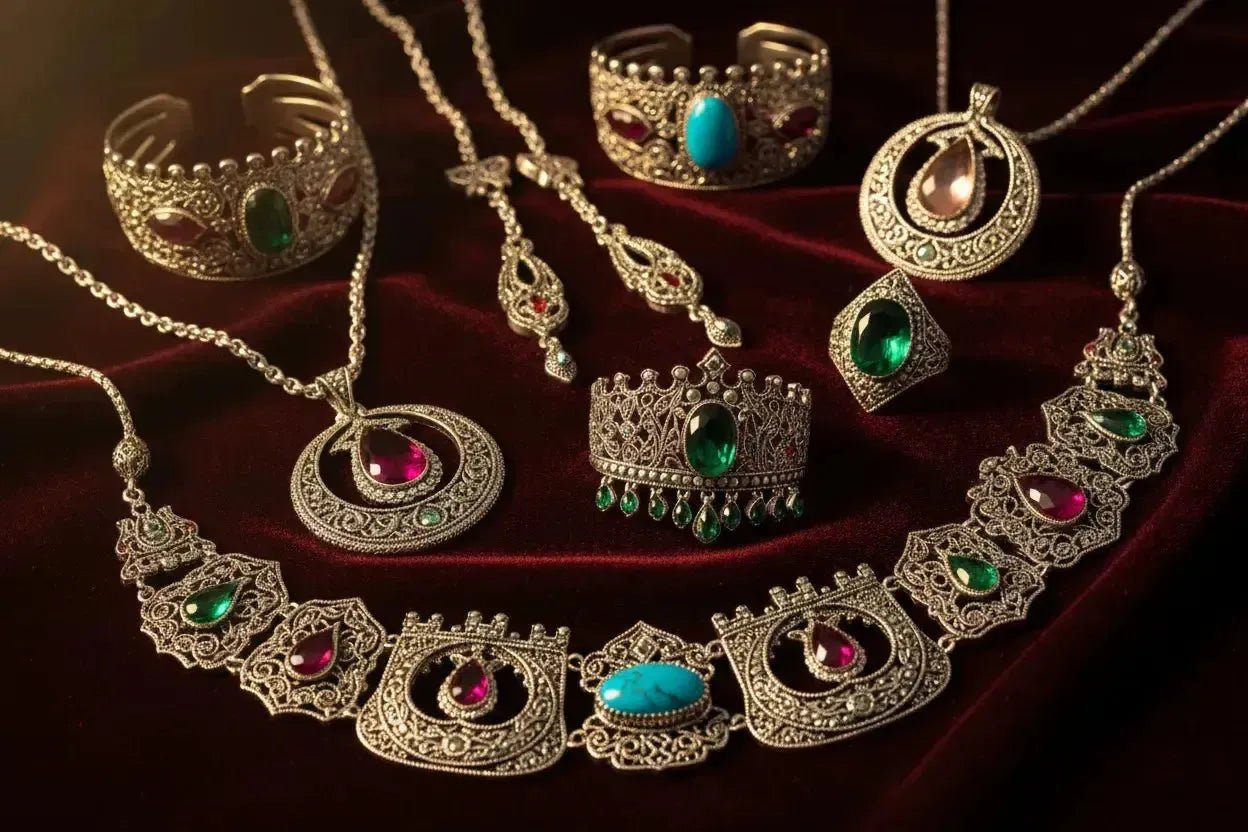
Contrary to the image of spontaneous craftsmanship, the goldsmithery of the Topkapi Palace was organized as a true state institution. Artisans—often recruited from among the best talents in conquered provinces, Armenians, Greeks, Persians—were grouped into hierarchical guilds, each specializing in a unique technique: some worked only filigree, others exclusively setting, others still engraved calligraphy. This division of labor, rare for the time, allowed for a level of finish that few contemporary European workshops could claim.
Suleiman the Magnificent and the Golden Age
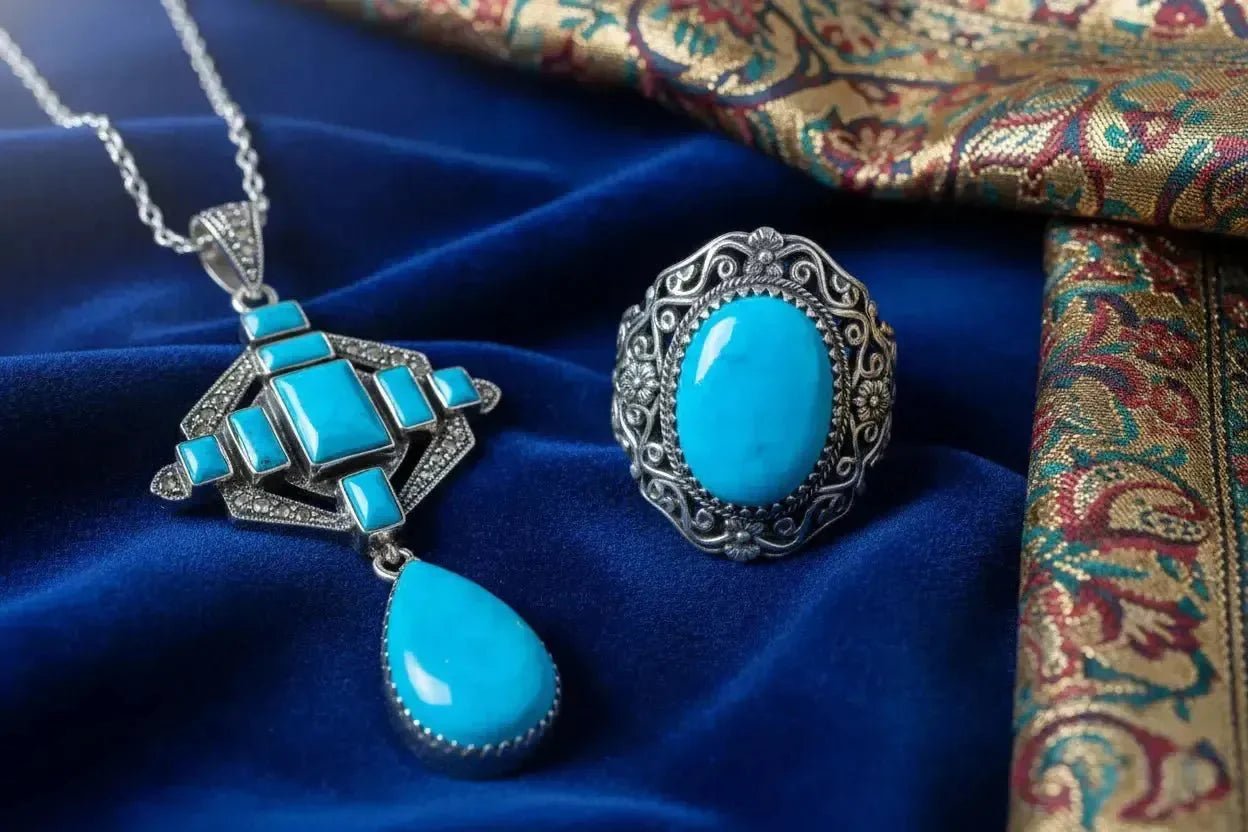
Under Suleiman's reign (1520-1566), commissions exploded: diamond-set turban aigrettes for official ceremonies, damascened daggers with emerald-covered guards, turquoise rings intended for dignitaries received at court. The Topkapi treasury still preserves pieces from this era, including the famous Topkapi Dagger, commissioned in 1747 but whose style directly perpetuates the codes established two centuries earlier under Suleiman.
Baroque and Egyptian Influence: Two Successive Waves
In the 17th and 18th centuries, the Ottoman court gradually incorporated baroque and rococo elements from Europe, without ever renouncing its own identity—an absorptive capacity that characterizes the entire artistic history of the Empire. Later, in the 19th century, a second wave of influence swept through jewelry: Egyptomania, born from archaeological excavations carried out in Egypt, then under Ottoman administration. Scarab motifs, stylized hieroglyphs, and sphinx silhouettes were then added to the already rich repertoire of imperial goldsmiths.
The Tulip, a Political as much as a Floral Emblem
No motif better embodies the Ottoman era than the tulip. It even gave its name to an entire period in the Empire's history, the "Tulip Era" (1718-1730), during which the flower became a true court obsession: entire gardens dedicated to its cultivation, nocturnal festivities organized around its blooming, motifs engraved on every precious object in the palace. For the sultans, the tulip represented divine perfection—its petals, arranged in a perfect spiral, were read as proof of the order willed by God in nature.
Seals and Signet Rings: Jewelry as an Official Document
In the Ottoman administration, the signet ring was not merely a decorative accessory—it was a legal instrument. Pressed into the wax of a document, it authenticated an order, a contract, an official correspondence. Losing one's signet ring was almost equivalent to losing one's administrative identity; some high officials had several identical copies engraved, kept in safe places, in anticipation of accidental loss.
Decline and Memory
With the fall of the Empire in 1922, the imperial workshops closed their doors and the artisans of the Naqqashhane dispersed into the major cities of the region—Istanbul, but also Cairo, Damascus, Aleppo—taking with them techniques that no imperial commissions would fuel anymore. Many of these skills survived thanks to private markets and the nascent tourism demand of the early 20th century, which explains why certain Ottoman chiseling techniques, even after the disappearance of the court that gave them birth, are still practiced today in Istanbul workshops.
The Grand Bazaar, a Showcase of this Heritage
Built from 1461 under Mehmed II, the Grand Bazaar of Istanbul remains today the largest covered market in the East, with over 4,000 shops spread across 61 streets. The goldsmiths' quarter, the Kuyumcular Çarşısı, has concentrated artisans working with silver for centuries, using techniques directly inherited from the imperial Naqqashhane—an uninterrupted transmission that makes the Grand Bazaar much more than a tourist destination: a true living conservatory of Ottoman craftsmanship.
Inventories of the Imperial Treasury
Ottoman archives preserve detailed inventories of the imperial treasury drawn up at each change of reign—administrative documents of remarkable precision, listing each piece, its weight in silver, its stones, and sometimes even the name of the artisan responsible. These registers, now kept in the Topkapi archives, constitute an unparalleled historical source for understanding the evolution of techniques and tastes over several centuries—a documentary luxury that few contemporary European courts have left behind with such rigor.
Wearing this Style Today
What makes Ottoman aesthetics so adaptable to the present is precisely this rigor: the motifs are designed to last, not to follow a seasonal trend. A 925 sterling silver signet ring engraved with a geometric pattern, a piece set with carnelian or turquoise, continues to embody this same demand for precision that characterized the Naqqashhane workshops—without ever seeking to slavishly imitate the past.
Maintenance
Highly chiseled pieces require special attention: a soft cloth for routine cleaning, a small soft brush for the recesses of the pattern, and storage away from humidity and perfumes, which accelerate the tarnishing of silver over time.
✦ Vindicta — Solid 925 silver
The piece that makes the difference
Certified 925 silver · Free shipping from €69 · 10 years of excellence
Oriental 925 Silver Jewellery →