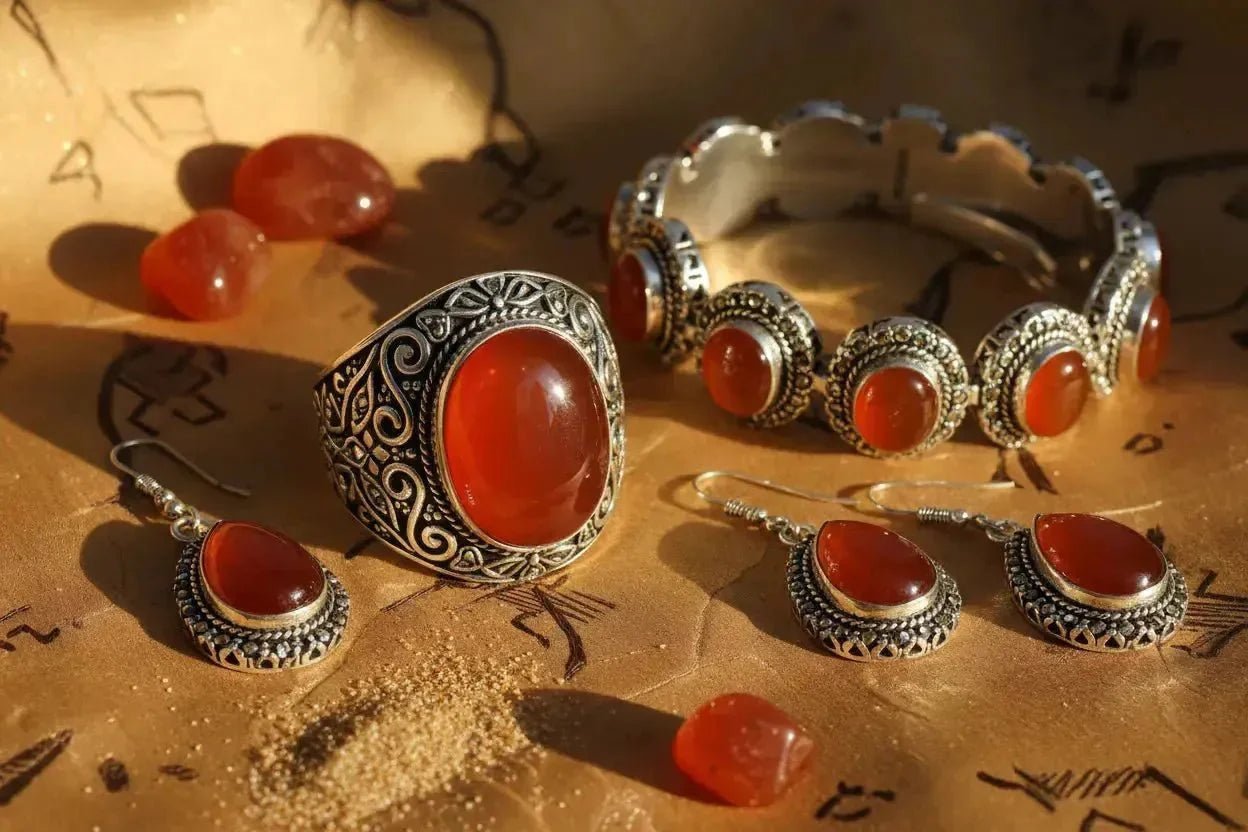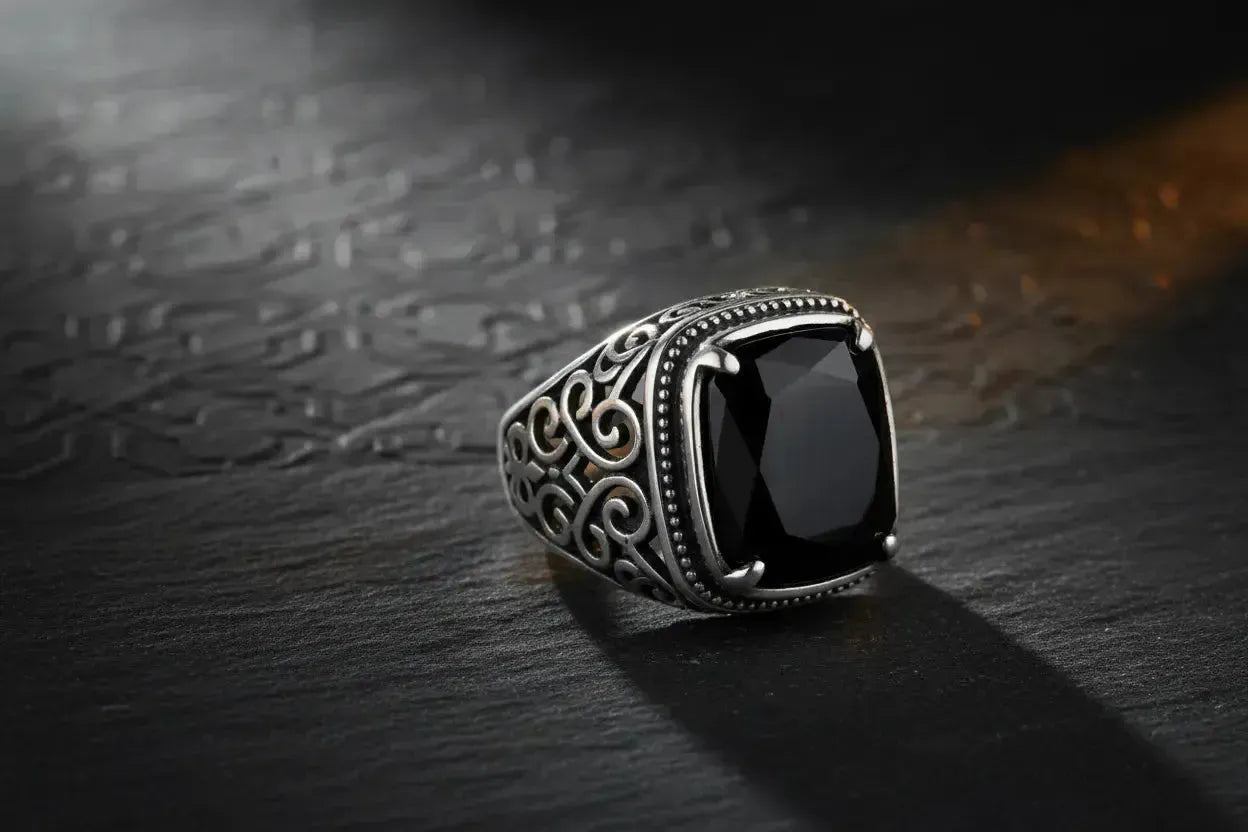
Black Onyx: Power and Oriental Mystery in Sterling Silver
Roman legions stationed on the borders of Anatolia sometimes wore an onyx ring engraved with an imperial profile — not out of vanity, but because the stone served as an official seal to authenticate military orders. This dual nature, both jewelry and instrument of authority, accompanied onyx through almost all civilizations that spanned the East — from the Romans to the Ottoman sultans, and the Caliphs of Baghdad.
A stone born of geological silence
Onyx belongs to the chalcedony family, microcrystalline quartz that forms through successive deposits of silica in rock cavities, over tens of thousands of years. This slow formation process, in regular layers, explains the almost perfect homogeneity of its black color — unlike agate, its close cousin, whose colored bands indicate interruptions in the deposition process. This absolute chromatic purity is precisely what fascinated oriental goldsmiths for centuries: no other common stone offers such a uniform black without the slightest parasitic reflection.
The seal, before the jewel
In Ottoman administration, as in the civilizations that preceded it in the East, the engraved onyx ring was not primarily an ornament — it was a functional identity document. Pressed into hot wax, it authenticated a letter, a contract, an official order. Losing one's seal was equivalent to losing a part of one's administrative authority; some high dignitaries had duplicates engraved, kept separately in case of theft or loss. It was only from the 16th century, with the widespread use of writing and handwritten signatures, that onyx gradually shifted to a purely ornamental use.
Inner strength and self-control
Among Persians as well as Arabs, onyx was considered a stone of protection and inner strength — warriors wore it in battle, convinced that it absorbed fear and stabilized courage. Ottoman sultans made it a symbol of absolute power, its blackness evoking an authority that needs no further demonstration to assert itself. Lithotherapy traditions still associate it with the root chakra, the seat of grounding and emotional stability, although these virtues are not scientifically proven and do not replace medical advice.
Onyx as a calligraphy medium
Its smooth surface and complete opacity made it a privileged medium for engraved Arabic calligraphy — Quranic verses, protective formulas, proper names. Specialized engravers, called hakkak in the Ottoman tradition, formed a separate guild, distinct from goldsmiths, as their calligraphic expertise required specific training. A seal ring engraved with a Quranic verse thus carried a double charge — legal and spiritual — rare for an object of that size.
Onyx and marcasite, an unprecedented contrast
The association of onyx with marcasite — this mineral with a subtle metallic grey reflection — creates a dark elegance that has spanned eras without ever aging. The absolute black of the stone, combined with the subdued sparkle of marcasite, produces a sober, almost architectural contrast, which explains why this combination remains one of the most sought-after in all oriental 925 silver jewelry.
Black onyx and green onyx: do not confuse
In today's market, there is frequent confusion between natural black onyx and certain artificially dyed chalcedonies to imitate its color — an ancient practice, already documented among Roman goldsmiths who sometimes dyed grey agates to obtain a more uniform black than that offered by nature. The process is not fraudulent as long as it is mentioned: it is a recognized practice in gemology since Antiquity, which does not detract from the final beauty of the stone.
Onyx in funerary tradition
Beyond its use as a seal, onyx held a special place in the funerary rites of several ancient oriental civilizations — its blackness was associated with the passage to the afterlife, a symbol of dignified mourning worn by loved ones. This dimension partly explains why onyx remains, even today in certain Mediterranean traditions, a stone associated with sobriety and contemplation rather than celebration, unlike more colorful stones like garnet or turquoise.
Onyx in oriental heraldry
Some large merchant families in Baghdad and Damascus incorporated onyx into their own engraved family emblems, in the same way that European coats of arms used colored enameling — a way of visually asserting lineage without using figuration, which was forbidden in religious art but tolerated in abstract form for private family use. These family seals, passed down from generation to generation, served to authenticate commercial correspondence over several centuries.
Wearing onyx today
An onyx signet ring with chased engravings on a dark outfit asserts an immediate presence, without ostentation. Associated with marcasite, onyx creates a mysterious sophistication particularly successful in the evening; in contrast on a white shirt, it plays on the black-and-white opposition with a sharp modernity.
Care
Onyx is cleaned with lukewarm soapy water and a soft cloth, then dried immediately. Avoid sharp impacts — the stone, although hard (6.5 to 7 on the Mohs scale), can crack under a violent impact — and store it separately from other jewelry to avoid micro-scratches on its polished surface.
✦ Vindicta — Solid 925 silver
The piece that makes the difference
Certified 925 silver · Free shipping from €69 · 10 years of excellence
Oriental 925 Silver Jewellery →