

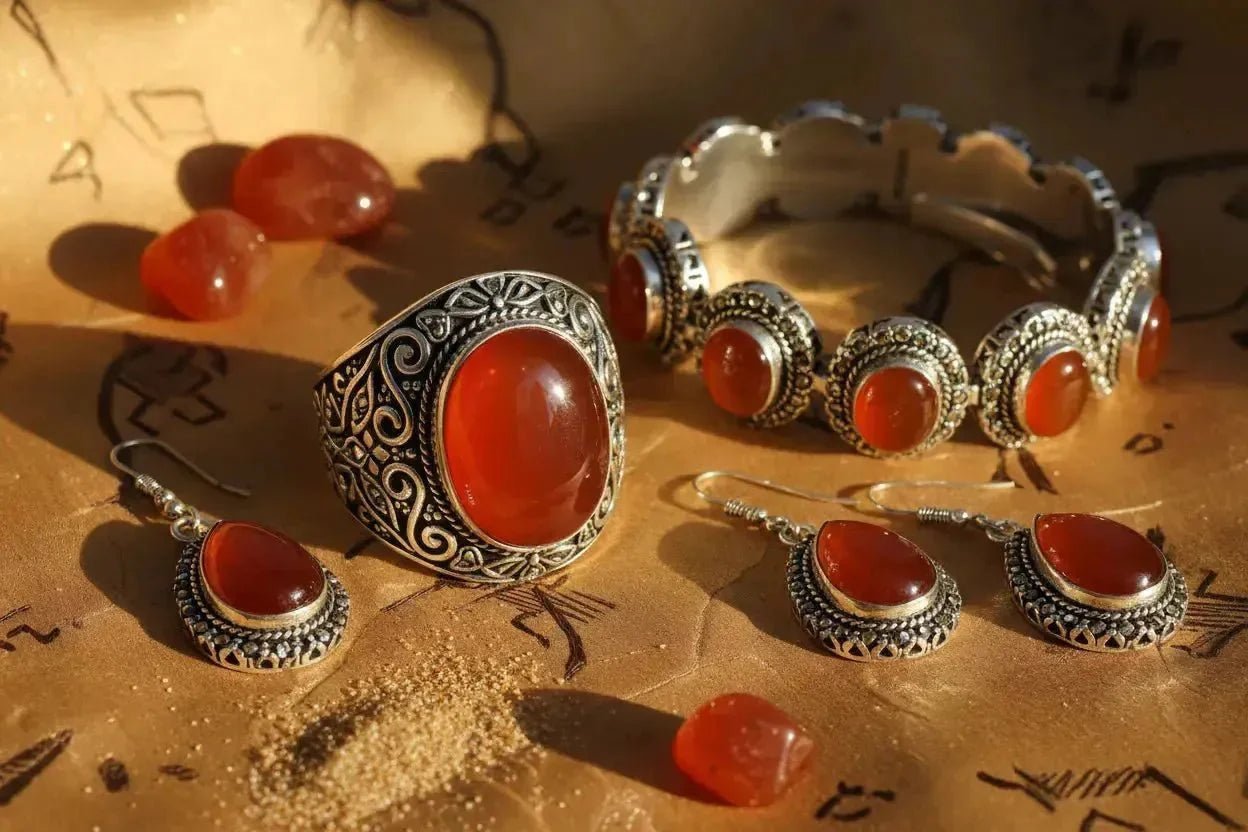
Carnelian: Desert Warmth and Oriental Vitality
According to Islamic tradition, the Prophet Muhammad wore a silver ring set with carnelian on his right hand. This detail, passed down through the hadiths, was enough to make carnelian one of the most widely worn stones throughout the Muslim world for over a millennium — an act of faith as much as an aesthetic choice, still replicated today by millions of men who sometimes have never heard its exact origin.
A stone colored by the desert itself
Carnelian belongs to the chalcedony family, like onyx and agate, but it is distinguished by a color due to the presence of iron oxide in its microcrystalline structure. The higher the iron concentration, the deeper the red hue; a lower concentration gives that characteristic warm orange, comparable to sand lit by a setting sun. The most renowned historical deposits were in India and the Arabian Peninsula, along the caravan routes that connected the Indian Ocean to the Mediterranean.
The scarabs of ancient Egypt
Long before Islam, ancient Egyptians already used carnelian to carve their sacred scarabs, symbols of rebirth placed in tombs to protect the deceased in their passage to the afterlife. This association between the reddish-orange stone and the idea of vital protection never truly faded — it simply passed down, from civilization to civilization, until it found itself at the heart of Islamic tradition several millennia later.
The courage of Persian warriors
In ancient Persia, generals wore carnelian signet rings before battle, convinced that it gave strength and protected from injury. This warrior belief left a lasting imprint on the symbolism of the stone: even today, it is credited with virtues of courage and determination, the stone of those who act rather than those who hesitate. Lithotherapy traditions associate it with the sacral and root chakras, promoting grounding and the realization of projects — though these virtues are not scientifically proven.
The only stone that recharges in the sun
Unlike most fine stones, which are sensitive to direct light that can alter their color in the long term, carnelian remarkably tolerates moderate sun exposure — an hour or two is even enough, according to lithotherapeutic tradition, to "recharge" it energetically. This peculiarity is not insignificant: it literally reflects the stone's origin, formed and colored in regions where the sun has always dominated the landscape.
Carnelian and marcasite, the harmony of twilight
The association of carnelian with marcasite — this mineral with a metallic gray reflection — directly evokes a sunset over the desert: the warm orange of the stone against the cold sparkle of the metal. It is one of the most sought-after combinations in Eastern 925 silver jewelry, bringing together warmth and sophistication in a single piece.
An engravable stone, worn as a personal talisman
Its moderate hardness and homogeneous texture made it, throughout history, one of the favorite stones of personal seal engravers in the Islamic world — easier to work with than onyx, while offering a surface that perfectly retains the finest details of an engraved name or formula. A merchant from Cairo or Damascus often had his own carnelian seal engraved, a personal item passed on to his eldest son upon his death.
Carnelian in the Talmud and Jewish tradition
Less well known: carnelian also appears among the twelve stones of the high priest's breastplate described in biblical tradition, each associated with one of the twelve tribes of Israel. This presence in several religious traditions of the Near East — Jewish, early Christian, then Islamic — testifies to a rare symbolic continuity: the same stone, worn for similar reasons (protection, spiritual dignity), across centuries and different faiths in this region of the world.