

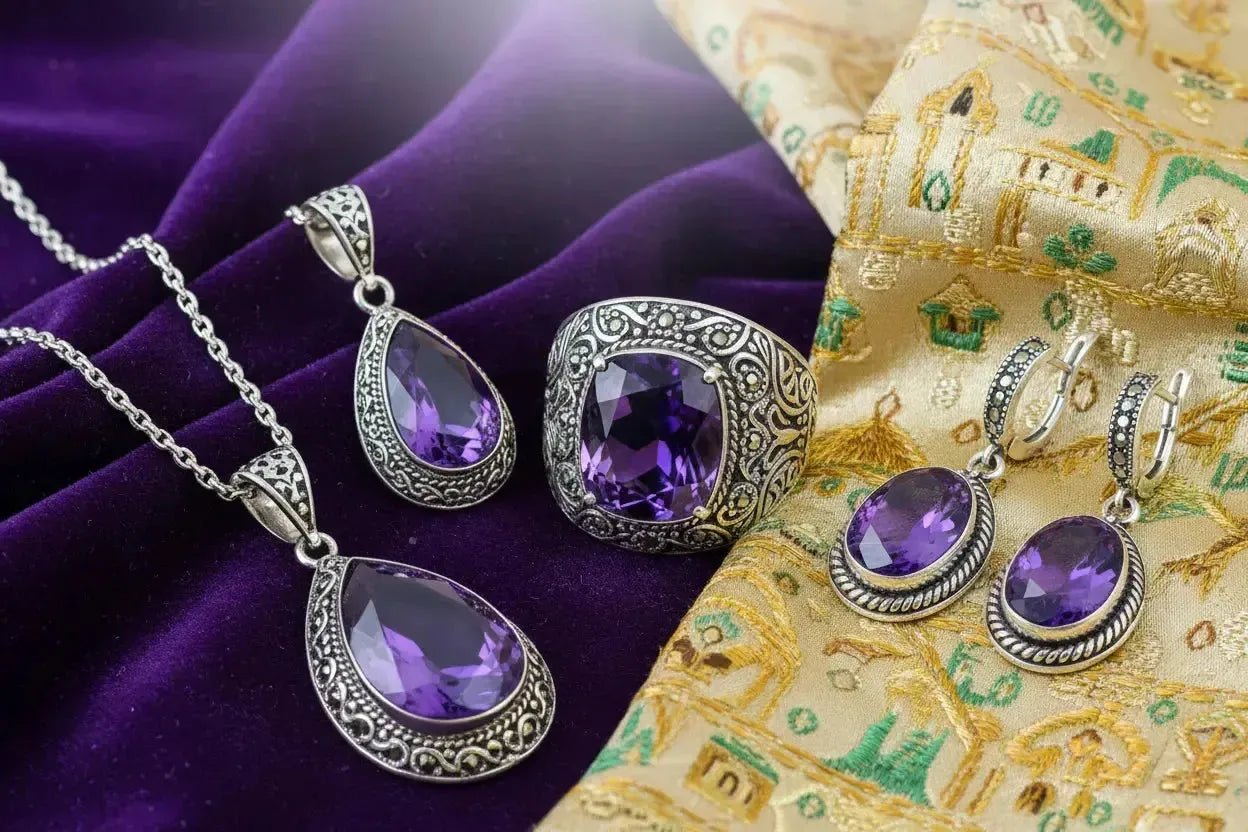
Amethyst: Royal Purple and Eastern Spirituality
In the Sufi monasteries of Persia, master meditators sometimes held an amethyst between their fingers during dhikr sessions – the repeated invocation of the divine name. This was not just a mere concentration accessory: the stone's deep purple was considered a color on the border between the visible and spiritual worlds, capable, it was said, of facilitating the passage from one to the other.
A purple born from an impurity
Mineralogically, amethyst is a simple variety of quartz – but colored by traces of iron trapped in its crystalline structure during its formation, then exposed to slight natural radioactivity present in the surrounding rock. This process, which can take millions of years, explains why no two amethysts ever have exactly the same intensity of purple – each bears the unique chemical signature of the soil where it formed.
The color of the caliphs
In both East and West, purple has always been associated with royalty – partly because natural purple dyes were historically among the most expensive to produce, reserved for the highest echelons of power. Caliphs and Ottoman sultans wore amethyst as a symbol of wisdom and spiritual power, a stone deemed worthy of adorning the turbans and rings of the most learned dignitaries of the court, those whose authority rested as much on knowledge as on strength.
The third eye and Sufi meditation
In the Muslim mystical tradition, amethyst was associated with the opening of the third eye – this faculty of intuition and clairvoyance that Sufis sought to develop through meditation and spiritual fasting. Meditation rosaries, called tasbih, were sometimes entirely composed of amethyst beads, believed to facilitate the state of concentration necessary for dhikr, this repetitive invocation practice that structures much of Sufi spiritual life.
Wisdom, discernment, psychic protection
Beyond its royal significance, amethyst was considered a stone of wisdom and discernment – it was worn to promote mental clarity before an important decision. Contemporary lithotherapy traditions attribute soothing virtues to it, associated with the crown and third eye chakras, without these effects being scientifically proven or replacing medical advice.
A stone to protect from the sun
Among the peculiarities of amethyst, one is worth knowing: prolonged exposure to the sun can alter, or even gradually discolor, its purple hue, a phenomenon linked to the very nature of the process that gave it its color. Persian jewelers already knew this and recommended keeping amethyst jewelry away from direct light when not worn – advice that remains perfectly valid today.
Amethyst and marcasite, spiritual elegance
The association of amethyst with marcasite creates a refined contrast between the deep purple of the stone and the discreet gray sparkle of the metal – a combination particularly appreciated in vintage jewelry inspired by the Orient, where it evokes both spirituality and sophistication.
From common stone to gemstone, and back
Until the 19th century, amethyst was classified among the rarest gemstones, on par with ruby or emerald – its rarity was due to the difficulty of accessing the few known deposits at the time. The discovery of vast Brazilian deposits in the 19th century overnight changed its status, transforming it from a precious stone to an accessible semi-precious stone. A purely economic reclassification, which took nothing away from its beauty or its symbolic charge in Eastern traditions, centuries older than this discovery.
Amethyst in the sacred breastplate
Like carnelian, amethyst is one of the twelve stones of the sacred breastplate described in biblical tradition – there it symbolized, according to ancient commentators, sobriety and temperance. This joint presence in Jewish, Christian, and Islamic traditions partly explains why the stone circulated so freely between these three religious worlds of the Near East, each attributing a similar spiritual value to it without ever fully appropriating it.