

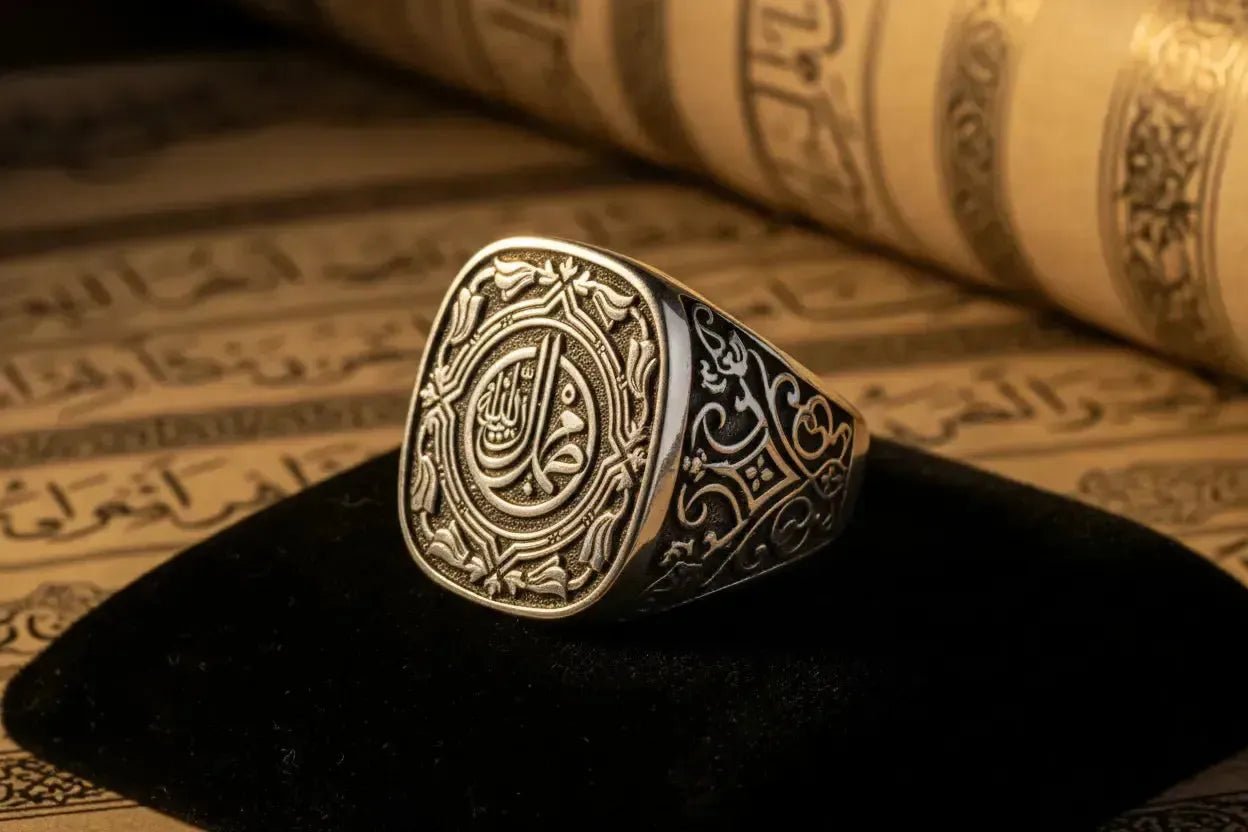
Oriental Calligraphy and Engravings: Sacred Art on Sterling Silver
In the sacred relics hall of Topkapi Palace, a simple engraved silver seal attracts less attention than the neighboring diamonds — yet it may be the most meaningful object in the entire collection. In Kufic calligraphy, one of the 99 names of Allah is inscribed. For the artisan who engraved it centuries ago, tracing each letter was less an exercise in style than an act of devotion repeated hundreds of times before achieving the perfect line.
A Prohibition that Founded an Entire Art Form
To understand why calligraphy holds such a central place in Islamic art, one must go back to a simple rule: the prohibition of representing living beings in religious art, established in the early centuries of Islam, for fear that the image might become an object of worship to the detriment of God alone. Deprived of figuration, artists turned to writing itself as artistic material — and eventually, within a few generations, transformed it into one of the most sophisticated forms of expression in art history. This forced detour produced a visual language unparalleled in richness, capable of conveying both religious meaning and pure aesthetic value.
Five Styles, Five Characters
Arabic calligraphy is not a single style but a family of distinct traditions, each born in a specific geographical and historical context. Kufic, the oldest, is recognizable by its angular and geometric letters — it can be found on the first mosques and early Islamic coins, as early as the 7th century. Thuluth, more fluid and expansive, adorns large monumental Ottoman inscriptions; its generous curves lend themselves perfectly to large surfaces such as mosque pediments. Naskh, rounder and more legible, was the preferred style for manuscript copying of the Quran, precisely because it is less tiring on the eye over long pages of text. Diwani, invented in the Ottoman chanceries, is distinguished by its letters that seem to almost soar towards each other — it was used exclusively for official sultanic documents, never for common uses. Each style required separate learning, often transmitted over several decades from a master to a single carefully chosen apprentice, in an almost initiatory transmission relationship.
Engraving Rather Than Writing: A Separate Discipline
Transposing calligraphy onto silver required an additional skill, distinct from that of the calligrapher on paper. The hakkak — the specialized engraver — formed a distinct guild in the Ottoman artisanal organization, separate from general goldsmiths and subject to its own apprenticeship rules. Unlike the brush, which allows for re-working and correction on paper, the burin forgives nothing on metal: a poorly traced letter on silver cannot be corrected; it requires starting the entire piece over from the beginning. It is this demand for definitive execution, with no room for error, that explains why the best hakkaks were so rare and sought after at court — some spent an entire lifetime perfecting the tracing of a single letter before being deemed worthy of engraving a complete verse.
The Arabesque, A Parallel Language of Infinity
Alongside calligraphy, geometric patterns and arabesques — these floral interlaces without beginning or end — complete the visual vocabulary of Islamic sacred art. Eight-pointed stars, rosettes, intertwined polygons: these patterns are never improvised; they follow rules of symmetry inherited from centuries of geometric calculation applied first to mosque architecture, before being transposed to the scale of a piece of jewelry. On an engraved piece, calligraphy and geometry often combine: a verse framed by a border of arabesques, the divine word literally embedded in the symbolic infinity of the endless curve.
Two Techniques, One Shared Dazzlement
Chasing incises the design directly into solid metal with a burin, creating lines of absolute sharpness. Openwork goes further by completely hollowing out the material around the design, transforming the silver into metallic lace through which light can pass. This second, particularly demanding technique gives the jewelry an almost ethereal lightness despite the inherent solidity of the metal — a visual paradox that Eastern artisans have always particularly sought, and which immediately distinguishes a handmade piece from an industrial reproduction.