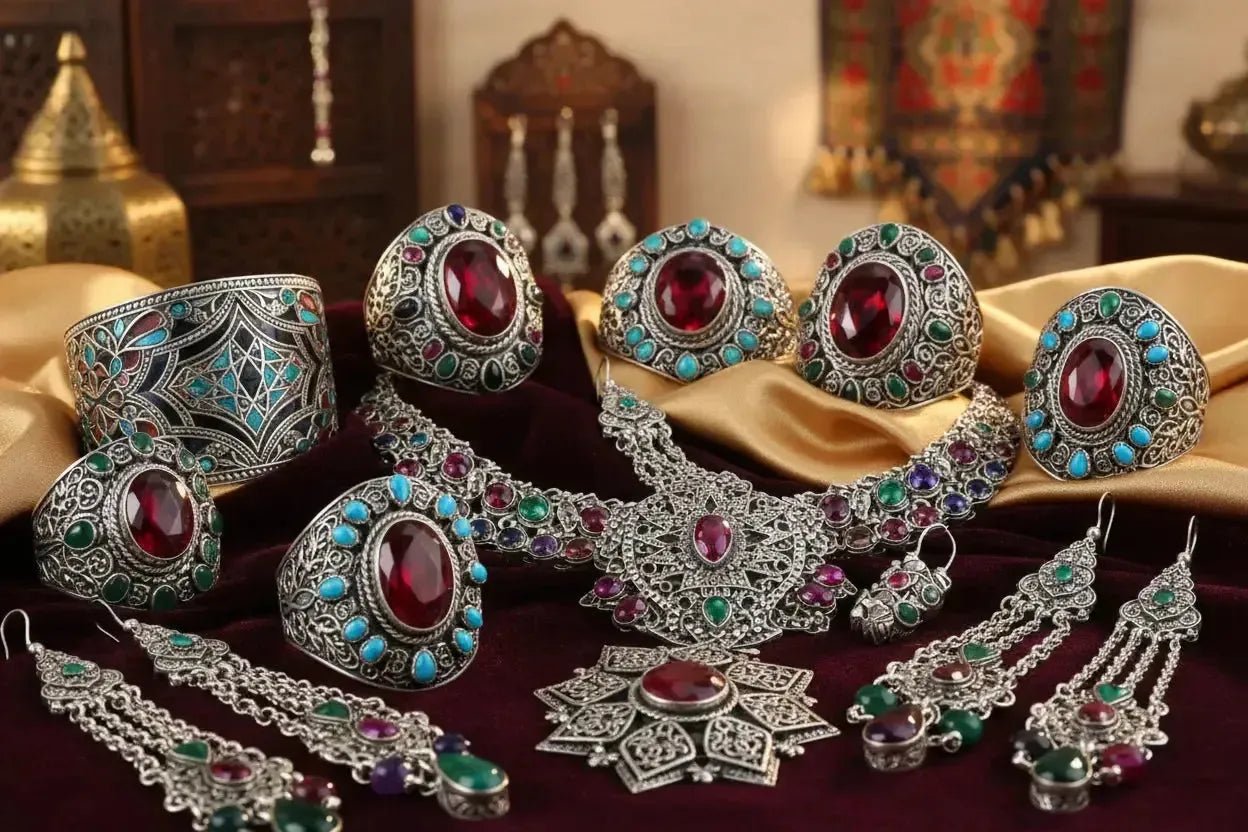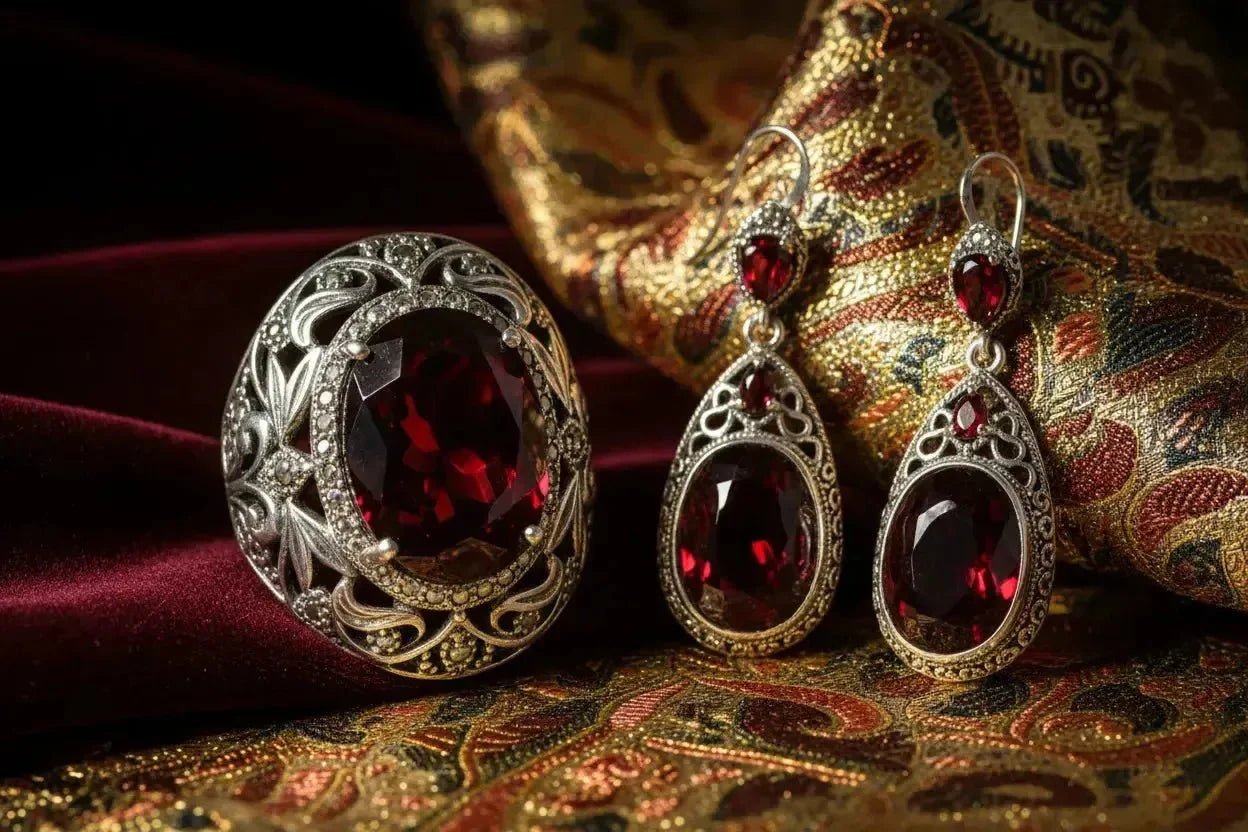
Arabesque Motifs: Islamic Art in 925 Sterling Silver Jewelry
The arabesque is born of constraint, not gratuitous aesthetic choice. In the 7th century, the prohibition of representing living beings in Islamic religious art pushed artisans towards abstraction: intertwined plants, sacred geometry, calligraphy. What could have remained a limitation became, in a few generations, one of the most sophisticated ornamental languages ever invented — a language that continues today to structure oriental 925 sterling silver jewelry.
A curve that refuses to conclude
What fundamentally distinguishes the arabesque from any other floral ornamentation is its refusal of formal conclusion. The curve extends, repeats, turns back on itself without ever frankly stopping — a way of representing infinity and divine unity without needing to name it with words. Under the Abbasid and then Fatimid dynasties (9th-13th century), this abstraction reached unparalleled complexity: stylized vine leaves, palmettes, spirals intertwining on several levels of interpretation. The Ottoman and Persian empires later added more recognizable floral motifs — tulips, carnations, roses — and increasingly fine chasing, applied as much to palace walls as to jewelry worn at court.
Three symbolisms in a single curve
The arabesque simultaneously carries three ideas. First, infinity and divine unity: a line without beginning or end that visually translates an abstract theological concept. Then, sublimated nature: plant motifs — vine leaves symbolizing abundance, palmettes evoking eternal life, flowers embodying divine beauty — represent the Garden of Paradise as described in sacred texts. Finally, cosmic harmony: rigorous symmetry and repetition of motifs embody universal order, the idea that the world, despite its apparent chaos, obeys an underlying structure.
The Baghdad School and the circulation of knowledge
It was in Baghdad, under the Abbasid caliphate, that a true theoretical corpus of ornamental geometry was established between the 9th and 12th centuries. Mathematicians from the House of Wisdom — a translation and research center founded by Caliph al-Ma'mun — worked simultaneously on Euclidean geometry and on problems of plane tiling. These researches, purely mathematical in origin, directly fed the artisans' vocabulary: the combinations of regular polygons that structure the arabesque are the same as those studied in the scientific treatises of the time. Islamic decorative art was not born in workshops alone: it is the result of a close dialogue with scholarly mathematics.
Chasing and openwork: two gestures, one dizzying technical challenge
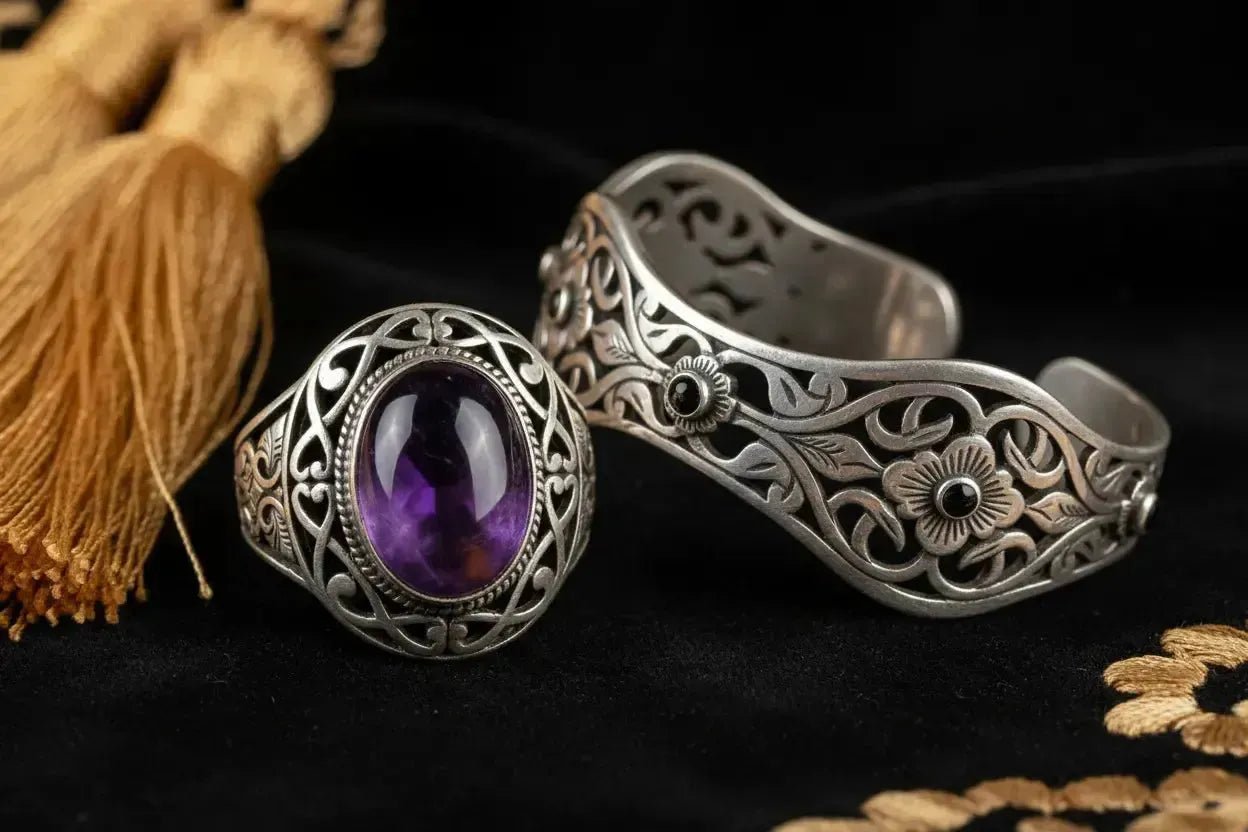
Engraving the arabesque in silver requires years of mastery. Chasing incises the motif directly with a chisel into the solid metal, creating lines of absolute sharpness. Openwork goes further: it completely hollows out the material around the motif to transform silver into true metal lace. This particularly demanding technique gives the jewelry an almost airy lightness despite the intrinsic solidity of the metal — a visual paradox that oriental artisans have always particularly sought. A master chaser could spend several days on a single ring bezel, repeating the same motif at different depths to create a relief effect that changes with the angle of the light.
From the Alhambra to contemporary rings
These intertwined patterns are found wherever Islamic art flourished, on radically different scales but with the same underlying visual grammar: the walls and ceilings of the Alhambra palace in Granada, the blue faience of the Blue Mosque in Istanbul, the colored marble inlays of the Taj Mahal in India. These three monuments, separated by thousands of kilometers and several centuries, nevertheless share the same formed vocabulary. It is this remarkable continuity that makes the arabesque so recognizable, even reduced to the size of a ring bezel.
The arabesque outside the Islamic world
Less known fact: this geometric vocabulary greatly influenced Western art itself, particularly through trade with Venice and the medieval Iberian Peninsula. Some art historians attribute part of the inspiration for the European Art Nouveau movement, at the turn of the 20th century, to the Western rediscovery of oriental interlaced patterns — the same fascination for the continuous and organic line, transposed into a secular European context. The arabesque has therefore never been totally confined to its original cradle.
Wearing the arabesque today
Worn on a women's 925 silver ring or an engraved signet ring, this geometry has lost none of its strength. Associated with black onyx, it gains dramatic contrast; set with marcasite, it captures light with every movement of the wrist. In both cases, it continues to say, without a word, that certain forms transcend centuries because they were conceived from the outset for eternity.
Care of chased or openwork jewelry
Recessed patterns require a little more care than a smooth surface: dust and cosmetic residues can easily accumulate there. A small soft-bristled brush, regularly passed into the grooves of the motif, is enough to maintain the sharpness of the design. Ultrasonic cleaners should be avoided on the finest openwork pieces, as their vibrations can eventually weaken soldered joints.
✦ Vindicta — Solid 925 silver
The piece that makes the difference
Certified 925 silver · Free shipping from €69 · 10 years of excellence
Oriental 925 Silver Jewellery →