925 Sterling Silver Oriental Jewelry: Opulence and Symbolism of the Orient
A Persian bazaar or a Cairo souk never looks like a Western shop arranged by color. Colors are deliberately mixed: a garnet red rug placed near a turquoise blue fabric, ochre spices next to emerald silks. This logic of assumed accumulation, far from being disorder, obeys a precise aesthetic — and it is directly reflected in the way the East has always conceived jewelry.
Why the East Never Chooses Just One Color
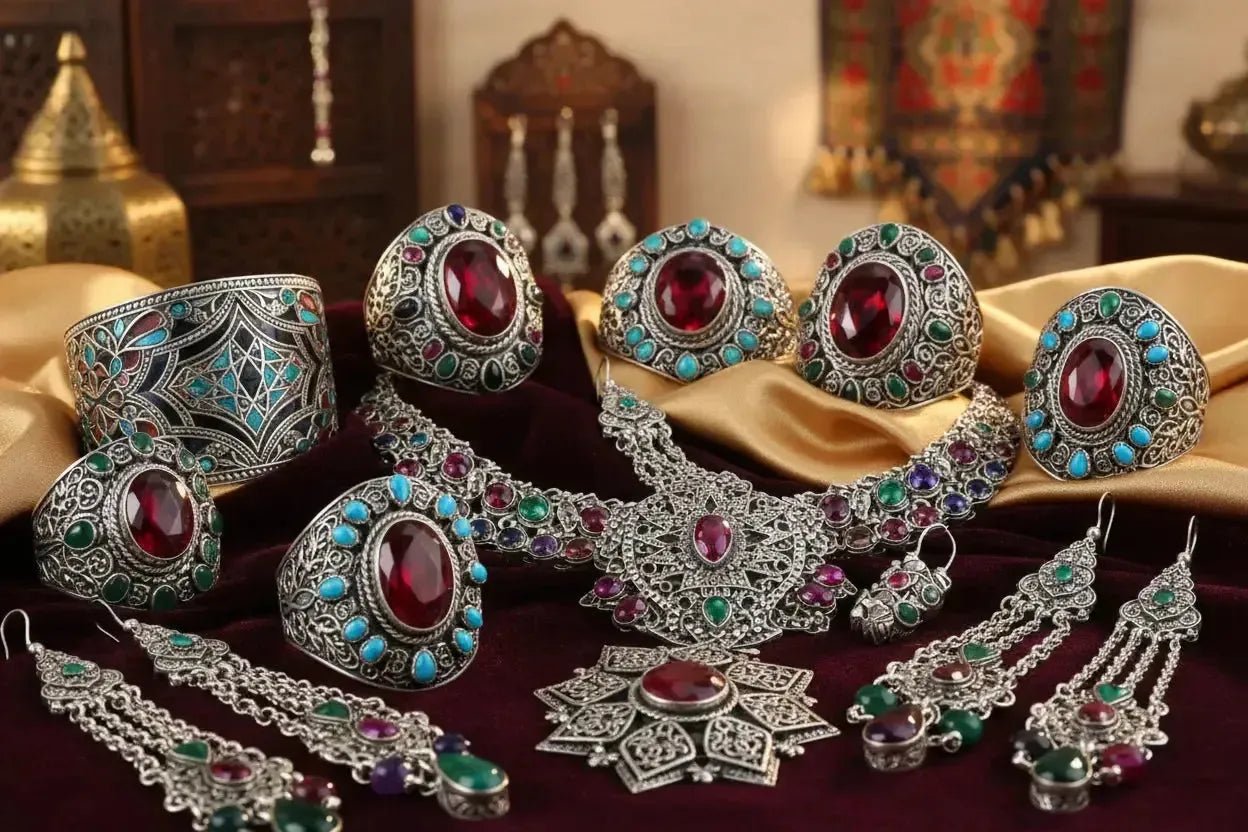
Where classic Western jewelry often favors a single stone highlighted alone, the Eastern tradition — whether Ottoman, Persian, or Mughal — has long celebrated accumulation: red garnet, green emerald, blue sapphire, purple amethyst, often gathered on the same piece. This practice dates back to royal courts, where the richness of a jewel was read as much in the diversity of stones as in their size. A sovereign who wore five colors at once affirmed access to distant trade routes — garnet came from India, lapis from Afghanistan, turquoise from Persia. The colored stone was therefore, before being an ornament, a map of commercial power.
The Mughal Court, Apex of Colorful Opulence
Nowhere was this logic pushed as far as at the Mughal court in India, between the 16th and 18th centuries. Mughal emperors — Akbar, Jahangir, Shah Jahan — simultaneously wore rubies, emeralds, diamonds, and sapphires on the same turban, the same chest. European jewelers visiting the court, astonished, described in their travel diaries sovereigns "covered in stones like an armor of light." This demonstration was never gratuitous: each stone attested to a commercial alliance, a conquest, a tribute received. The multi-colored jewel was, literally, a diplomatic map worn on the body.
The Arabesque: Endless Geometry
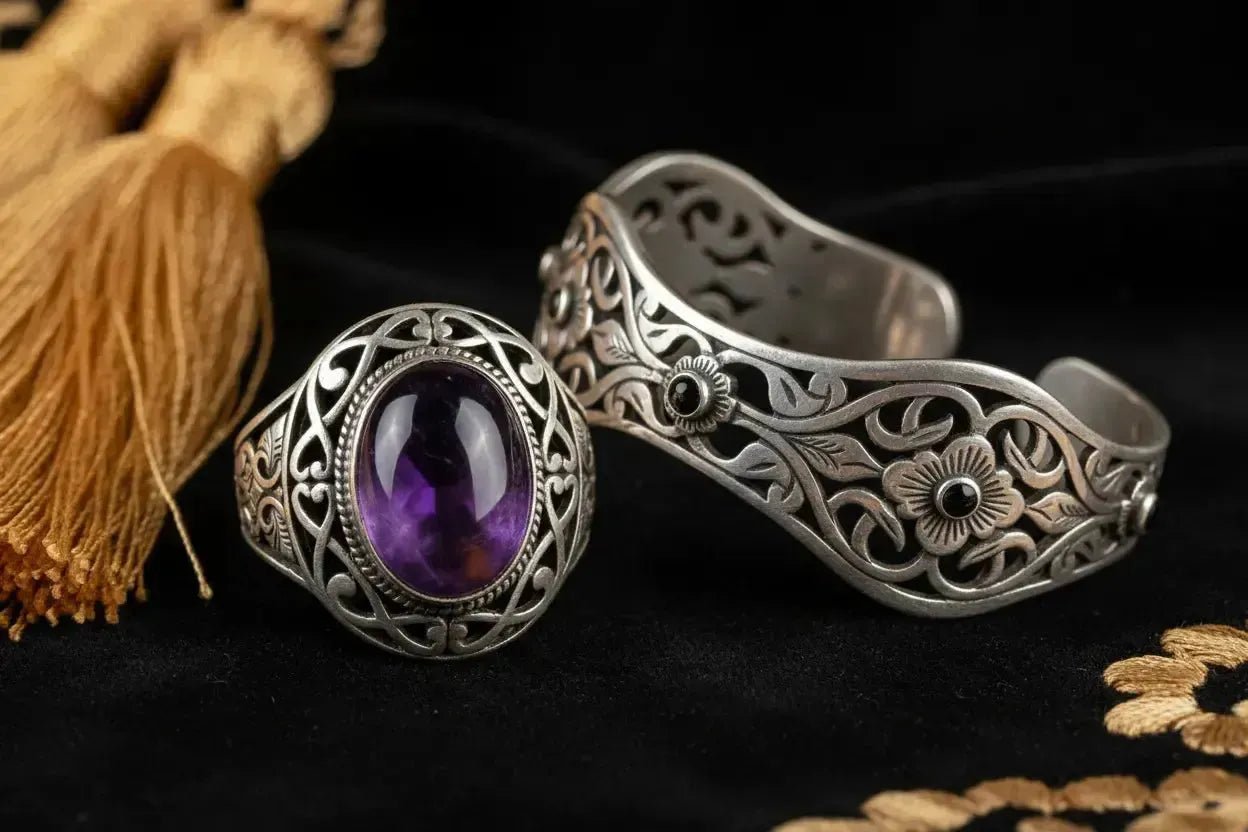
The second pillar of this aesthetic is arabesque motifs — those floral and geometric interlaces born from a religious constraint: the prohibition of representing living beings in sacred art pushed artisans, from the 7th century, towards an abstraction of remarkable sophistication. The curve that makes up the arabesque has neither beginning nor end: it extends, turns back on itself, creates a continuous visual rhythm that symbolizes infinity and divine unity without needing to formulate it in words. It can be found on all scales — engraved in the marble of the Alhambra, painted on the faience of the Blue Mosque, or simply chiseled on the setting of a silver ring.
Garnet, Stone of Power
Among all colored stones, garnet holds a special place in the Eastern imagination. The ancient Persians believed it capable of illuminating the night and warding off nightmares; Ottoman sultans inlaid it in their swords and crowns as a sign of absolute power. Even today, Topkapi Palace preserves daggers and crowns set with exceptionally sumptuous garnets. Its deep red, mounted on 925 silver, creates that warm-cool contrast that Eastern aesthetics systematically seek.
Sacred Geometry, Not Decorative
Purely geometric motifs — eight-pointed stars, interlaces, rosettes — are not simple ornaments: in the Islamic tradition, they represent divine order and mathematical infinity. Their precision is never approximate; every angle, every repetition obeys rules of symmetry inherited from centuries of geometric calculation applied to religious architecture before being transposed onto metal. The artisans who generated these motifs often worked from preparatory grids drawn with compasses — nothing was improvised, every curve first existed on paper before existing in metal.
Setting Techniques for Multiple Stones
Setting several colored stones on the same piece imposes a particular technical constraint: each stone has its own hardness, its own sensitivity to soldering heat. Eastern goldsmiths developed precise work sequences — setting the most heat-resistant stones first, protecting the most fragile ones with a damp cloth during the soldering of neighboring elements. It is this know-how, invisible to the naked eye, that allows a multi-colored ring to remain intact for several generations without any stone falling out.
The Stone Trade, Discreet Driver of This Aesthetic
Behind every multi-colored jewel lay a commercial network of considerable scale. Caravans crossing Central Asia simultaneously transported Afghan lapis lazuli, Persian turquoise, Indian garnet, and Mediterranean coral — a trade so structured that certain stopover cities, like Isfahan or Bukhara, became stone cutting and trading centers in their own right, employing entire generations of lapidaries specializing in a single variety of stone. The finished jewel was therefore only the visible part of an entire transcontinental economy.
Wearing This Palette Today
What distinguishes an oriental jewel from a Western equivalent is not the quality of the metal — solid 925 silver remains identical everywhere — but this deliberate desire to make colors converse rather than hierarchize them. A natural stone piece, an association with marcasite, or simply a statement ring are enough to invoke this spirit — without the need to accumulate ten pieces at once for oriental elegance to be fully expressed.
✦ Vindicta — Solid 925 silver
The piece that makes the difference
Certified 925 silver · Free shipping from €69 · 10 years of excellence
Oriental 925 Silver Jewellery →