Article: The Art of Ottoman Oriental Jewelry: Luxury and Heritage
The Art of Ottoman Oriental Jewelry: Luxury and Heritage
In the Topkapi Palace workshops, an apprentice goldsmith often spent seven years before being allowed to touch a piece intended for the sultan. Not because silversmithing was secret, but because the margin of error, on such a malleable metal, left no room for approximation: a poorly soldered filigree wire, an overly deep engraving, and weeks of work would be sent to the melting pot. This demand largely explains why Ottoman silversmithing remains, six centuries later, a benchmark that continues to be studied and cited.
Why silver, and not gold
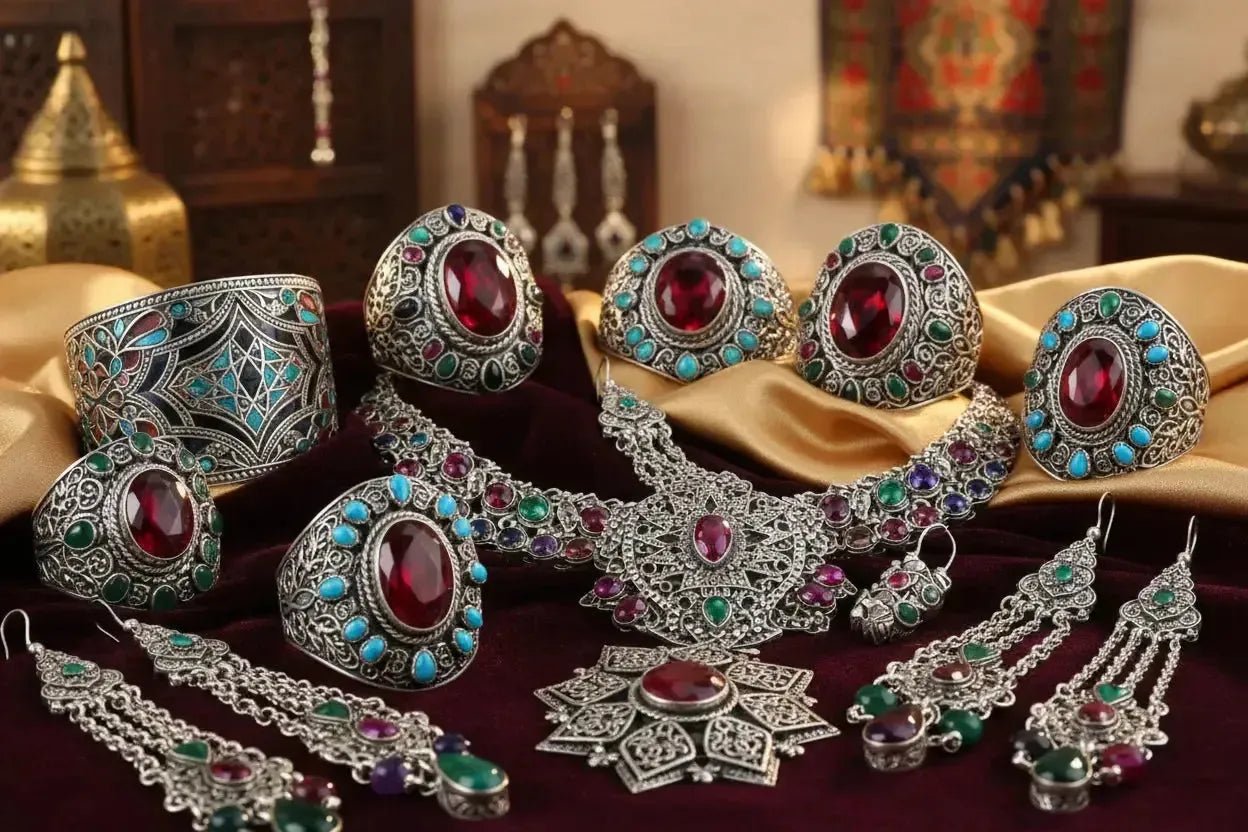
We often imagine the Ottoman court drowning in gold — which is partly true for the highest ceremonial objects, such as the throne or ceremonial weapons. But in the daily life of the court as well as in jewelry intended for the merchant and educated classes, .925 silver (92.5% pure silver, alloyed with 7.5% copper for durability) occupied a larger place than is commonly believed. Its malleability allowed for motifs of a fineness that gold, which is softer in this regard, made more fragile to work with in fine wire. Its white luster, above all, had a virtue that gold did not: it never overpowered the set stone. A turquoise or a garnet mounted on silver retains its full color; mounted on gold, it is sometimes overwhelmed by the yellow of the metal. 16th-century goldsmiths already knew this — it is an aesthetic choice as much as a choice of availability.
Three stones, three characters
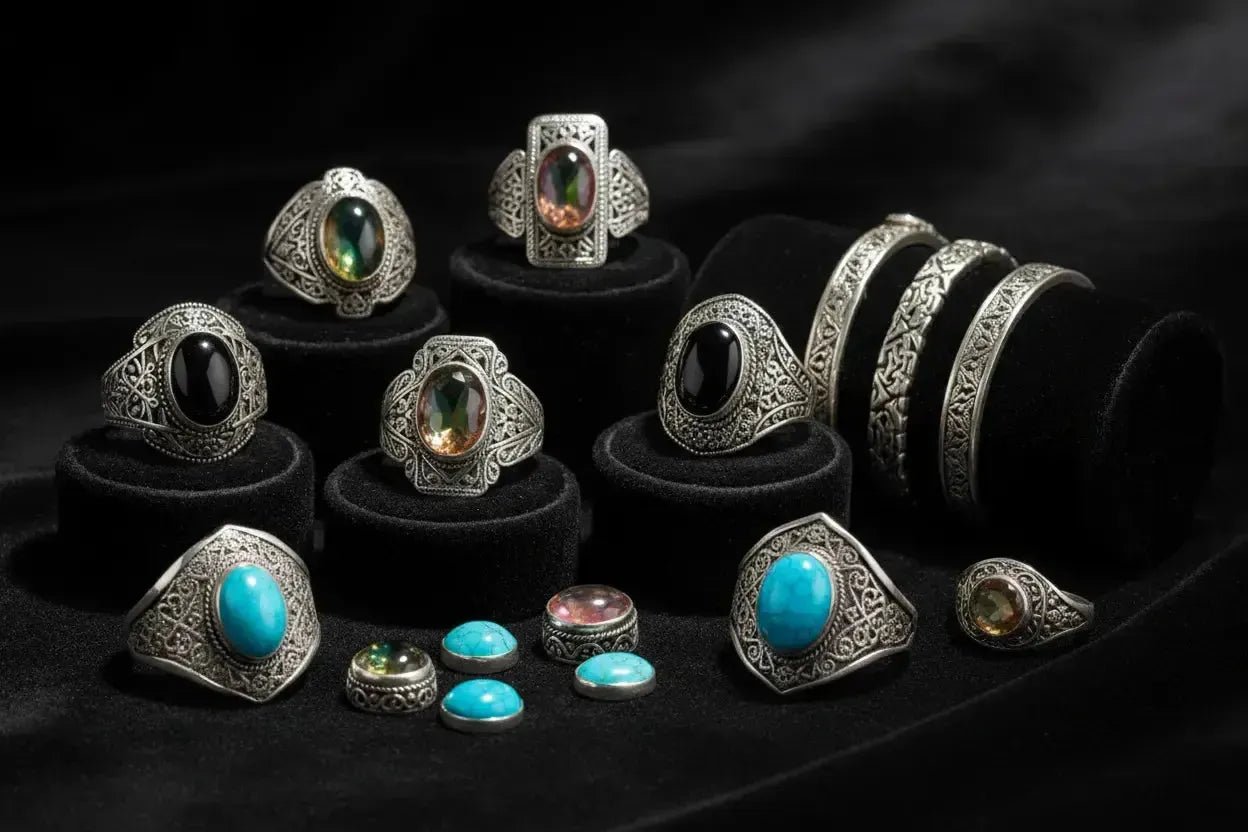
Ottoman jewelry never chose a stone at random. Turquoise, with a blue that directly recalls the domes of Istanbul's great mosques, was considered a bulwark against the evil eye — the sultans themselves adorned themselves with it, as much by belief as by an assumed aesthetic taste. Black onyx, sober and impenetrable, embodied self-control and inner strength: it was the stone offered to a man taking on a position of responsibility. Carnelian, a warm orange-red, was worn as a courage amulet by warriors before combat — a tradition that dates back long before the Ottoman Empire itself, to ancient Egypt and the early centuries of Islamic tradition.
Filigree, or the art of making lace with metal
The most recognizable technique from this period remains filigree: a silver wire is twisted on itself, soldered point by point to create openwork motifs of an almost paradoxical lightness — the jewel seems ethereal even though it is made of solid metal. Alongside this, repoussé (the metal is hammered from the back to bring out a raised motif) and chasing (the detail is refined from the front, with a chisel) allowed for the creation of remarkably precise floral motifs: tulips, carnations, stylized roses, always symmetrical, always rigorously proportioned. The tulip in particular was not merely a decorative motif — it was the very emblem of the Empire, a symbol of floral perfection and, by extension, of political perfection. Sultans cultivated entire gardens of tulips at the palace, and this passion was directly engraved into the silver of court rings and pendants.
Setting: two philosophies
Two approaches coexisted for setting a stone in its mounting. The claw setting allows light to pass under the stone, maximizing its brilliance — this was the preferred choice for turquoises and translucent stones, which benefit from being lit from below. The bezel setting, conversely, completely encloses the gem in a silver frame: more protective, more sober, it was better suited for onyx and opaque stones, which have nothing to gain from allowing light to pass through since they do not transmit it.
Female goldsmiths, a discreet exception
Contrary to popular belief, Ottoman silversmithing was not exclusively masculine. Imperial harems employed their own craftswomen, specializing in jewelry intended for the women of the court — pieces often finer, more openwork, designed to be layered without weighing down the outfit. Ottoman archives mention several master female goldsmiths recognized by their own names, a rare occurrence for the time in a craft generally dominated by male guilds.
What remains today of this heritage
What is striking when observing these pieces in the Topkapi Museum collections is their formal modernity. The geometric rigor of the motifs, the assumed contrast between the cold metal and the warm stone, the balance between sobriety and richness — none of this needs to be "reinvented" to appeal to a contemporary eye. Wearing a .925 silver signet ring or men's ring, a turquoise piece, or jewelry combining onyx and marcasite today, is unknowingly extending six centuries of craftsmanship that never needed to shout to be noticed.
Caring for .925 silver jewelry
Silver, contrary to what one might imagine, improves with regular wear: it is contact with the skin that slows down its natural oxidation, not the other way around — a piece of jewelry left in a drawer darkens faster than a piece worn every day. A soft cloth is sufficient for routine cleaning; simply avoid prolonged contact with perfumes, creams, and chlorinated water, which accelerate tarnishing. For the most intricate pieces, a small soft brush can reach the hollows of the motif without damaging them.
✦ Vindicta — Solid 925 silver
The piece that makes the difference
Certified 925 silver · Free shipping from €69 · 10 years of excellence
Oriental 925 Silver Jewellery →