Garnet: Royal Gem of the Orient and Symbol of Passion
According to an Islamic legend, Noah hung a garnet in the Ark to light up the darkness of the Deluge—the stone shining, the story goes, with its own red light, without the need for a flame. True or embellished, this story says something precise about the place the garnet occupies in the Eastern imagination: a stone that is not merely looked at, but expected to act.
The Blood of Kings
The ancient Persians regarded garnet as a sacred stone, capable of warding off nightmares and illuminating the night. Rulers embedded it in their crowns, swords, and court jewelry—a sign of power as much as divine protection. Under the Ottoman Empire, this tradition continued directly: the Topkapi Palace in Istanbul still preserves imperial daggers and crowns set with garnets of rare splendor, testifying to an era when the red stone was inseparable from the very idea of sovereignty.
On the Silk Road, which connected Persia to China via India, merchants carried garnet as a protective talisman for their journey—a fragment of red worn close to the body on a path of sand, bandits, and uncertainty for several thousand kilometers. Caravanners recounted that the garnet imperceptibly darkened at the approach of danger—a belief that made it as much a jewel as an instrument of shared vigilance among travelers.
Three Shades, Three Characters
Garnet is not a single stone but a family with distinct hues, classified according to its exact chemical composition. Almandine, a dark red with purple reflections, is the most common—it is the garnet of sultans, the one most often found in historical pieces, rich in iron and aluminum. Pyrope, a vivid red directly evoking blood, takes its name from the Greek "pyr," meaning fire, and was particularly sought after in Oriental jewelry for its almost incandescent chromatic intensity. Rhodolite, a more delicate reddish-purple, remains the rarest of the three and the most prized in contemporary high jewelry—its hybrid hue requires a precise mineral balance, rarely found in nature. A fourth type from Africa, tsavorite, emerald green and unrelated chromatically to its red cousins, reminds us that the word "garnet" actually refers to an entire mineral family defined by its crystalline structure, not by a single color.
What Deep Red Tells
Symbolically, garnet carries a dual charge. On one hand, passion and desire—it was traditionally the stone of lovers, given to seal a lasting commitment, a use found in both Persian courts and medieval Europe, which then heavily borrowed from Oriental codes. On the other hand, power and authority—sultans wore it precisely to assert their legitimacy, in a logic where the color red was directly associated with the blood shed to defend the throne. Lithotherapy traditions associate it with the root chakra, the seat of grounding and self-confidence, although these virtues are not scientifically proven nor do they replace medical advice.
Garnet and Marcasite: The Ottoman Contrast
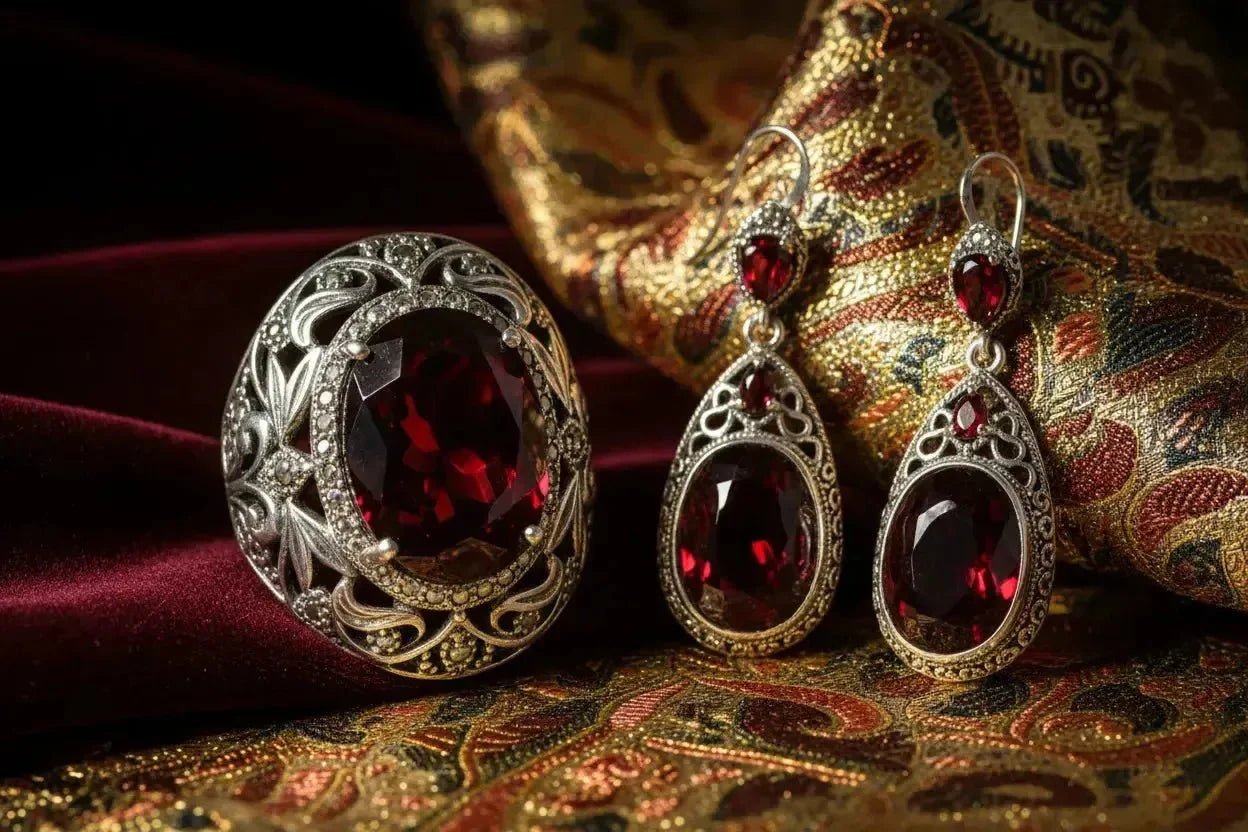
The association of garnet with marcasite—this iron sulfide mineral with a subtle metallic sheen—is one of the most recognizable signatures of Oriental filigree goldsmithery. The intense red of the stone against the discreet gray sparkle of marcasite creates an opulence that directly evokes major Art Deco and Ottoman pieces—two aesthetics separated by centuries but united by this same taste for controlled contrast. Goldsmiths particularly appreciated this combination because marcasite, being mineral and opaque, never competes with the garnet's own brilliance—it frames it rather than dispersing it.
Garnet in the Ottoman Trousseau
In the Ottoman wedding tradition, offering a garnet jewel to a young woman leaving the family home was considered a gesture of protection as much as celebration—wealthy families sometimes set several garnets on a single parure including a matching necklace, earrings, and bracelet, a masterpiece then passed down from mother to daughter for several generations. This practice explains why so many ancient garnet sets found today show signs of wear concentrated only in certain areas, indicating regular wear over decades rather than occasional use.
Wearing Garnet Today
A garnet and marcasite ring paired with a dark outfit creates immediate opulence; dangling earrings add a royal dimension to an evening dress, while a discreet openwork ring can be worn daily with jeans and a white shirt. Garnet naturally dialogues with other stones of the Oriental tradition: with onyx, the red-black contrast creates a mysterious power; with turquoise, the tension between fire and water, passion and serenity.
Care
Garnet should be cleaned with lukewarm soapy water and a soft cloth, rinsed, and dried immediately. Avoid shocks—its hardness of 7 to 7.5 on the Mohs scale makes it resistant to daily wear, but not unalterable in the event of a direct impact—as well as sports and household chores with the ring on your finger. Store it separately from other jewelry to prevent micro-scratches, as marcasite itself is relatively sensitive to repeated rubbing.
✦ Vindicta — Solid 925 silver
The piece that makes the difference
Certified 925 silver · Free shipping from €69 · 10 years of excellence
Oriental 925 Silver Jewellery →