
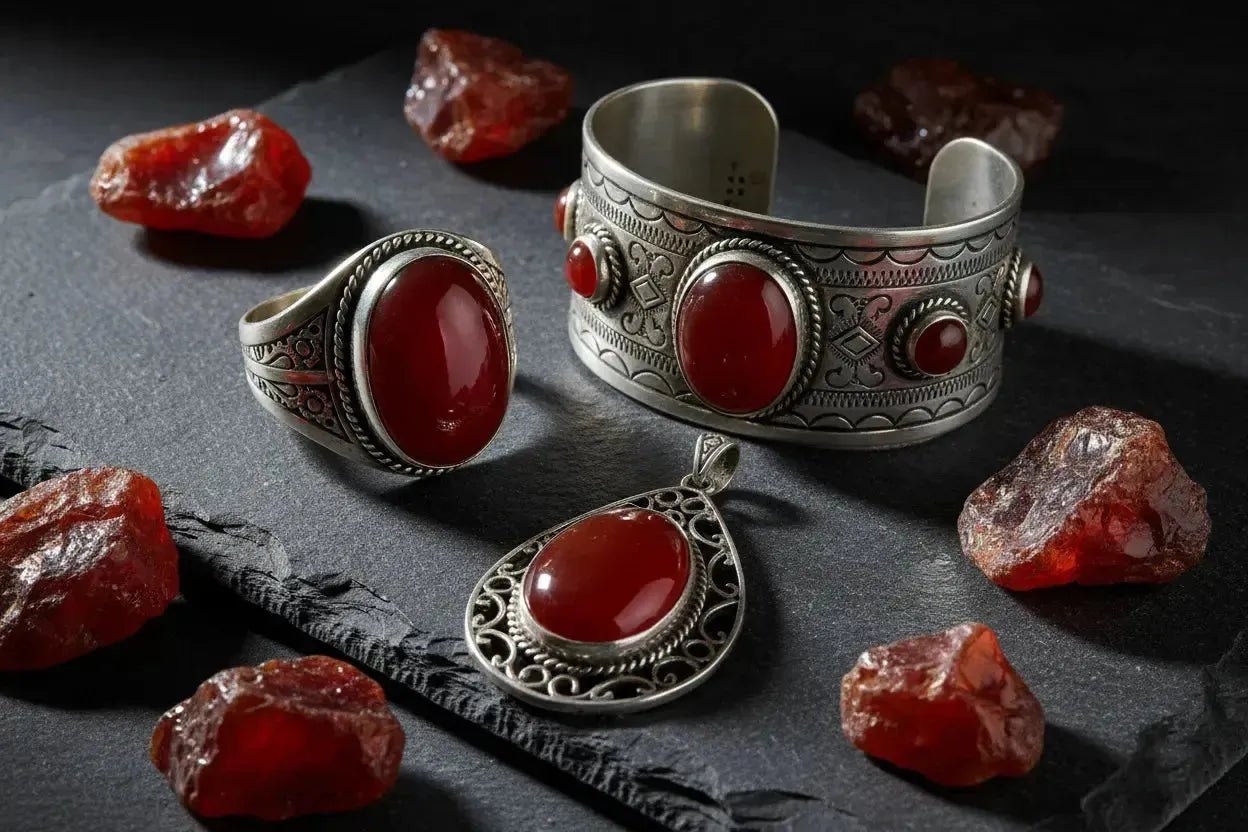
Carnelian and Sterling Silver: Sacred Stone of the Maghreb
Carnelian: The Red Stone of the Maghreb
Among all the natural stones used in Berber jewelry, carnelian holds a special place. This semi-precious stone with intense red-orange hues is much more than an ornament—it is a sacred stone, charged with ancient symbolism that transcends cultures, religions, and eras.
From Morocco to Algeria, from Tunisia to Egypt, carnelian has always been the favorite stone of Berber artisans. Associated with solid 925 sterling silver, it creates jewelry of striking beauty and unparalleled symbolic depth.
History of Carnelian in the Maghreb
An Ancient Stone
The use of carnelian in the Maghreb dates back over 5,000 years. Archaeological excavations in Morocco, Algeria, and Tunisia have revealed carnelian adornments dating from the Neolithic period.
Carnelian in Islamic Tradition
The arrival of Islam in the 7th century cemented carnelian's sacred status in the Maghreb. According to Islamic tradition, the Prophet Muhammad wore a silver ring set with a carnelian on his right pinky finger.
Characteristics of Carnelian
Carnelian is a variety of chalcedony whose red-orange color is due to the presence of iron oxide. Its hardness of 6.5 to 7 on the Mohs scale makes it a robust stone, ideal for jewelry.
Symbolism of Carnelian in Berber Culture
Stone of Courage and Protection
Throughout Berber culture, carnelian is primarily a stone of protection against the evil eye and negative energies.
Stone of Fertility
Carnelian is also a stone of fertility. Pregnant women wear carnelian jewelry to protect their pregnancy.
Spiritual Stone
In the Sufi tradition, it is associated with the purification of the soul and spiritual elevation.
Carnelian and 925 Silver: An Ancient Alliance
The association of carnelian with 925 silver is one of the oldest and most harmonious in all Berber jewelry. The contrast between the intense red-orange of the stone and the cold brilliance of solid silver creates a visual tension of striking beauty.
- Silver — metal of purity, protection, and spiritual connection
- Carnelian — stone of courage, fertility, and vital force
Carnelian's Virtues in Lithotherapy
- Stimulation of vital energy — it revitalizes the body and combats fatigue
- Strengthening self-confidence — it encourages courage and determination
- Emotional protection — it creates a shield against negative energies
- Stimulation of creativity — it promotes artistic expression
- Grounding and stability — it connects to the earth and strengthens the sense of security
The Trade Routes of Carnelian in the Maghreb
The carnelian used by Berber artisans did not always originate from the Maghreb itself. A large portion passed through the trans-Saharan caravan routes, coming notably from India and Egypt, where quality carnelian deposits had been renowned since antiquity. These trade routes, which connected the Maghreb to sub-Saharan Africa and the Middle East, made carnelian a material that was both local and cosmopolitan—extracted far away, but worked according to techniques and symbolism deeply rooted in Berber culture.
Some carnelian deposits also exist directly in the Sahara and arid regions of the Maghreb, where the stone forms in volcanic geological environments similar to those in India. Local artisans knew how to distinguish nuances of color based on provenance—a more orange carnelian might indicate a different origin than a darker red carnelian—although this distinction is more a matter of empirical knowledge passed down from workshop to workshop than modern scientific classification.
Stone Working: From Raw Rock to Jewel
Transforming a rough carnelian into a set stone on a silver jewel required specific expertise. The stone was first cut into a cabochon—a domed, unfaceted shape that emphasizes the depth of carnelian's color rather than its play of light, unlike faceted stones like diamond. This cabochon technique remains the most common for carnelian in Berber and broader Mediterranean jewelry today, as it respects the translucent and warm nature of the stone.
Once cut, the stone was set using techniques passed down through generations—most often in a bezel setting, where a thin band of silver completely surrounds the stone's perimeter to protect it from impacts, a method particularly suited for jewelry worn daily and subjected to household or pastoral work.
Carnelian in Other Berber Traditions
Carnelian holds an equally central place among the Tuaregs of the Sahara, where it frequently adorns the tenaghalt worn by women, and in Kabyle jewelry, where it often complements geometric patterns engraved on fibulae. This omnipresence across Berber regions, despite otherwise very different styles, attests to the truly central place of this stone in the protective imagination of the Maghreb—far beyond a simple regional fashion, it is a cultural constant that spans the entire Amazigh space.
To understand how this stone fits into the broader symbolic system of Berber jewelry, our article on Berber geometric motifs details how carnelian is often combined with the rhombus or triangle to create pieces with enhanced symbolic meaning.
Our Carnelian and 925 Silver Jewelry
At Vindicta, we select natural carnelians of superior quality. Each stone is hand-set in certified 925 sterling silver.
- Women's 925 silver rings — carnelian and solid silver
- Women's 925 silver bracelets — elegance and protection
- Women's 925 silver necklaces — exceptional adornments
- Men's 925 silver rings — in the tradition of the Prophet
Each piece of jewelry comes with a certificate of authenticity guaranteeing the 925 sterling silver and natural stones.
Conclusion: Carnelian, The Eternal Stone of the Maghreb
Carnelian is much more than a semi-precious stone—it is a living symbol of Berber culture, an ancient talisman that transcends eras without losing its power or beauty.
Explore our complete guide to Berber jewelry to discover this fascinating heritage.
✦ Vindicta — Solid 925 silver
The piece that makes the difference
Certified 925 silver · Free shipping from €69 · 10 years of excellence
Berber & Oriental Jewellery →


