
Traditional Moroccan 925 Sterling Silver Jewelry: Art, History, and Identity
Morocco is one of the countries where silver jewelry has reached its highest peaks. From the Atlas Mountains to the medinas of Fez and Marrakech, from the Souss plains to the Atlantic coasts of Essaouira, each region has developed a distinctive silversmithing style—a visual signature immediately recognizable to those who know how to look. Understanding Moroccan silver jewelry is understanding an entire country in its diversity and depth.
Fez, capital of Moroccan silversmithing
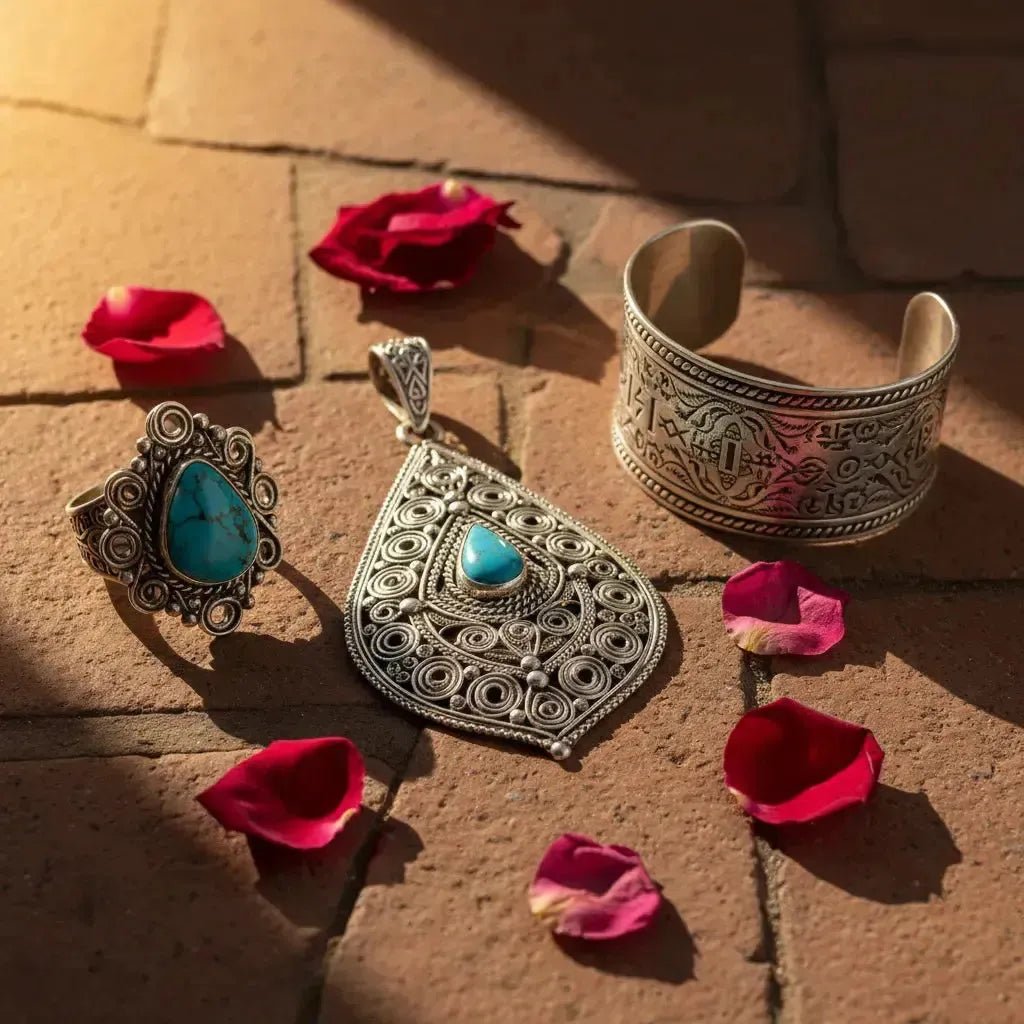
If one city were to embody the excellence of Moroccan silver jewelry, it would be Fez. The spiritual and intellectual capital of Morocco, Fez has been home for centuries to the country's most refined workshops—tiny boutiques in the medina's alleys where artisans have passed down their know-how from father to son for generations. The Fassi filigree—this work of braided silver wires soldered into extremely fine patterns—is considered one of the most sophisticated silversmithing techniques in the Islamic world.
Fez jewelry bears the imprint of Andalusia—the Hispano-Moorish civilization whose refugee artisans brought their expertise to Morocco after the Reconquista. The same geometric interlaces, the same stylized floral motifs, the same pursuit of formal perfection that characterized the art of Granada and Cordoba can be found in Fassi pendants and bracelets. It is a living heritage, carried in the hands of today's artisans.
The Berbers of Morocco: a monumental silversmithing tradition
Alongside the urban jewelry of Fez and Marrakech, Morocco has an extraordinarily rich Berber silversmithing tradition. Women from the tribes of the Atlas, Souss, and Rif wore monumental adornments of solid silver—voluminous, architectural pieces, where each element has a precise symbolic function.
Moroccan Berber fibulae were the centerpieces of female adornment. The Moroccan style is distinguished by its often more imposing dimensions, its inlays of red coral and yellow amber, and its remarkably complex geometric motifs. Wide embossed silver bracelets, necklaces of superimposed silver coins, diadems adorned with pendants—these pieces constitute an invaluable silversmithing heritage.
The stones of Moroccan jewelry
Traditional Moroccan jewelry is inseparable from its stones. Mediterranean red coral is the emblematic stone—omnipresent in Berber adornments, associated with protection and fertility. Yellow amber, imported for centuries via trans-Saharan routes, brings its golden warmth to the most precious compositions.
Turquoise holds a special place in the jewelry of southern Morocco—Tuareg and Saharan artisans use it abundantly in their creations, creating a striking contrast between the blue-green of the stone and the cold gleam of solid silver. Carnelian, the Prophet's stone, is also present in men's jewelry—rings and signet rings—where it brings its characteristic red-orange warmth.
The Fibula (Tizerzit): much more than a jewel
It is impossible to talk about Moroccan jewelry without dwelling on the fibula, called tizerzit in Berber. These monumental brooches, worn in pairs to hold the panels of traditional clothing, were not mere decorative accessories: they constituted a woman's mobile savings, her personal dowry, passed down from mother to daughter. A woman could judge her wealth and social status by the size and weight of her fibulae, often engraved with protective motifs believed to ward off the evil eye. Even today, some Moroccan Berber families carefully preserve these ancient pieces as irreplaceable family heirlooms.
Essaouira and Judeo-Moroccan jewelry
No overview of Moroccan jewelry would be complete without mentioning the Judeo-Moroccan tradition. For centuries, Jewish artisans in Morocco—concentrated particularly in Essaouira, Meknes, and the Souss—were the country's main producers of silver jewelry. This tradition, now weakened by emigration, has left a considerable heritage: filigree and granulation techniques of exceptional fineness, motifs that blend Hebrew symbols and Islamic motifs in a unique synthesis.
Judeo-Moroccan jewelry is now among the most sought-after pieces by collectors—objects that alone embody the richness of Moroccan civilization in its diversity and complexity.
A heritage that inspires the present
Traditional Moroccan jewelry is currently experiencing a remarkable revival. A new generation of Moroccan designers—trained in ancient techniques but open to contemporary influences—are reinterpreting this heritage in a modern language. 925 silver pieces that reference Berber motifs without copying them, that carry history without being museum pieces, that speak to a generation proud of its roots and open to the world.
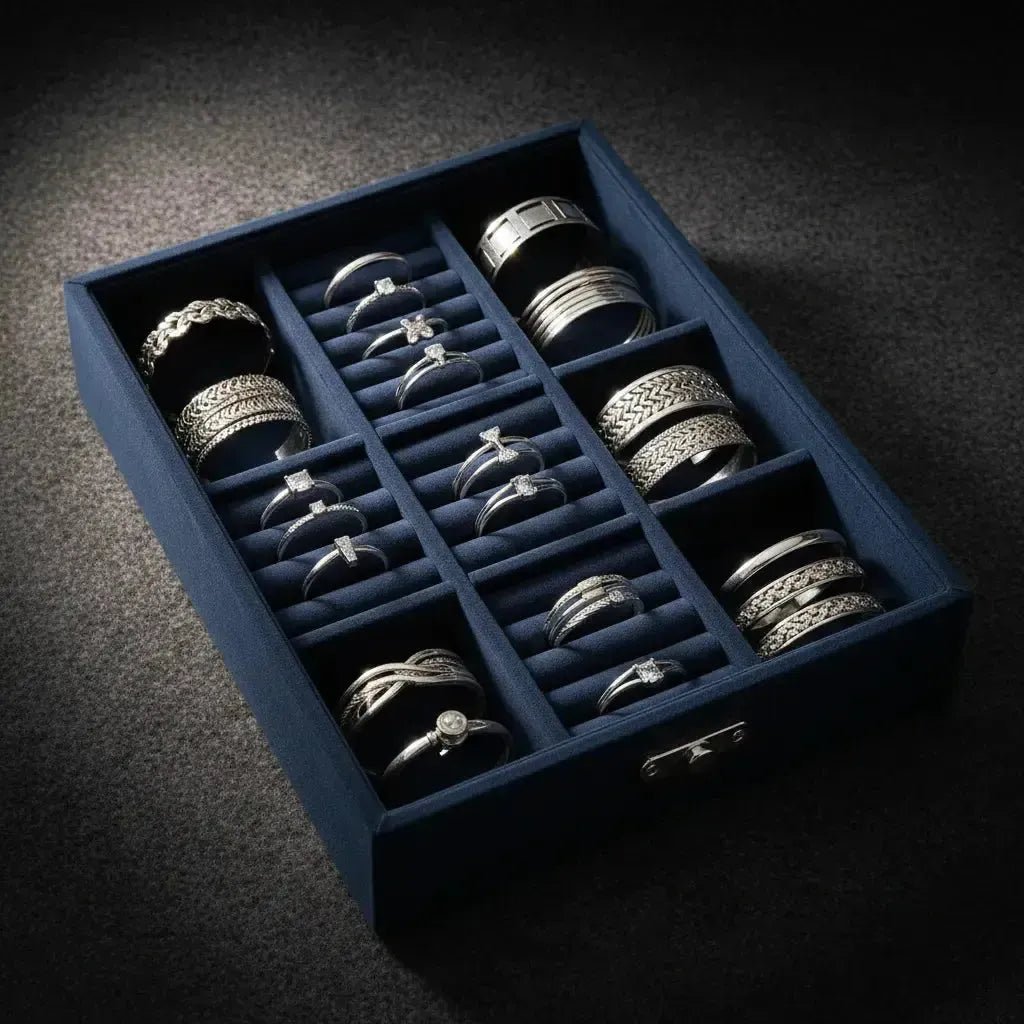
At Vindicta, we are part of this continuity. Our 925 silver jewelry with natural stones and our 925 silver men's rings draw inspiration from these millennia-old traditions to create timeless pieces.
✦ Vindicta — Solid 925 silver
The piece that makes the difference
Certified 925 silver · Free shipping from €69 · 10 years of excellence
Natural Stone Jewellery →




Leave a comment
This site is protected by hCaptcha and the hCaptcha Privacy Policy and Terms of Service apply.