Tunisian Sterling Silver Jewelry: Heritage, Craftsmanship, and Identity
Tunisia is a crossroads. For millennia, Phoenicians, Romans, Arabs, Ottomans, Andalusians, and Berbers have met, mingled, and settled there—each leaving their mark on the culture, language, architecture, and jewelry. Tunisian silver jewelry is a direct reflection of this extraordinarily rich history: it embodies centuries of encounters, exchanges, and creative syntheses unparalleled anywhere else in the Maghreb.
Carthage and the first goldsmiths
Even before Islam, Tunisia was already a land of goldsmiths. Carthage, founded by the Phoenicians in the 9th century BC, was one of the great metropolises of the ancient Mediterranean—and its artisans produced jewelry of remarkable sophistication. Pendants in the shape of the goddess Tanit, silver and gold amulets, earrings with geometric patterns: these pieces, found in Carthaginian necropolises, bear witness to a technical mastery that would influence North African jewelry for centuries.
With the arrival of Islam in the 7th century, followed by successive Arab and Berber dynasties, Tunisian jewelry reinvented itself without losing its essence. Geometric motifs inherited from antiquity merged with Islamic arabesques. Silver, the metal of baraka, became the noble material par excellence for everyday and special occasion jewelry.
Sfax, Djerba, Tunis: three silver capitals
Tunisia does not have one jewelry tradition—it has several, depending on the regions and communities that shaped them.
Tunis, the Ottoman capital since the 16th century, developed refined goldsmithing under Turkish and Andalusian influence. Artisans in the medina produced elaborate female adornments—tiaras, multi-strand necklaces, wide nielloed silver bracelets—intended for the city's wealthy bourgeois families. These exceptionally fine pieces bear the imprint of Ottoman art in their floral motifs and enameling techniques.
Sfax and its region are renowned for their solid silver jewelry with architectural forms—heavy pieces, built to last, where the quantity of silver itself is a sign of wealth and status. Sfaxian women traditionally wore complete sets of adornments for weddings: fibulae, necklaces, bracelets, ornate anklets—an ensemble that could represent a considerable fortune and constituted a form of family savings passed down from generation to generation.
Djerba, an island off the Tunisian coast, is home to one of the oldest Jewish communities in North Africa—and with it, a goldsmithing tradition of exceptional richness. For centuries, Jewish jewelers in Djerba produced the finest silver pieces in the region, mastering filigree and granulation techniques inherited from antiquity. This tradition, now fragile due to emigration, remains one of the most precious in the entire Mediterranean basin.
Stones and symbols in Tunisian jewelry
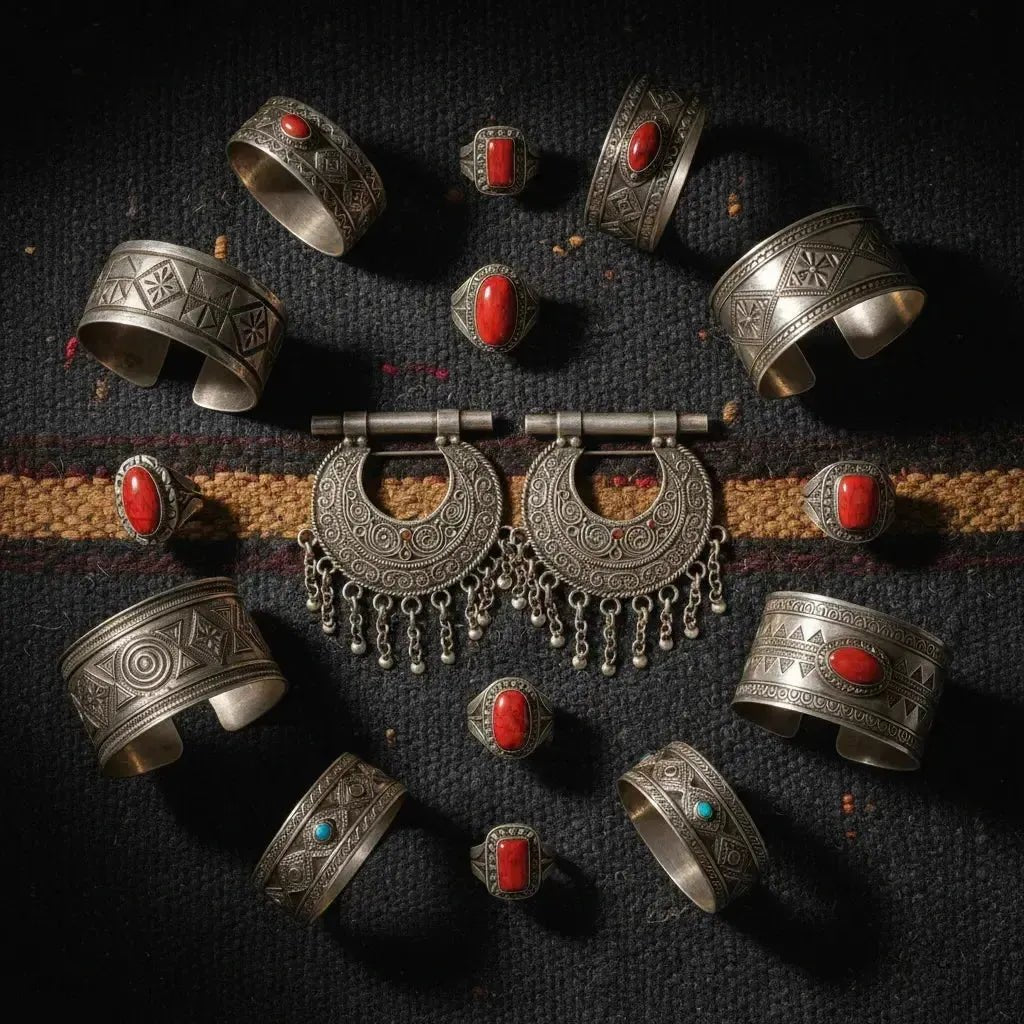
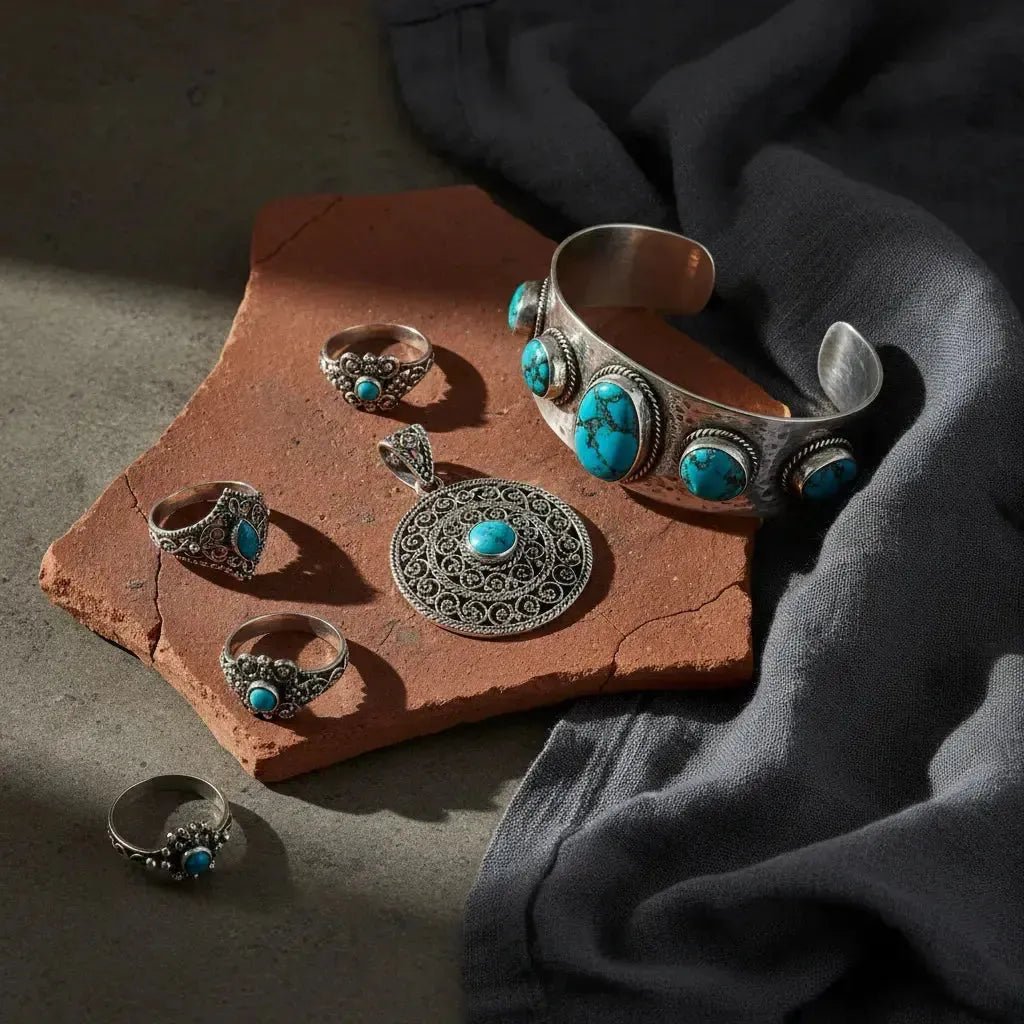
As in all Maghrebi jewelry, natural stones play a central role in the Tunisian tradition. Red Mediterranean coral is ubiquitous—it is found in bridal adornments, protective necklaces, and bracelets worn by children to ward off the evil eye. Turquoise, imported from Persia and Anatolia via Ottoman trade routes, adorns both men's and women's jewelry with its soothing blue-green hues.
The symbol of the Hand of Fatima—the Khamsa—is particularly present in Tunisian jewelry, where it appears as pendants, earrings, and brooches. The fish, a symbol of fertility and protection against the evil eye, is another recurring motif found engraved on rings and bracelets. These symbols are not mere ornaments: they constitute a shared visual language, understood by all, that transforms each piece of jewelry into an object of social and spiritual communication.
A living craft that reinvents itself
Contemporary Tunisian jewelry is at a crossroads. Traditional workshops in the medina of Tunis, Sfax, or Nabeul perpetuate ancestral techniques but face competition from imported industrial jewelry. At the same time, a new generation of Tunisian designers are embracing this heritage to reinterpret it in a modern language—925 silver pieces that reference traditional motifs without copying them, that carry history without being museum pieces.
Wearing a 925 silver jewel inspired by this tradition is participating in this continuity. At Vindicta, we select pieces that honor this rich Mediterranean heritage. Discover our selection of 925 silver jewelry with natural stones and our turquoise jewelry to explore this world.
✦ Vindicta — Argent 925 Massif
La pièce qui fait la différence
Certifié argent 925 · Livraison offerte dès 69€ · 10 ans d'excellence
Bijoux Orientaux Argent 925 →