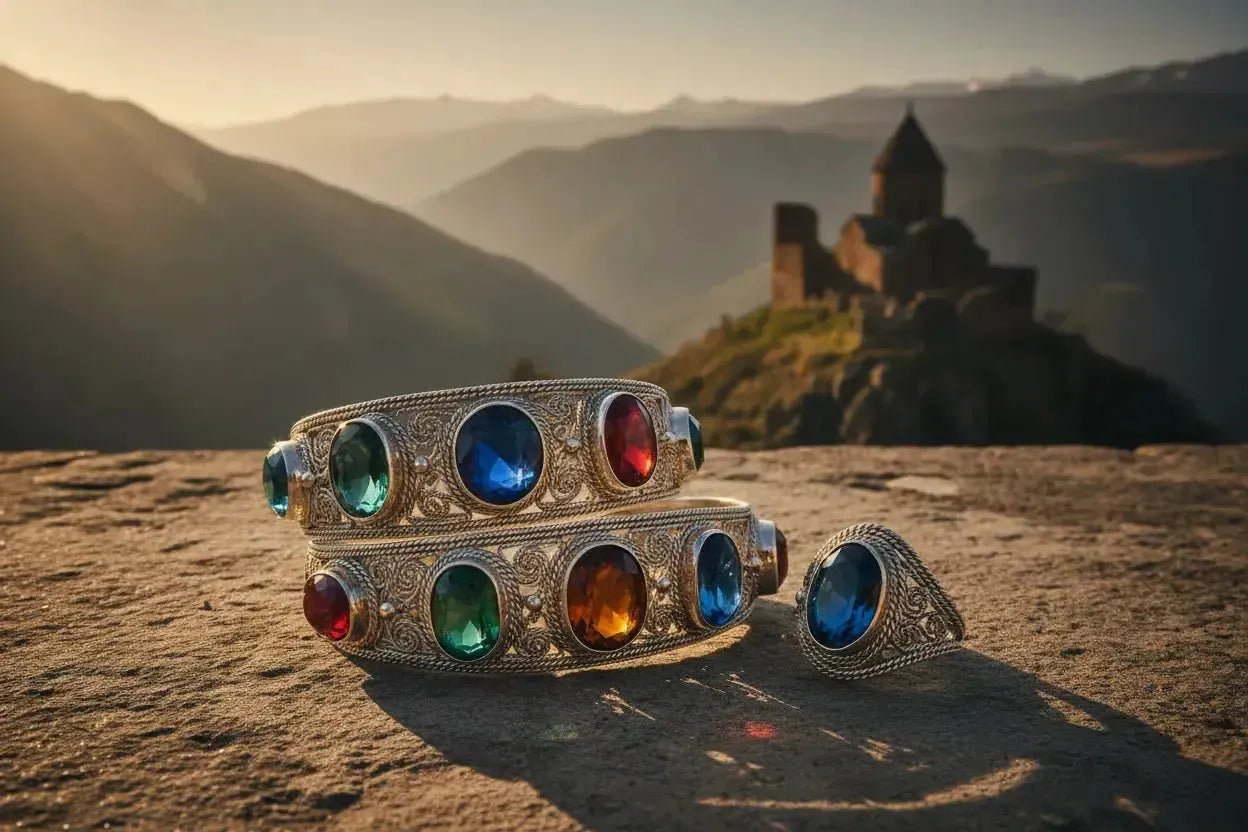

The Woman Knight and the European Aristocracy: Lineage, Power, and Legacy
In Europe, the signet ring was not just a piece of jewelry. It was a document. For centuries, it served as a seal, proof of identity, a sign of rank, and a means of transmitting lineage. Understanding its history within the European aristocracy is to understand how a simple ring could concentrate so much symbolic power.
The Origins: The Seal Ring of Antiquity
The seal ring — the signet ring in English, the annulus signatorius in Latin — dates back to ancient Egyptian and Mesopotamian times. But it was Rome that made it a systematic instrument of power. In the Roman Republic, only senators and knights — the equestrian order — had the right to wear a gold ring. Ordinary citizens wore iron. The ring was a visible mark of status, immediately legible to everyone.
With the fall of Rome and the emergence of Germanic kingdoms, this tradition transformed. Frankish, Visigothic, and Ostrogothic kings adopted the seal ring as an instrument of government. The king's seal authenticated charters, donations, and treaties. Without it, no document had legal value. The ring was literally power itself.
The Middle Ages: The Signet Ring as a Noble Identity
It was in the Middle Ages that the signet ring took on its most characteristic form and meaning within the European aristocracy. The feudal system created a strict hierarchy — king, dukes, counts, barons, knights — and each level of this hierarchy had its own distinctive signs. The ring was part of this.
The bezel of the signet ring bore the family's coat of arms — the shield, heraldic charges, the motto. These armorial bearings were unique to each noble family, registered and protected by heralds of arms. To affix one's seal to a document was to pledge one's word, one's honor, and that of one's family. To falsify this seal was a capital crime.
The transmission of the signet ring followed precise rules. Upon the lord's death, his seal ring was broken — to prevent it from being used fraudulently. A new ring was then engraved for the heir. This ritual of destruction and recreation is a powerful metaphor for the continuity of lineage through generations.
The Renaissance: The Golden Age of the Aristocratic Ring
The Italian Renaissance transformed the signet ring. Great families — the Medici in Florence, the Sforza in Milan, the Este in Ferrara — commissioned rings of unprecedented sophistication. The best goldsmiths of the era — Benvenuto Cellini foremost among them — created pieces that were as much works of art as instruments of power.
The aristocratic ring of the Renaissance was no longer just a seal. It became an object of representation, a sign of culture and refined taste. Precious stones — rubies, emeralds, sapphires — were added to the engraved coats of arms. The ring simultaneously stated "who I am" and "what I am worth."
In France, Francis I and Henry II wore rings of extraordinary richness. In England, the Tudors — Henry VIII in particular — are depicted in their portraits with massive rings on every finger. The ring had become a central element in the representation of royal power.
The Modern Era: The Signet Ring as Family Heritage
With the development of the modern state and the gradual disappearance of the feudal system, the signet ring lost its administrative function. It was no longer necessary to authenticate documents — notaries, official registers, and written signatures took over. But it retained its symbolic value.
In the 18th and 19th centuries, the signet ring became, above all, an object of family transmission. It passed from father to son, from generation to generation, bearing the family coat of arms as a visible link to ancestors. In prominent European aristocratic families — English, French, Austrian, Russian — the signet ring was as much an heirloom as it was jewelry.
In England, this tradition is particularly vibrant. The signet ring continues to be worn by members of the royal family and aristocracy to this day. King Charles III wears a signet ring on the little finger of his left hand — an unbroken tradition for centuries.
Heraldry: The Language of Coats of Arms
To understand the aristocratic signet ring, one must understand heraldry — the science of coats of arms. Each element of the blazon has a precise meaning: the colors — gold, silver, azure, gules, sable — the figures — lion, eagle, fleur-de-lis, cross — and their arrangement on the shield.
The lion is the most common heraldic figure in Europe — a symbol of courage, strength, and royalty. The eagle — with one or two heads — is the symbol of empires, from the Holy Roman Empire to Tsarist Russia. The fleur-de-lis is the emblem of French royalty. The cross is the symbol of Christian faith and orders of chivalry.
These figures, engraved in intaglio on the bezel of the signet ring, allowed the seal to be impressed into wax. The intaglio engraving is therefore the reverse of what is seen on the ring — what appears in relief on the seal is in intaglio on the ring. This is a demanding engraving technique, requiring perfect mastery of the tool and the metal.
The Signet Ring Today: Heritage Without Protocol
The contemporary signet ring no longer has a heraldic or administrative function. But it retains something of this history — the idea that a ring can carry an identity, a heritage, a self-affirmation that goes beyond mere adornment.
Wearing a 925 silver signet ring today means becoming part of this millennia-old tradition — without needing its protocol. It means choosing a piece that has meaning, that says something about who you are and what you value. Not a fashion accessory. A piece of jewelry with character.
Complete History of the Men's Signet Ring · The Signet Ring in the Ottoman Empire · Men's 925 Silver Signet Ring Collection
✦ Vindicta — Argent 925 Massif
La pièce qui fait la différence
Certifié argent 925 · Livraison offerte dès 69€ · 10 ans d'excellence
Chevalières Homme Argent 925 →