The Female Knight in the Ottoman Empire: Power, Faith, and Imperial Legacy
When we talk about men's jewelry in history, few civilizations have elevated the ring to the status it enjoyed in the Ottoman Empire. For six centuries—from 1299 to 1922—the signet ring was much more than an ornament in Ottoman lands. It was a seal, a declaration of faith, a sign of rank, and sometimes an instrument of power. Understanding the Ottoman signet ring means understanding something essential about this civilization.
The Ring as the Sultan's Seal
In the Ottoman Empire, the sultan's ring was not jewelry—it was an instrument of government. The sultan wore a signet ring—the mühür—engraved with his tughra, his official calligraphic signature. Placing this seal on a document was to authenticate it with imperial authority. No firman, no decree, no appointment was valid without it.
This tradition dates back to the first Ottoman sultans. Osman I, the founder of the dynasty, already wore a signet ring. Suleiman the Magnificent—Kanuni Sultan Süleyman—owned several, some adorned with exceptionally large rubies and emeralds. These rings are now preserved in the treasury of the Topkapi Palace in Istanbul.
But the seal was not reserved for the sultan. Viziers, pashas, cadis—all high officials of the Empire wore their own signet rings, engraved with their name or title. The ring was their signature, their official identity. Losing it or having it stolen was an administrative and personal catastrophe.
The Spiritual Dimension: The Sunnah of the Prophet
In Islamic tradition, wearing a silver ring is a sunnah—a practice recommended by the Prophet Muhammad. According to hadiths, the Prophet wore a silver ring on the little finger of his right hand, with a carnelian stone. This practice deeply influenced men's jewelry throughout the Islamic world, and the Ottoman Empire was no exception.
Carnelian—akik in Arabic and Turkish—was the preferred stone for Ottoman sultans for their religious rings. From blood red to burnt orange, it was considered a stone of protection and baraka (blessing). Sultans often wore several, on different fingers, for different occasions—one for religious ceremonies, one for official audiences, one for military campaigns.
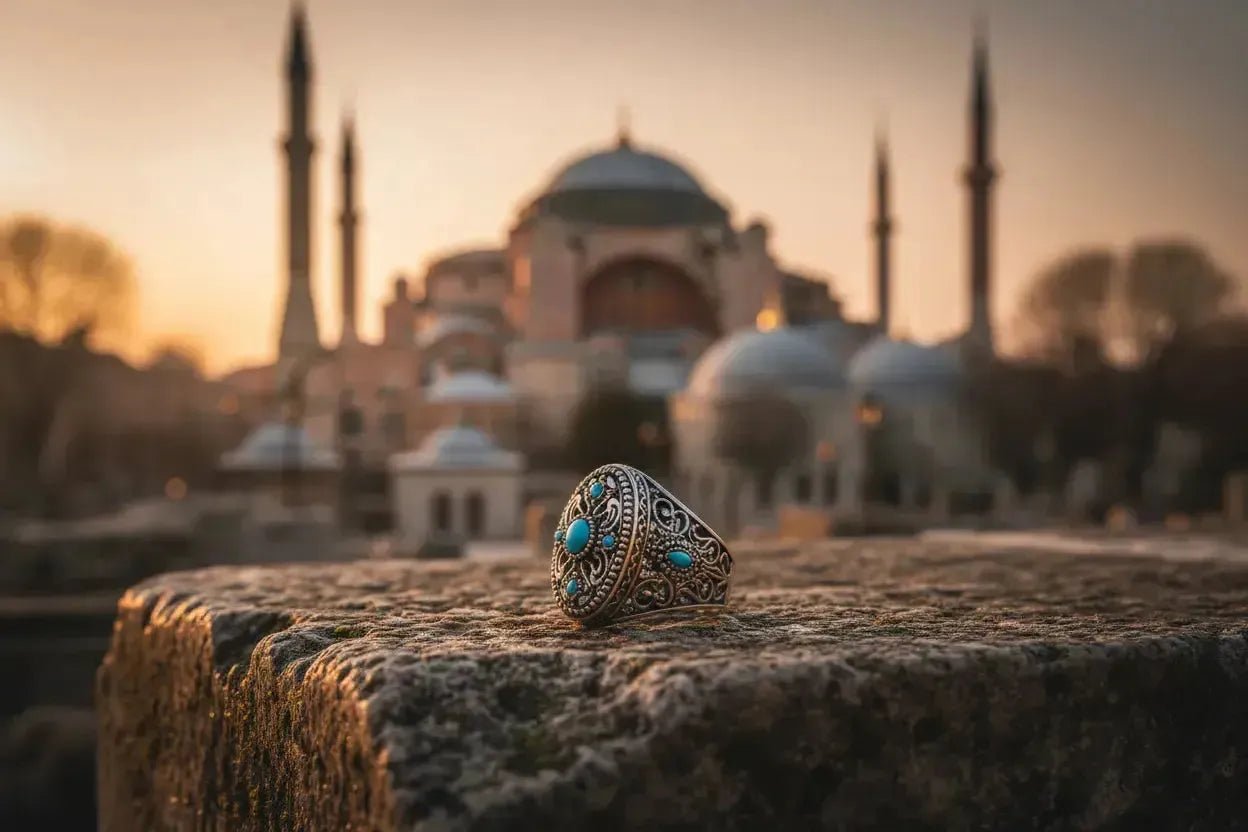
Turquoise—firuze in Turkish—was also highly prized. As a protective stone par excellence in Turco-Mongol traditions, it adorned the armor, sabers, and rings of Ottoman warriors. It was believed to protect its wearer from injuries in battle and the evil eye.
The Court Artisans: The Palace Jewelers
The quality of Ottoman jewelry was no accident. Topkapi Palace housed artisan workshops—the ehl-i hiref, the "people of skill"—specializing in goldsmithing, setting, and engraving. These artisans came from all over the Empire and beyond—Persians, Arabs, Greeks, Armenians, Jews—attracted by the prestige and generosity of the Ottoman Court.
The techniques they mastered were remarkably sophisticated. Tel kâri—filigree—allowed for the creation of extremely delicate patterns by twisting silver or gold wires. Savat—niello—consisted of inlaying a black alloy into engravings to highlight the motifs. Mine—enamel—brought vivid colors to metal surfaces. These techniques are still practiced today by artisans in Istanbul's Grand Bazaar.
The Janissary Signet Ring
The Janissaries—the elite military of the Ottoman Empire—had their own relationship with the ring. An elite corps created in the 14th century, the Janissaries were professional soldiers trained from childhood to serve the sultan. Their collective identity was strong, and their jewelry reflected this.
Janissary rings were massive, geometric, often engraved with military or religious symbols. No precious stones—these were reserved for officers and dignitaries. But solid silver, carefully crafted, bearing Quranic inscriptions or protective motifs. The Janissary's ring was as much his talisman as his ornament.
Stones and Their Meanings in Ottoman Tradition
Each stone had a specific meaning in Ottoman culture, inherited from Islamic, Persian, and Turco-Mongol traditions.
Carnelian was the stone of faith and protection—worn by pious men and warriors. Lapis lazuli was the stone of wisdom and authority—reserved for scholars and high officials. Turquoise was the stone of protection in combat—worn by soldiers and horsemen. Garnet was the stone of passion and loyalty—given between men as a sign of friendship and alliance.
Black onyx held a special place: a stone of strength and protection against the evil eye, it was worn by men who wanted to protect themselves from envious people and enemies. In an empire where court intrigues were common, this was a very practical concern.
The Ottoman Legacy in Contemporary Jewelry
The Ottoman Empire disappeared in 1922, but its jewelry aesthetic lives on. Turkey is today one of the world's leading producers of 925 sterling silver jewelry, and Ottoman motifs—arabesques, tulips, crescents, calligraphy—are still at the heart of production.
At Vindicta, this heritage is central. Our 925 sterling silver signet rings are part of this tradition—massive, crafted pieces, rich in meaning. Not fashion jewelry, but character jewelry that carries a story.
Wearing a 925 sterling silver signet ring with carnelian or turquoise today means being part of a tradition that dates back to the sultans of Constantinople. That is the legacy.
Complete history of the men's signet ring · Ottoman jewelry: heritage of the sultans · Men's signet ring collection · Oriental jewelry collection
✦ Vindicta — Argent 925 Massif
La pièce qui fait la différence
Certifié argent 925 · Livraison offerte dès 69€ · 10 ans d'excellence
Bijoux Orientaux Argent 925 →