15 Men's Oriental Rings in 925 Silver: The Heritage of the Sultans
There exists a men's jewelry that has nothing to do with Western trends. Jewelry that comes from Ottoman palaces, Cordoba souks, Persian caravans. Pieces that carry centuries of history and craftsmanship. This is the jewelry that Vindicta has been selecting since 2016.
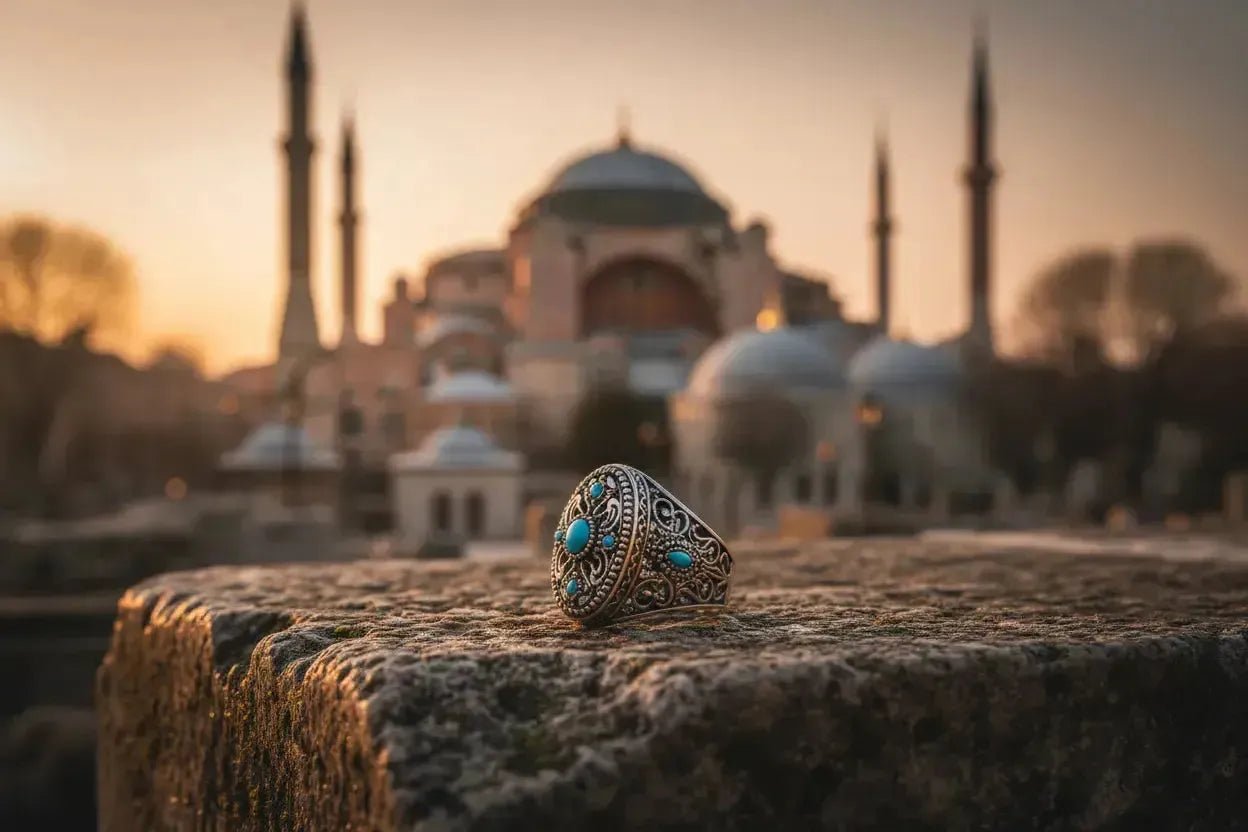
Here are 15 solid 925 sterling silver oriental rings for men — categorized by cultural universe, highlighting the uniqueness of each piece.
The Ottoman Heritage: Imperial Power
The Ottoman Empire produced some of the most beautiful men's jewelry in history. Sultans wore massive rings of silver and precious stones as symbols of power and faith. This tradition is alive — Turkey remains today one of the world's leading producers of 925 sterling silver jewelry.
1. The Carnelian Sultan Style Ring
Carnelian is the stone of the Prophet and sultans. Blood red to burnt orange, translucent, warm — it has been worn by the greatest rulers of Islam for millennia. Mounted on a massive 925 sterling silver bezel with chiseled engravings on the shoulders, it is a piece that carries all this history. Carnelian protects, gives vitality, and strengthens confidence — three qualities that sultans sought in their jewelry.
2. The Persian Turquoise Oval Plate Ring
Persian turquoise is one of the oldest and most sacred stones of the Orient. Its unique blue-green — the color of the sky above the desert — was considered a shield against the evil eye. Ottoman sultans adorned their armor, sabers, and rings with it. On an oval 925 sterling silver plate with chiseled fillets, it has a sober and powerful beauty.
3. The Ottoman Tulip Motif Ring
The tulip is the symbol of the Ottoman Empire — found on Iznik tiles, court carpets, imperial embroideries. Engraved in relief on an oxidized 925 sterling silver plate, it creates a piece of remarkable finesse. It is the jewelry of the man who knows history and chooses to wear it.
4. The Crescent and Star Ring
The crescent and star are the symbols of Islam and the Ottoman Empire. On a 925 sterling silver ring, they create a piece that is both spiritual and aesthetic. Simple, legible, powerful — it is a ring that says something about your identity without needing explanation.
5. The Black Onyx Ottoman Style Ring
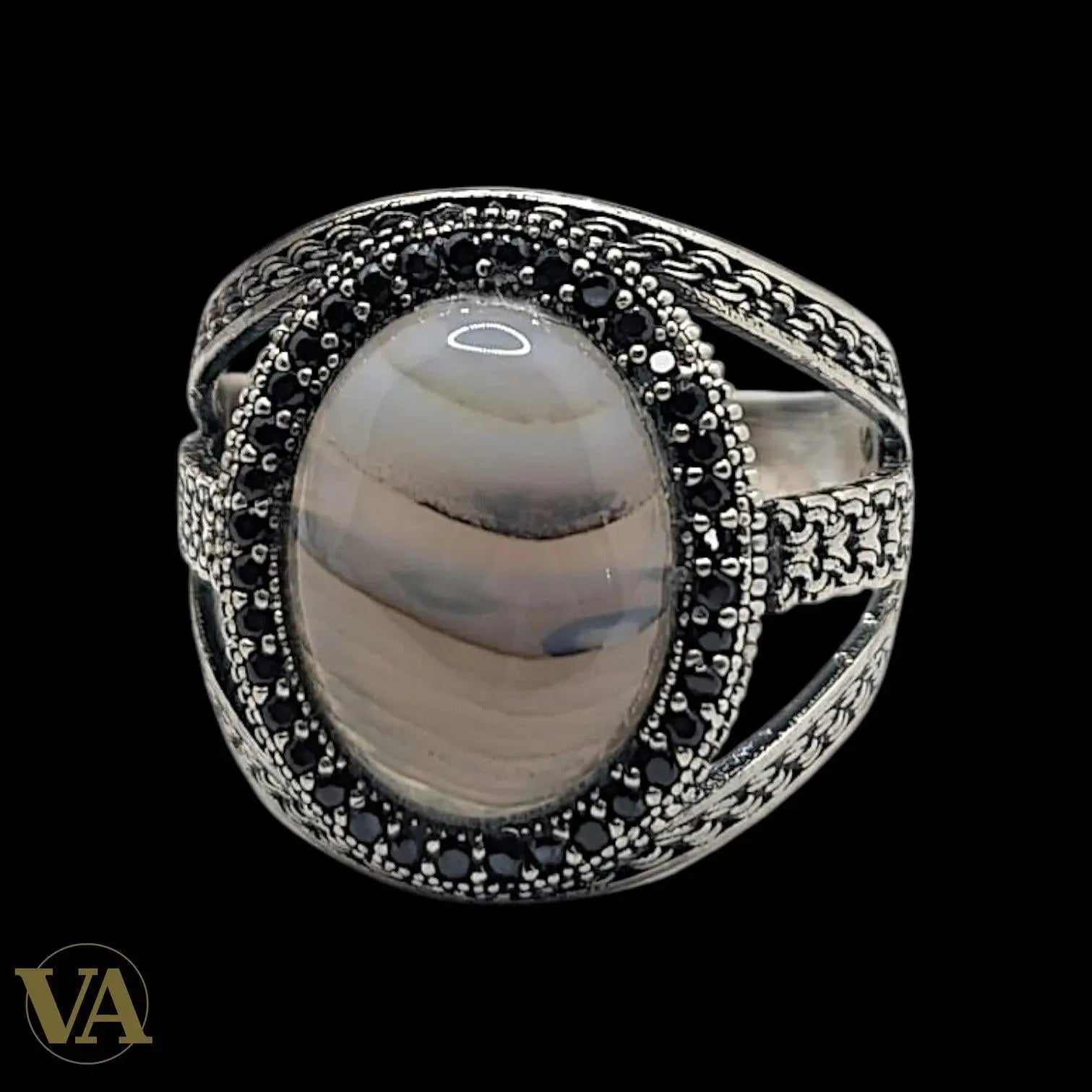
Black onyx in the Ottoman tradition is a stone of protection and strength. Mounted on a massive bezel with worked shoulders — filigree, arabesques, geometric patterns — it gives a ring of remarkable presence. The contrast between the absolute black of the stone and the worked silver is striking.
The Andalusian Heritage: Refinement and Synthesis
Al-Andalus — Muslim Spain — was for five centuries the intellectual and artistic center of the West. Andalusian jewelry is the result of a unique synthesis of Arab, Berber, Roman, and Visigothic traditions. It possesses a finesse that few traditions can match.
6. The Filigree Ring
Filigree is one of the most demanding jewelry techniques. 925 sterling silver wires are hand-woven and soldered to form extremely delicate patterns. On a ring, the result is a piece that seems almost unreal — as visually light as it is massive in hand. It is craftsmanship at its highest level.
7. The Deep Red Garnet Ring
The deep burgundy red garnet, almost purple under certain lights, is of rare elegance. On a 925 sterling silver ring with chiseled engravings, it is a piece of historical beauty.
8. The Arabic Calligraphy Ring
Arabic calligraphy is considered the highest visual art of Islamic civilization. Engraved on a 925 sterling silver plate — a verse, a word, a name — it transforms a ring into an object of meditation. It is a deeply personal piece, carrying a meaning that only its wearer fully knows.
9. The Islamic Geometric Motifs Ring
Islamic geometric motifs — stars, hexagons, interlaces — transposed onto a 925 sterling silver plate create a ring of striking modernity. Islamic geometry has not aged a day.
The Persian Heritage: Sophistication and Depth
Persia — present-day Iran — is one of the oldest jewelry civilizations in the world. Achaemenid kings, Abbasid caliphs, Safavid shahs — all wore jewelry of a sophistication that few cultures can match.
10. The Imperial Lapis Lazuli Ring
Lapis lazuli comes from the mines of Badakhshan in Afghanistan — the same mines exploited for 6,000 years. Its night blue speckled with gold is unique in the world. In the Persian tradition, it is the stone of the sky and truth. On a massive 925 sterling silver ring, it has an immediate royal presence.
11. The Two-Tone Turquoise and Carnelian Ring
The combination of turquoise and carnelian is one of the oldest chromatic combinations in oriental jewelry — the blue-green of turquoise against the red-orange of carnelian. On a 925 sterling silver ring with two stones facing each other, the result is a remarkable visual richness.
12. The Nazar Eye Protection Ring
The Nazar eye — the protective blue eye — has been present in all Mediterranean and oriental cultures since antiquity. On a 925 sterling silver ring with an enamel blue eye or turquoise, it is as much a talisman as a piece of jewelry.
The Berber Heritage: Nomadic Strength
Berber jewelry is among the most powerful in men's jewelry. Massive, geometric, loaded with symbols — it comes from a tradition where jewelry was as much armor as ornament.
13. The Berber Geometric Motifs Ring
Berber geometric motifs — rhombuses, triangles, broken lines — are symbols of protection and identity. Engraved on a massive 925 sterling silver plate, they give a ring of raw strength and rare authenticity.
14. The Maghrebi Style Carnelian Ring
In the Maghrebi tradition, carnelian is the sacred stone par excellence — worn for protection, vitality, and baraka. On a 925 sterling silver ring with geometric engravings on the shoulders, it unites two traditions in a single piece.
15. The Solid Silver Khamsa Ring
The khamsa — the hand of Fatima — is the most widespread protective talisman in the Mediterranean and oriental world. Present in Jewish, Muslim, and Christian traditions, it transcends religious boundaries. On a solid 925 sterling silver ring, sculpted in relief, it is both a piece of jewelry and a shield.
Wearing an Oriental Ring: Some Guidelines
Oriental rings are generally more massive than Western rings — it's in their nature. They are worn alone, without trying to associate them with other rings. A single strong piece is better than three average pieces. In Islamic tradition, the ring is worn on the little finger or ring finger of the right hand. To understand oriental stones, their history, and their virtues, our complete guide to natural stones is the reference. And for the care of your 925 sterling silver jewelry, our care guide covers everything you need to know.
Discover our entire selection in our men's 925 sterling silver rings collection — signet rings, natural stone rings, and chiseled pieces.
And to complete your wrist style, discover our men's 925 sterling silver bracelets — carnelian, turquoise, onyx, and natural stones in certified solid 925 sterling silver.
✦ Vindicta — Argent 925 Massif
La pièce qui fait la différence
Certifié argent 925 · Livraison offerte dès 69€ · 10 ans d'excellence
Bijoux Orientaux Argent 925 →