

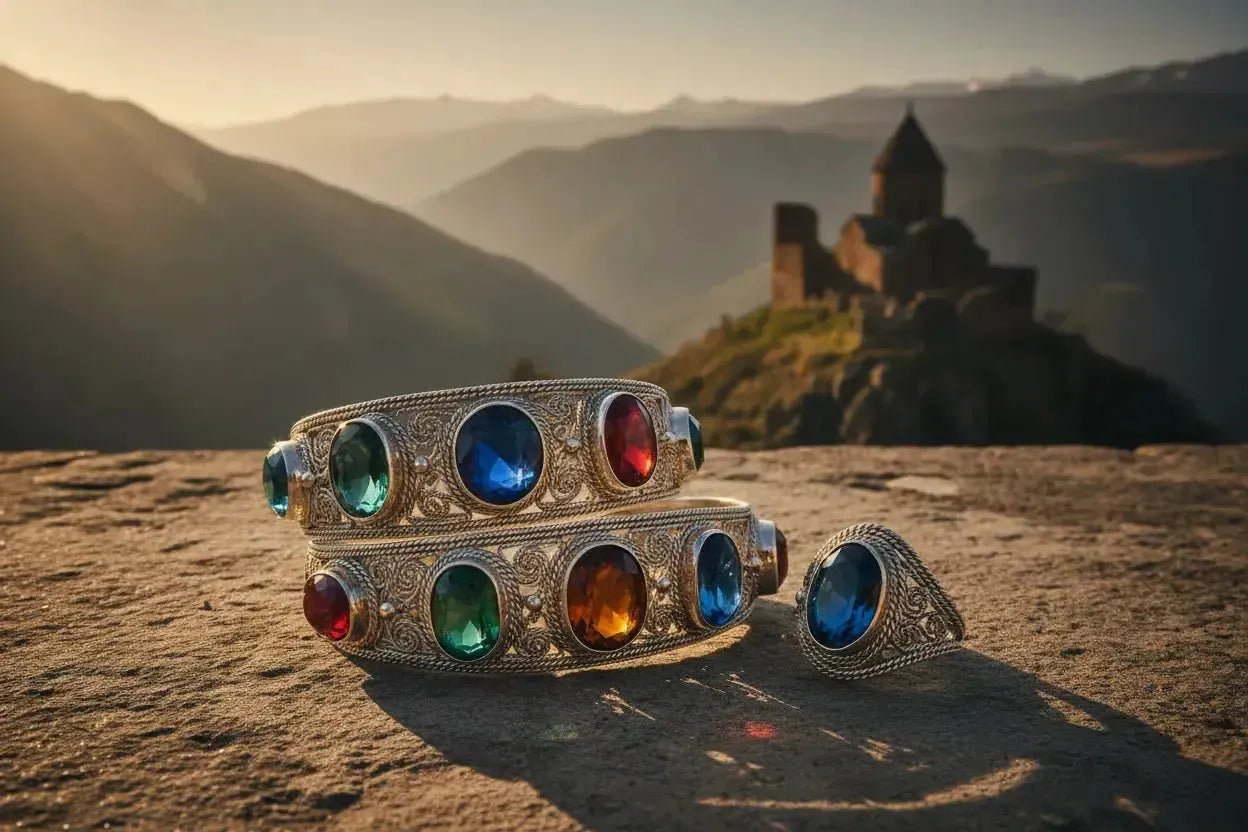
Georgian and Armenian Silver: Caucasian 925 Sterling Silverwork
Between the Black Sea and the Caspian Sea, between Europe and Asia, the Caucasus is one of the oldest and most overlooked cradles of global silversmithing. Georgia and Armenia—two of the world's oldest Christian nations—have developed over the centuries a jewelry tradition in solid 925 sterling silver of exceptional originality and richness. A crossroads of civilizations, the Caucasus has absorbed and synthesized Byzantine, Persian, Ottoman, and Slavic influences to create something unique: a silversmithing that is both Eastern and Christian, wild and refined, ancient and timeless.
At Vindicta, a fine jewelry house specializing in 925 sterling silver with over 10 years of excellence, we draw on these intersecting traditions to select pieces that tell a story—jewelry with character, certified, and destined to last.
Georgia: Three Thousand Years of Silver Craftsmanship
Georgia is one of the world's oldest countries in terms of precious metal work. Archaeological excavations in the Colchis region—the legendary destination of Jason and the Golden Fleece—reveal solid gold and silver jewelry dating back over 3,000 years. The legend of the Golden Fleece itself is linked to the ancient Georgian gold panning technique: shepherds used sheepskins to capture gold and silver flakes in the rivers of the Caucasus.
After the Christianization of Georgia in the 4th century—one of the first nations to adopt Christianity—Georgian silversmithing developed in two simultaneous directions: liturgical objects in solid silver for churches and monasteries, and personal jewelry for the nobility and warriors.
Signature Techniques of Georgian Silversmithing
Georgian 925 sterling silver jewelry is distinguished by several unique techniques:
- Georgian niello—darker and deeper than Russian niello, it creates striking contrasts on solid silver
- Caucasian filigree—silver threads woven into complex geometric patterns, influenced by both Byzantium and Persia
- Fine granulation—tiny silver beads soldered to the surface, a technique inherited from Colchian antiquity
- Inlay of colorful stones—turquoise, carnelian, garnet, lapis lazuli—in solid silver settings with organic shapes
- Narrative chasing—hunting scenes, battles, figures of saints engraved with remarkable precision
Armenia: The Silversmithing of Resilience
Armenia, the first nation to adopt Christianity as its state religion in 301 AD, developed a silversmithing tradition intimately linked to its faith and its resilience in the face of successive invasions. Armenian silver is the silver of survival and preserved identity—jewelry was often the only possession families could take with them during exiles and forced displacements.
This painful history has given Armenian silversmithing a unique symbolic depth. Each piece of solid 925 sterling silver jewelry is an act of remembrance, a refusal of oblivion, an affirmation of identity. Armenian motifs—the pomegranate (symbol of fertility and resilience), the tree of life, the Armenian cross with flowered ends—are engraved in silver as if in stone: for eternity.
The Crossroads of Influences: What Makes the Caucasus Unique
What fundamentally distinguishes Caucasian silversmithing from all other Eastern European traditions is its position as a crossroads between several worlds:
- Byzantine influence—filigree, cloisonné enamel, Christian iconography
- Persian influence—complex floral motifs, colorful stones, a sense of ornamental detail
- Ottoman influence—rigorous geometry, deep niello, massive men's jewelry
- Slavic influence—ancestral symbolism, protective stones, power signet rings
This unique synthesis produces solid 925 sterling silver jewelry of absolute originality—recognizable among all, impossible to confuse with any other jewelry tradition.