The Eastern Star in 925 Sterling Silver — Symbol, History, and Style
The star is one of humanity's oldest symbols. Before compasses, before maps, people navigated, traveled, and found their way by the stars. It's no wonder they became symbols of guidance, protection, and divine power in almost every culture. In the East, this symbolism took on particularly rich forms—and 925 sterling silver jewelry is one of its most eloquent vectors.
At Vindicta, the Eastern star is a recurring motif in our selection. Engraved, cut out, set, or represented in relief on solid 925 sterling silver, it brings a symbolic dimension to each piece that few other motifs can claim.
The different Eastern stars and their meanings
There isn't just one Eastern star, but several—each with its own geometry, cultural origin, and specific meaning. Understanding these differences means understanding what you're wearing.
The eight-pointed star — Rub el Hizb. This is the quintessential Islamic star. Formed by two squares superimposed and rotated 45 degrees relative to each other, it has appeared in mosque architecture, Quranic manuscript illuminations, and Persian carpet designs since the 7th century. The number eight represents the eight angels who support the divine Throne according to Islamic tradition. In Ottoman and Andalusian jewelry, it is omnipresent—engraved on sultans' signet rings, inlaid in sword guards, depicted on official seals.
The six-pointed star — Seal of Solomon. Called Khatam Sulayman in Arabic, this star, formed by two interlaced triangles, is common to Islam, Judaism, and certain Eastern Christian traditions. In Islamic tradition, it is associated with the Prophet Solomon and his power over djinns and invisible forces. It frequently appears in Moroccan, Algerian, and Turkish jewelry as a symbol of protection and wisdom.
The Berber star — Agerruj. In the Amazigh traditions of the Maghreb, the five- or six-pointed star is a fundamental protective motif. It is found in traditional Berber tattoos, Kabyle carpet patterns, and Tuareg silver jewelry. It protects against the evil eye, guides travelers, and symbolizes the unity of tribes. In Tuareg jewelry—made entirely of silver, never gold—the star is one of the most meaningful motifs.
The four-pointed star — symbol of the East. Simpler, more geometric, the four-pointed star represents the four cardinal points, the four elements, the four seasons. In Islamic art, it is often the starting point for arabesque motifs—a central star from which infinite intertwining patterns radiate.
The Eastern star in the history of men's jewelry
Eastern men's jewelry has always been a language. Ottoman sultans wore signet rings engraved with stars—these rings served to authenticate official documents and affirm the wearer's authority. Andalusian emirs adorned their signet rings with star motifs inspired by the architecture of the Alhambra. Tuareg chiefs wore silver amulets engraved with Berber stars as signs of rank and protection.
This was not mere decoration. It was communication—a system of signs that the initiated knew how to read. Wearing an eight-pointed star meant displaying one's belonging to the Islamic tradition and connection to the divine. Wearing the Seal of Solomon meant claiming wisdom and protection against unseen forces.
Today, these motifs are returning to contemporary jewelry for similar reasons: men who wear them are looking for jewelry with meaning, not just aesthetics. The Eastern star in 925 sterling silver is an answer to this demand.
How to wear an Eastern star piece of jewelry
The Eastern star is a strong motif—it stands out without needing to be accompanied. Here are a few principles for wearing it appropriately:
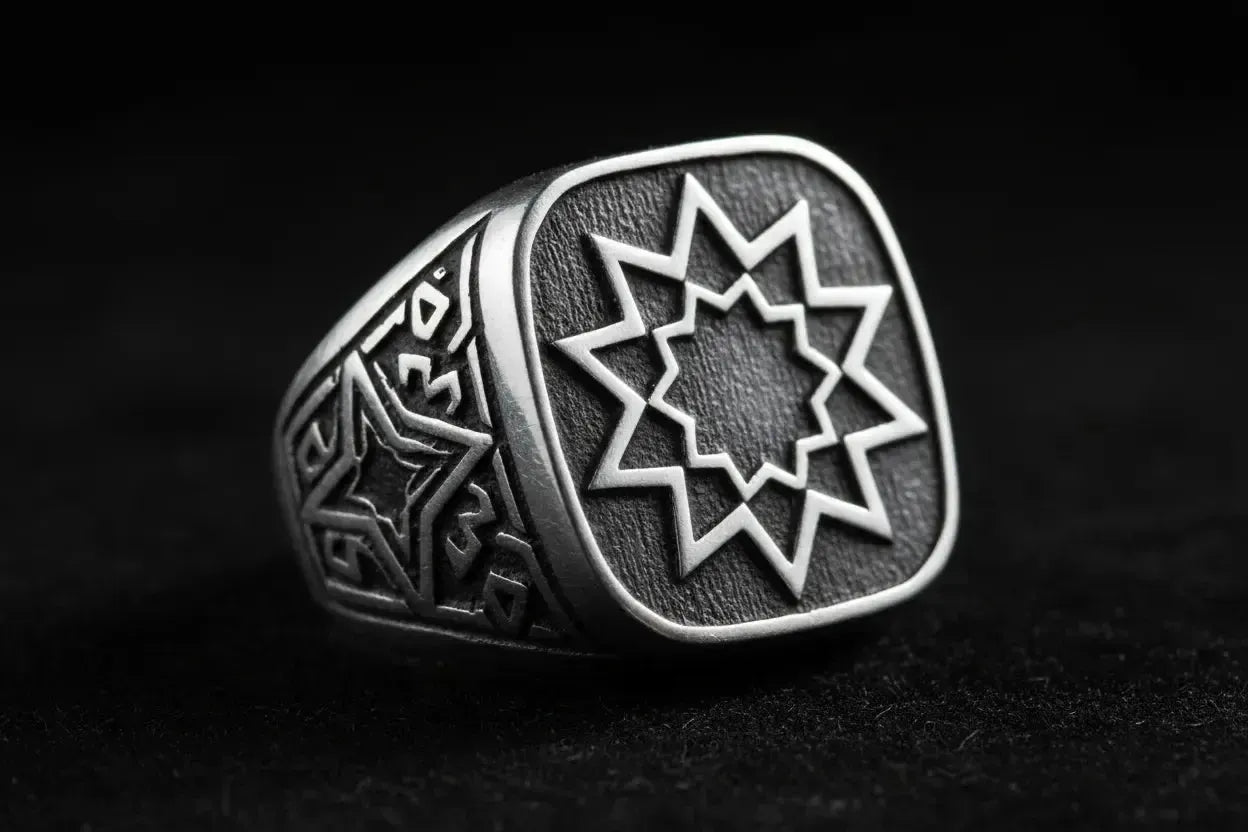
As a signet ring. This is the natural medium for the Eastern star. The wide plate allows the motif to be represented in all its geometric complexity. An eight-pointed star signet ring in oxidized 925 sterling silver is a self-sufficient piece—no need for other rings on the same hand.
As a pendant. The Eastern star as a pendant on a 925 sterling silver chain is a more discreet alternative—worn under a shirt, it remains personal. Worn outwardly, it makes a statement.
Associations. The Eastern star pairs well with other geometric motifs—arabesques, interlacing patterns, calligraphy. It works less well with naturalistic motifs (animals, flowers) which create a visual conflict. Stick to the geometric universe and you can't go wrong.
Color. On raw 925 sterling silver, the star is luminous and modern. On oxidized (blackened) silver, it takes on an older, more charged dimension—the dark recesses highlight the silver reliefs with striking precision. This is the effect we favor at Vindicta.
The Eastern star in the Vindicta collection
We select our star-patterned pieces for their fidelity to historical sources and their execution in solid 925 sterling silver. Each motif is engraved or represented with the precision it deserves—not simplified, not distorted, not reduced to a vague inspiration.
Discover our selection of Eastern 925 sterling silver jewelry—signet rings, rings, and pendants inspired by Ottoman, Andalusian, and Berber traditions. And to explore our entire men's universe, find our men's 925 sterling silver rings—each piece has its story, each motif has its meaning.
✦ Vindicta — Solid 925 silver
The piece that makes the difference
Certified 925 silver · Free shipping from €69 · 10 years of excellence
Oriental 925 Silver Jewellery →