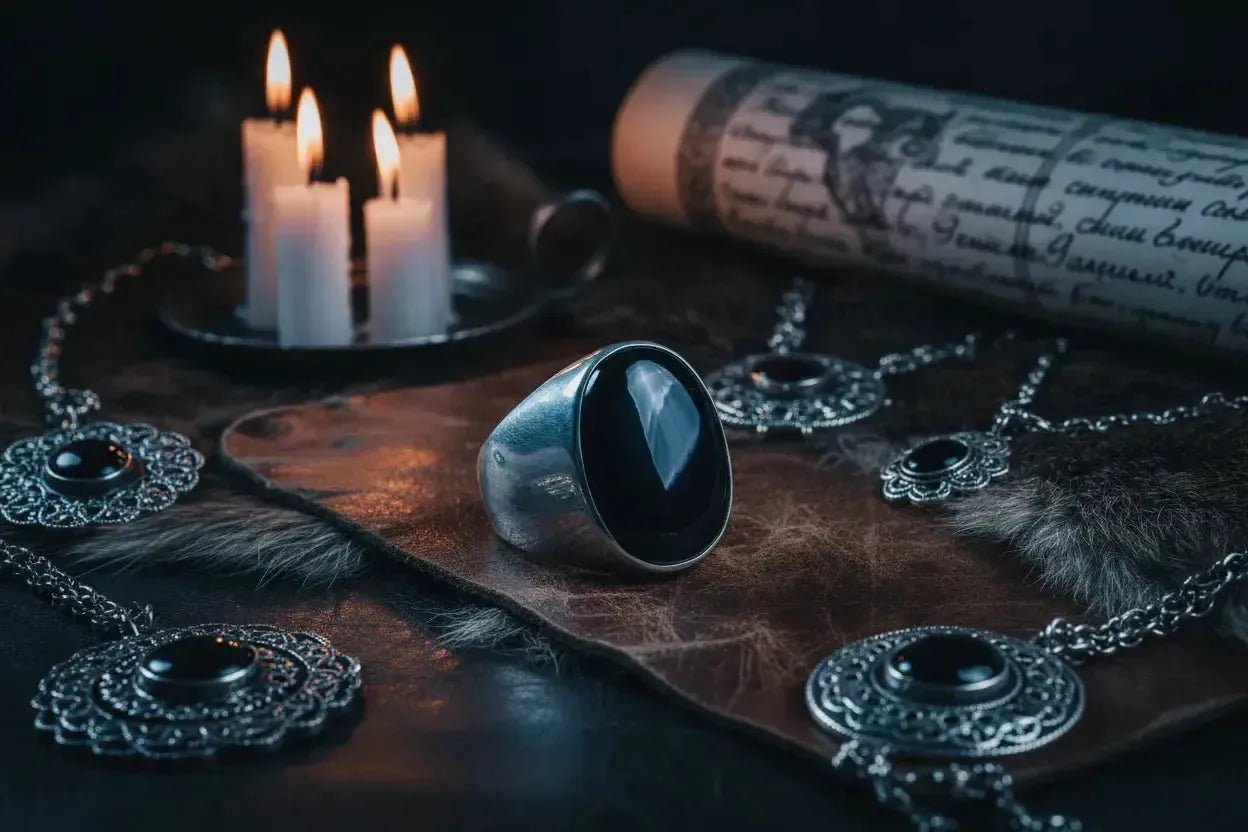
Signet Rings Inspired by Eastern European Traditions
The signet ring was not born in the West. Before becoming a symbol of distinction in European courts, it was already worn by Slavic warriors, Russian boyars, and Polish nobles as a sign of identity, rank, and power. A millennial tradition that Vindicta, a jewelry house specializing in solid 925 sterling silver with over 10 years of excellence, honors in every selected piece.
The Signet Ring in Slavic Culture: A Jewel of Power
In medieval Slavic societies, the massive silver ring was much more than an ornament. It served as a personal seal—nobles engraved their coats of arms or initials to authenticate documents and decisions. Wearing a signet ring was asserting one's authority, lineage, and belonging to an elite.
Archaeological excavations in Russia, Ukraine, and Poland reveal solid silver signet rings dating from the 10th to the 17th centuries, often adorned with geometric patterns, Orthodox crosses, or dark stones—onyx, garnet, Baltic amber.
Novgorod and Kyiv: The Earliest Traces
The merchant cities of Kyivan Rus'—Novgorod in particular—provide some of the oldest evidence of this jewel. Archaeologists have unearthed silver seal rings, sometimes stamped with a Cyrillic monogram or a heraldic animal, worn by merchants and druzhinniki, the elite warriors serving the princes. Unlike Western signet rings of the same era, often reserved for a titled aristocracy, these rings also circulated among prosperous merchants: commercial success, in the medieval Slavic world, already granted a mark of recognition worn on the hand.
The Boyars and the Family Seal
Under the grand princes and then the tsars, the boyars—the Russian landed nobility—made the signet ring an instrument of governance as much as a piece of jewelry. Each boyar family had its own seal, passed down from father to son with the title and lands. Losing one's signet ring was not a simple incident: it was literally losing the ability to sign in one's own name. Some Russian chronicles report cases where the disappearance of a family seal was treated with the same seriousness as the theft of a property deed.
This legal function explains the robustness sought in these pieces: the silver had to be solid, never hollow, capable of maintaining a clear impression in wax for decades of daily use.
The Aesthetic Codes of the Slavic Signet Ring
What distinguishes the Slavic-inspired signet ring is above all its character:
- Mass—a prominent, never discreet, presence
- Dense engravings—geometric patterns, interlaces, ancestral symbols
- Dark stones—black onyx, deep garnet, warm amber
- Oxidized silver—which accentuates reliefs and gives an ancient, noble appearance
- Square or rectangular shape—imposing, authoritative
From Tsarist Russia to Today
Under the tsars, the signet ring reached its peak in Russian culture. Workshops in Moscow and Saint Petersburg produced pieces of exceptional finesse, combining Byzantine techniques with an imperial taste for splendor. 925 sterling silver—the quality standard we use at Vindicta—was then the absolute benchmark for court jewelry.
Today, this heritage inspires a new generation of men's jewelry: massive, engraved, imbued with meaning. Pieces that are worn with intention, not by chance.
Craftsmanship that Crosses Borders
What makes the Slavic signet ring particularly interesting is its ability to absorb influences without ever losing its identity. Byzantine motifs arriving via Orthodoxy, Scandinavian interlaces brought by Varangian trade routes, geometric engravings from the Ottoman world: everything converges in the same object, without ever giving an impression of pastiche. It is precisely this synthesis—rather than the imitation of a single model—that distinguishes the Slavic signet ring from English signet rings or French signet rings, which are more uniformly heraldic in their composition.
The Artisan's Work: Solid, Engraved, Alive
Reproducing the spirit of these historic signet rings requires true expertise. Deep engraving demands thick metal from the outset—it's impossible to achieve marked relief on a thin or hollow ring without weakening the structure. Controlled oxidation, on the other hand, works in recesses: blackening accumulates in the engravings while polished surfaces remain clear, creating the contrast that gives the piece its immediately ancient character. It is this technical requirement—solid silver, deep engraving, controlled patination—that distinguishes a true Slavic-inspired signet ring from a simple geometric-patterned ring.
How to Choose Your Signet Ring in this Spirit
To embody the contemporary Slavic aesthetic:
- Prioritize solid 925 sterling silver—never plated, never hollow
- Choose a dark stone—black onyx for protection, garnet for passion
- Opt for visible engravings—geometric or symbolic
- Embrace the size—a Slavic signet ring does not hide itself
Discover our selection of men's 925 sterling silver signet rings and men's 925 sterling silver rings. For the intensity of dark stones, explore our black onyx jewelry and our natural stone jewelry. This Nordic and Slavic heritage extends the one explored in our article on silver in Slavic civilizations.
Each piece selected by Vindicta is certified solid 925 sterling silver. Learn more about our quality commitment.
✦ Vindicta — Solid 925 silver
The piece that makes the difference
Certified 925 silver · Free shipping from €69 · 10 years of excellence
Men's 925 Silver Signet Rings →