
Money in Slavic Civilizations: History and Heritage
Before gold became the universal symbol of wealth, silver reigned supreme in Slavic civilizations. From the Russian steppes to the Polish plains, from the Carpathians to the Baltic Sea, the white metal shaped the identity, spirituality, and power of Eastern European peoples for over a thousand years.
At Vindicta, a house of solid 925 sterling silver jewelry with over 10 years of excellence, we draw on these ancient legacies to select pieces that carry a story—not just a metal.
Silver Among Slavs: A Sacred Metal
For ancient Slavic peoples, silver was more than just a currency. It was imbued with deep symbolic power: protection against malevolent spirits, a connection to the moon and the invisible world, a sign of belonging to a noble lineage.
Archaeological excavations in Russia, Ukraine, and Poland reveal buried treasures—kladys—containing hundreds of solid silver coins and jewelry, hidden by their owners in times of war. These treasures attest to the absolute value given to this metal in Slavic culture.
The Kladys: Fortunes Buried in the Earth
The phenomenon of kladys deserves closer attention. Faced with recurring invasions—Mongol in the 13th century, Polish, Swedish—Slavic families would bury their silver before fleeing or fighting, hoping to return and retrieve it once the danger passed. Thousands of these treasures were never reclaimed: their owners died in combat, were deported, or simply could not find the exact location. Archaeologists continue to unearth them today, sometimes composed of several hundred solid silver coins, bracelets, and necklaces, stacked in clay pots or wrapped in fabric.
What is striking about these discoveries is the consistency: regardless of the Slavic region, silver—rather than gold—always dominates these family treasures. It was the metal of savings as much as it was of adornment.
Slavic Goldsmithing: Between East and West
Geographically at the crossroads of influences, Slavic artisans developed a unique style, blending:
- Byzantine techniques of cloisonné enamel and filigree
- Norse motifs of interlace and runes
- Ottoman influences of geometric engravings
- Local traditions of solar and animal symbols
This synthesis gave rise to goldsmithing of exceptional richness, recognizable by its dense motifs, elaborate surfaces, and a fondness for dark stones—onyx, garnet, Baltic amber.
Tsarist Russia: Silver at its Peak Glory
It was under the tsars that Slavic goldsmithing reached its zenith. From Ivan the Terrible to Nicholas II, the Russian imperial court commissioned pieces of unparalleled sophistication. Workshops in Moscow and Saint Petersburg rivaled the great European houses.
925 silver—the same standard we use at Vindicta—became the benchmark for quality in imperial Russian jewelry. Massive signet rings, Orthodox crosses, bracelets engraved with family crests: all pieces that passed through generations.
The Amber Road and Silver Trade
From antiquity, a trade route connected the Baltic to the Mediterranean: the Amber Road. Slavic merchants traded Baltic amber—this fossilized resin so prized in Rome—for silver from the Byzantine and Arab worlds. This ancient trade explains why silver flowed so early into Slavic territories, long before the emergence of organized Russian or Polish states. Viking treasures found in Russia often contain Arab silver dirhams, proof of these trade routes that already connected Baghdad to the Baltic via Russian rivers.
Recurring Symbols in Slavic Jewelry
Certain motifs consistently appear in Eastern European goldsmithing:
- The sun and moon — cosmic duality, divine protection
- The Firebird (Zhar-Ptitsa) — power, rebirth, royalty
- Geometric interlaces — continuity, eternity, strength
- The Orthodox cross — faith, identity, belonging
- Dark stones — onyx, garnet, amber — grounding and mystery
A Legacy That Resonates Today
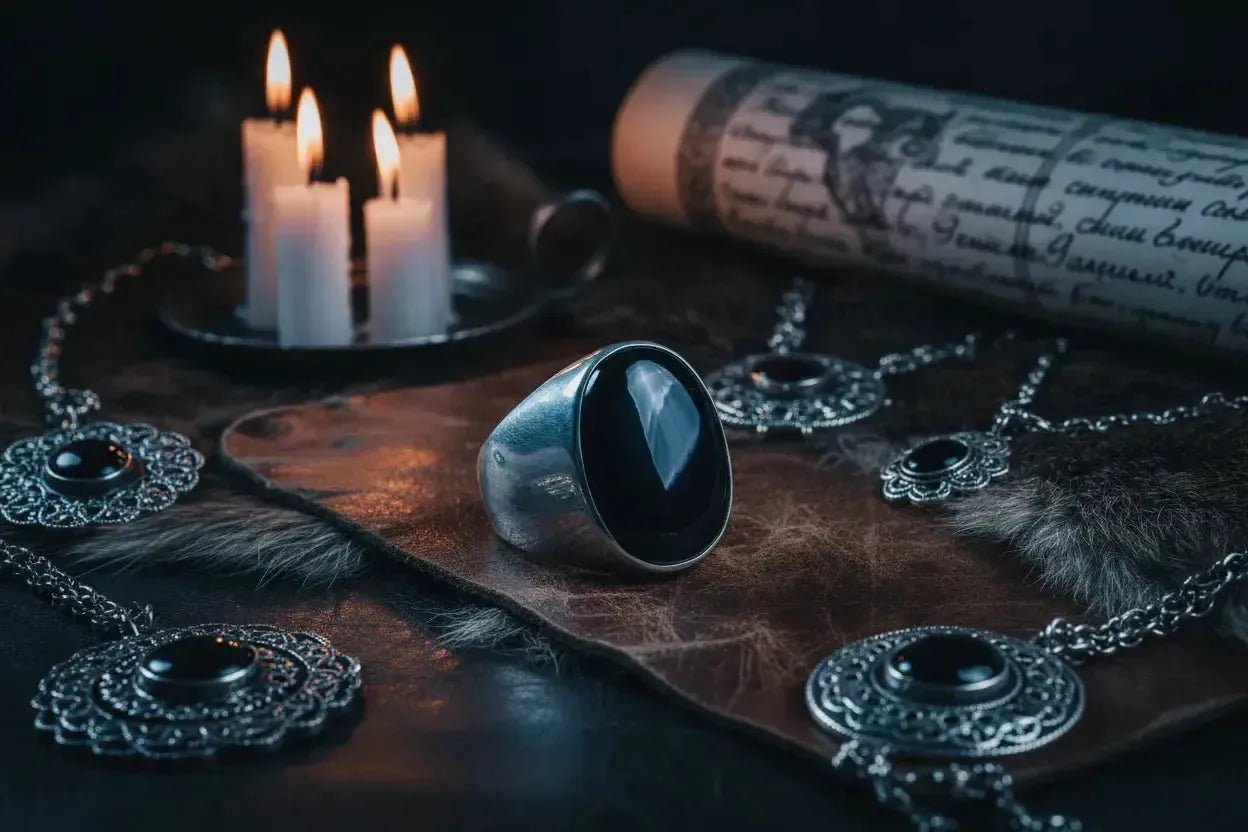
The Slavic aesthetic—cold, noble, rich in history—is experiencing a resurgence in contemporary men's jewelry. Massive 925 silver signet rings, dark stone rings, geometric engravings: all visual codes that draw directly from this imperial heritage.
Discover our selection of men's 925 silver rings, especially our men's 925 silver signet rings that are part of this tradition of powerful and durable men's jewelry. For those seeking the intensity of dark stones, our black onyx jewelry collection perfectly embodies the contemporary Slavic aesthetic. This heritage naturally extends to our articles on Eastern European signet rings and Cossack jewelry.
Every piece we select at Vindicta is certified solid 925 silver. Discover our commitment to quality and authenticity.
✦ Vindicta — Solid 925 silver
The piece that makes the difference
Certified 925 silver · Free shipping from €69 · 10 years of excellence
Men's 925 Silver Signet Rings →


