Article: Portuguese Filigree: when silver becomes lace
Portuguese Filigree: when silver becomes lace
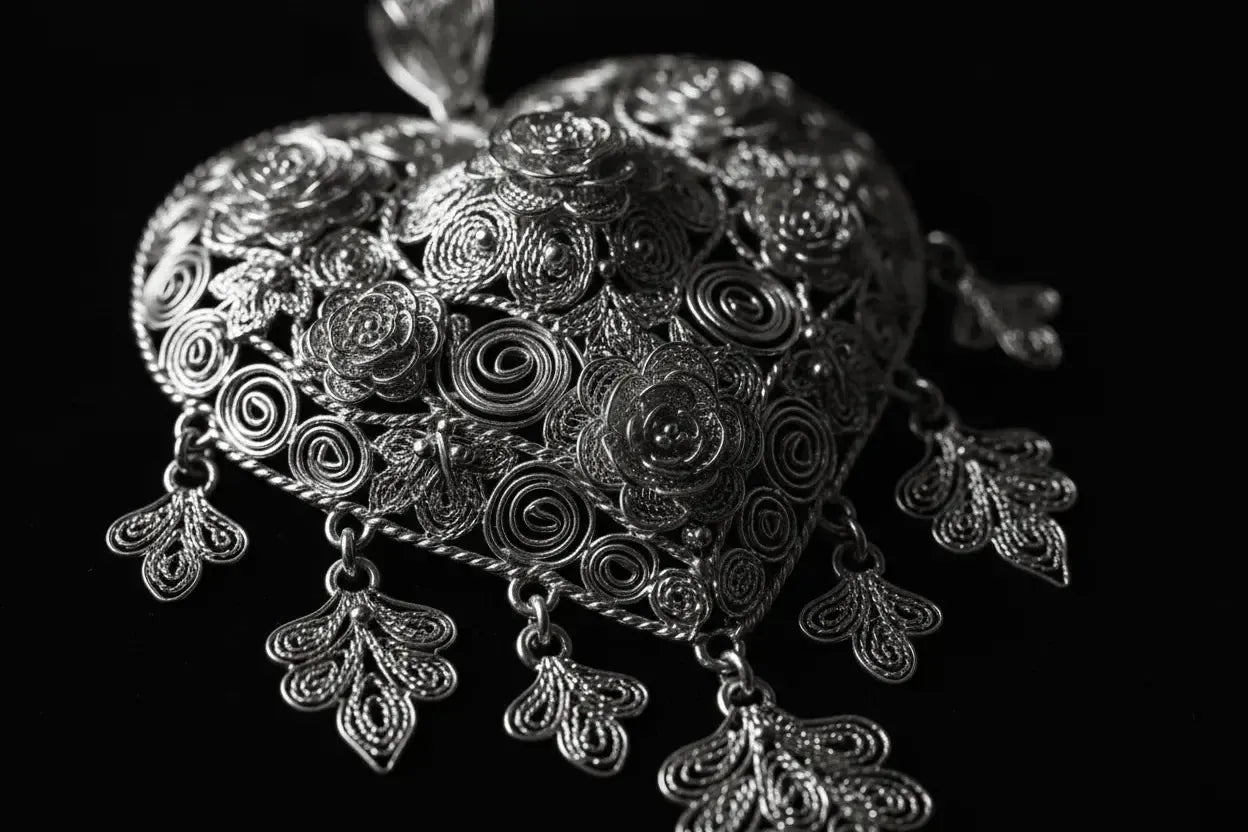
There are goldsmithing techniques that defy the logic of metal. Portuguese filigree is the most striking example: taking a solid 925 silver wire, twisting it upon itself, cold soldering it, and chiseling it until it resembles lace. Not an imitation of lace. Lace made of silver.
This craftsmanship, born in the Viana do Castelo region in northern Portugal, is now recognized by UNESCO as intangible cultural heritage. It did not develop in the workshops of royal courts, but in the hands of rural artisans in Minho — a region where silver was the wealth of peasants, not nobles.
A wire, a technique, a thousand years of history
Filigrana (from Latin filum, thread, and granum, grain) is a universal technique: it is found in India, Persia, and Arab goldsmithing. But Portugal has made something unique of it. Where other traditions use filigree as decoration on a solid surface, Portuguese artisans have removed the surface. Only the wire remains. The structure is held together by the precision of the solders, not by a support.
The result is a piece of jewelry of paradoxical lightness: visually dense, physically almost imponderable.
The most emblematic motifs are the Heart of Viana — a symbol of the region, worn as a pendant or brooch — and the large half-moon earrings that accompanied the traditional costumes of Minho women during religious festivals. These pieces were not luxury ornaments: they represented a family's savings, passed down from mother to daughter as a life insurance policy in solid silver.
The link with Arab goldsmithing and Andalusian filigree
Portuguese filigree did not develop in isolation. The eight centuries of Arab presence on the Iberian Peninsula left a deep technical imprint on local goldsmithing. Moorish artisans mastered filigree with remarkable precision, and their methods were absorbed, transformed, and then reinterpreted by Portuguese goldsmiths after the Reconquista.
It is this technical cross-pollination — between the geometric rigor of Arab goldsmithing and the organic sensibility of natural Portuguese forms — that gives filigrana its unique character in Europe.
The Two Major Centers: Viana do Castelo and Gondomar
The Portuguese filigree tradition has historically been organized around two distinct poles. Viana do Castelo, in Minho, remains the symbolic and cultural birthplace of the technique — it is where the Heart of Viana was born and where the traditional costumes worn during the Nossa Senhora da Agonia festivities still display complete filigree sets today, passed down through several generations. Gondomar, near Porto, has over the centuries become the densest artisanal production center in the country, now concentrating the vast majority of family workshops still in operation. This two-pole geography — one symbolic, the other productive — explains why filigrana remains vibrant while so many other European artisanal crafts have disappeared due to lack of economic outlets.
Today: between living craft and contemporary jewelry
Filigrana is not a dead art. In Gondomar, near Porto, family workshops perpetuate the technique by hand, with the same tools as two centuries ago. Each piece takes between several hours and several days depending on its complexity. There is no machine capable of reproducing the point-by-point soldering performed by a master filigraneiro.
This craftsmanship has directly influenced the chased silver goldsmithing that we practice at Vindicta: the same demand for the wire, the same attention paid to the structure rather than the mass, the same conviction that the lightness of a piece of jewelry is not a defect but a technical feat.
If you wear a 925 silver ring with a filigree motif, you are wearing the echo of this millennial craftsmanship — adapted, contemporary, but rooted in a tradition that has spanned centuries without being industrialized. Discover our entire collection of solid 925 silver jewelry to continue this exploration of European goldsmithing heritage.
✦ Vindicta — Solid 925 silver
The piece that makes the difference
Certified 925 silver · Free shipping from €69 · 10 years of excellence
Discover our jewellery →