The Claddagh Ring: History and Meaning of an Irish Symbol
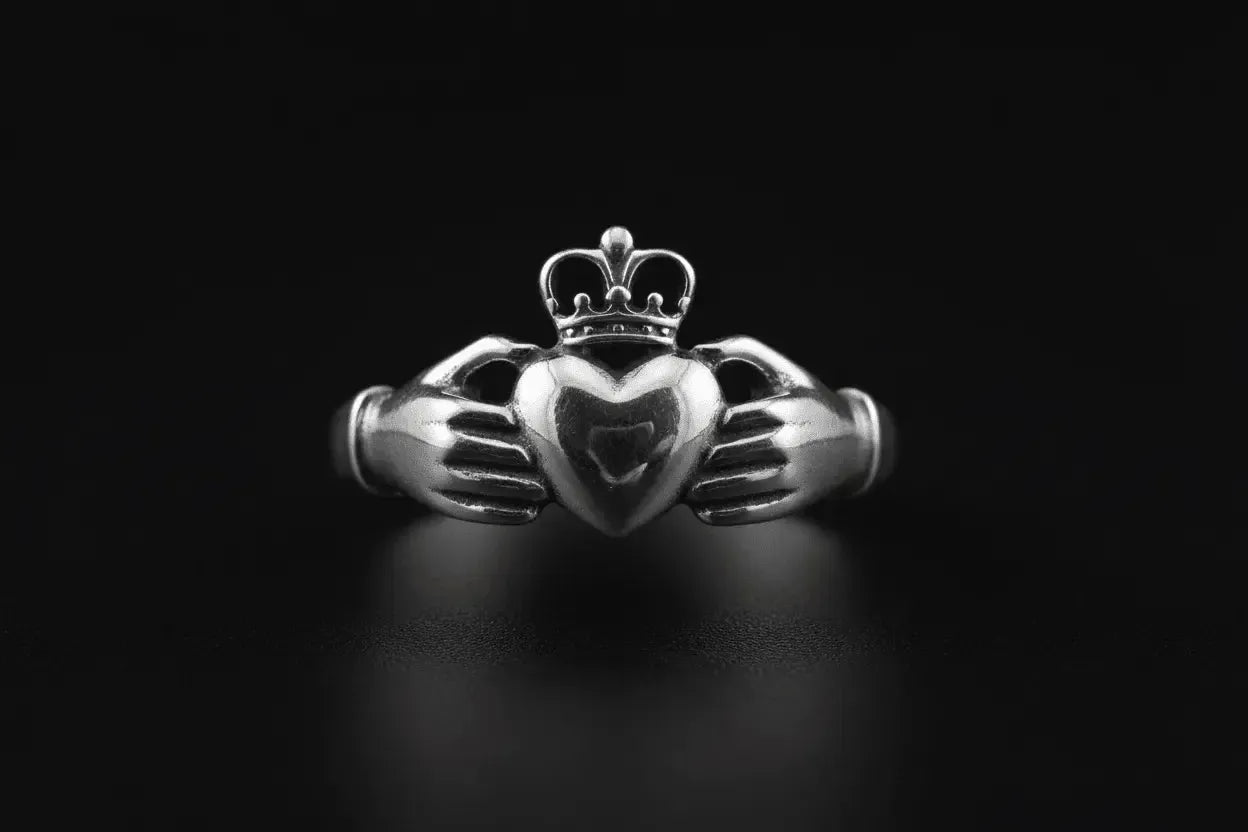
Some pieces of jewelry tell a story all on their own. The Claddagh ring is the perfect example: two hands holding a heart topped with a crown. Love, friendship, loyalty — three values etched in silver, worn for four centuries on the fingers of Irish people worldwide.
It is not a fashion accessory. It is a symbol of legacy, as recognizable in Ireland as a wedding band in France — and often more meaningful.
Galway, 1700: The Birth of a Symbol
The Claddagh ring gets its name from the fishing village of Claddagh, now absorbed into the city of Galway on Ireland's west coast. The most widespread legend attributes its creation to Richard Joyce, a Galway goldsmith captured by Barbary pirates in the 17th century and sold into slavery to a Moorish goldsmith in Algiers.
During his years of captivity, Joyce is said to have learned the trade with remarkable precision. Upon his liberation, he reportedly returned to Galway with the design of a ring he had created for the woman he loved and hoped to find again. This ring was the Claddagh.
The legend may be embellished — historians debate its details — but it says something true about the ring itself: it is a piece of jewelry made to transcend time and distance.
The Grammar of the Symbol
Each element of the Claddagh has a precise meaning, and their combination forms a language that every Irish person instinctively understands.
The two hands represent friendship — the gesture of holding, supporting, being present. The heart in the center symbolizes love. The crown above it embodies loyalty, fidelity, constancy over time.
But the Claddagh ring also has a grammar of wearing. Worn on the right hand, heart facing outwards: the heart is free. Worn on the right hand, heart facing inwards: the heart is taken. Worn on the left hand, heart inwards: engagement or marriage. These conventions are not written into law — they are passed down from generation to generation, like a silent code among Irish people.
A Diaspora Jewel
The Claddagh ring crossed the Atlantic with the millions of Irish people who fled the Great Famine of the 1840s. It became one of the most recognizable symbols of the Irish diaspora, worn in Boston, New York, Chicago, Sydney — wherever Irish people rebuilt their lives far from their island.
Today, it is estimated that tens of millions of Claddagh rings have been produced since the 18th century. It remains one of the most gifted pieces of jewelry in Ireland, passed down from mother to daughter or grandmother to granddaughter as a tangible heritage of belonging.
Variants According to Families and Regions
While the Galway Claddagh remains the historical reference, other Irish cities developed their own variants of the motif over the centuries, with slight differences in the detail of the hands or the shape of the crown — some Dublin or Cork goldsmiths would apply a distinct hallmark allowing the identification of the original workshop. These variations, long considered minor, are now sought after by collectors as testimonies to local artisanal history. Some Irish families still possess antique Claddaghs passed down through five or six generations, whose worn motifs alone tell decades of daily wear.
Sterling Silver: The Natural Metal of the Claddagh
Traditionally, the Claddagh ring is made of silver. Not by default or economy — but by cultural choice. Solid silver is the metal of popular Irish jewelry, one that fishing and artisan families could acquire and pass down. Gold was reserved for prestige versions, but it was silver that established the Claddagh's reputation as a jewel of the people.
Sterling silver (925) — 92.5% pure silver — is now the standard that guarantees both durability and authenticity of the metal. A sterling silver ring worn daily develops a slight patina over time that gives it character — exactly what is expected of a piece of jewelry intended to span generations.
At Vindicta, we share this conviction: a solid silver piece of jewelry is not a substitute for gold. It is a choice in itself, rooted in an artisanal tradition that values the material for what it is, not for what it imitates. Discover our complete collection of sterling silver jewelry.
✦ Vindicta — Solid 925 silver
The piece that makes the difference
Certified 925 silver · Free shipping from €69 · 10 years of excellence
Discover our jewellery →