

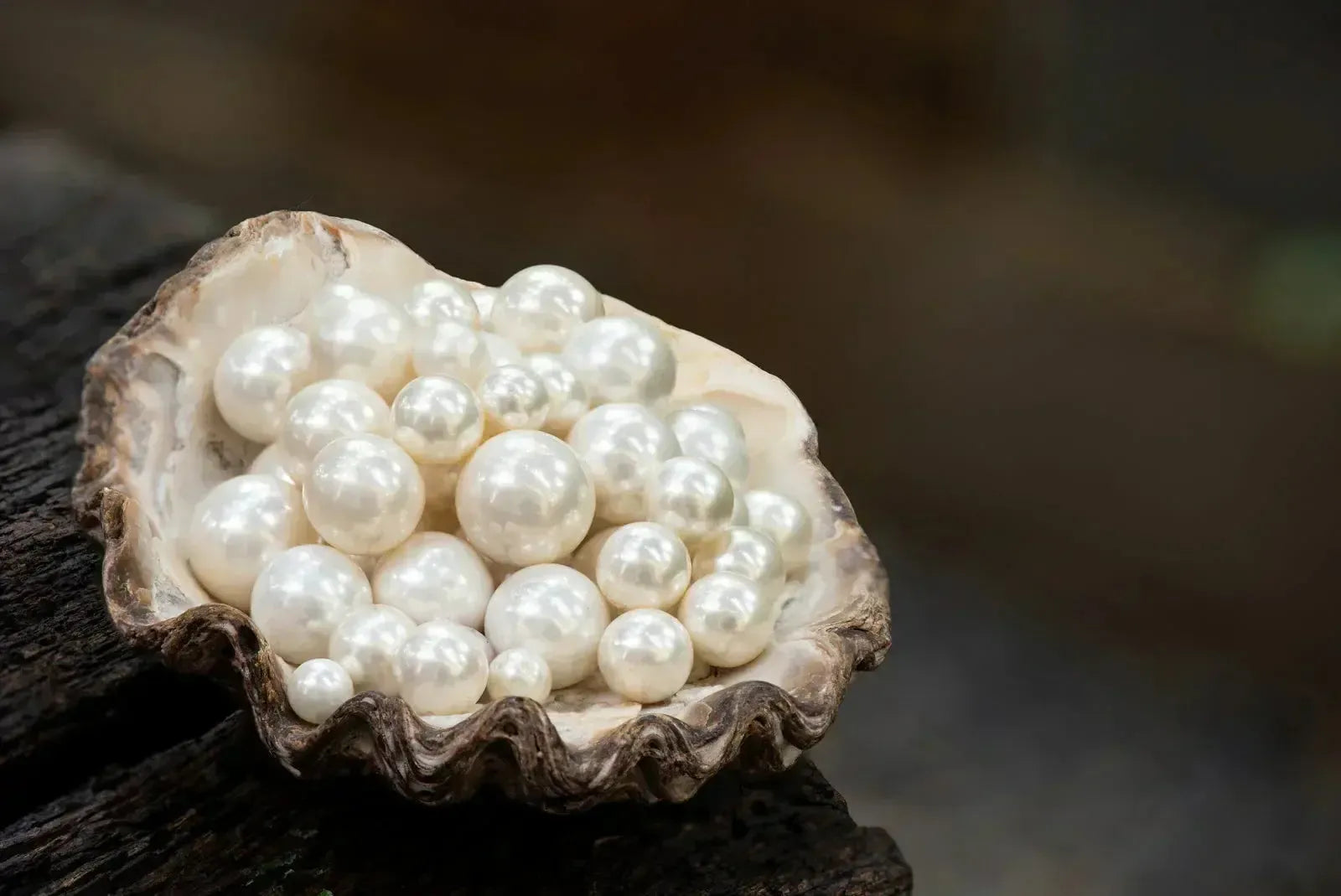
Pearls: Virtues, Properties and Meaning
Focus on Pearls
Summary
- Introduction
- Pearl Characteristics
- History and Symbolism
- Types of Pearls
- Meaning and Virtues
- Origins Around the World
- Pearl Jewelry at Vindicta
- The Vindicta Perspective
- Care and Advice
- Materials to Discover
- Frequently Asked Questions
- Conclusion
Introduction
The pearl is one of the oldest, most universal, and most symbolically charged gemstones in human history. As the only gem of entirely organic and living origin—created without human intervention by a mollusk—it has fascinated for millennia with its soft and luminous beauty, nacreous reflections, and spherical perfection. No other gem is born from a living creature.
A pearl forms when a foreign body—a grain of sand, a parasite, a shell fragment—enters a mollusk's mantle. To protect itself, the mollusk envelops the intruder with successive layers of nacre—the same material that lines the inside of its shell. Year after year, layer after layer, the pearl is built. It is a biological response to aggression—and the result is one of the most beautiful things nature has ever created. Paired with sterling silver 925, it creates jewelry of unparalleled elegance.
Pearl Characteristics
Composition and Structure
- Type: organic gemstone (concentric layers of nacre — aragonite CaCO₃ + organic proteins)
- Structure: concentric layers of nacre around a nucleus (natural or implanted)
- Optical phenomenon: orient (light that seems to come from inside the pearl)
- Color: white, cream, pink, gray, black, gold, blue — depending on species and origin
Hardness and Resistance
- 2.5 to 4.5 on the Mohs scale — a soft gem, to be handled with care
- Very sensitive to acids (even perspiration can tarnish them)
- Sensitive to heat, desiccation, and chemicals
Physical Properties
- Density: 2.60 to 2.85
- Luster: "orient" is the specific optical quality of pearls — a luminous depth that seems to come from within
- Size: from 2 mm (Akoya pearls) to 20 mm and more (South Sea pearls)
History and Symbolism of Pearls
The pearl is the oldest gemstone used by humanity. Pearl ornaments have been found in tombs dating back to 4000 BC in Persia (modern-day Iran)—among the oldest jewels ever discovered. The pearl was already a symbol of wealth and prestige in early human civilizations.
In ancient Greece, pearls were associated with Aphrodite, goddess of love and beauty. Legend had it that Aphrodite was born from the sea foam—and that pearls were the drops of water that fell from her body when she emerged from the waves. This association between the pearl, the sea, and divine femininity has endured through the centuries.
In ancient Rome, pearls were the ultimate symbol of luxury and power. Julius Caesar reportedly gave Servilia a pearl worth 6 million sesterces. Cleopatra, according to legend, dissolved a giant pearl in vinegar and drank it to impress Mark Antony—a gesture of absolute prodigality.
In Islamic and Ottoman tradition, the pearl (لؤلؤ, lu'lu') is mentioned several times in the Quran as one of the wonders of Paradise. Ottoman sultans were famous for their extraordinary pearl collections—the Topkapi Treasury still contains priceless pearl-adorned pieces today. The pearl was the quintessential Ottoman royal gem.
In Asia, the pearl was associated with wisdom, purity, and perfection. In Chinese tradition, the pearl symbolized the moon and femininity. Chinese dragons were often depicted holding a pearl—a symbol of wisdom and perfect knowledge.
The cultured pearl revolution, initiated by Mikimoto Kokichi in Japan at the end of the 19th century, democratized access to pearls without diminishing their beauty. A cultured pearl is a real pearl—created by a real mollusk, with real nacre—simply triggered by human intervention.
Types of Pearls
Natural Pearls vs. Cultured Pearls
- Natural pearl: formed without human intervention, extremely rare and precious, almost impossible to find today
- Cultured pearl: triggered by the implantation of a nucleus by humans, but created by the mollusk with real nacre — 99% of pearls on the market
Main Varieties
- Akoya Pearl (Japan, China): 2-10 mm, pearly white to cream with pink overtones, the classic pearl for necklaces
- Tahitian Pearl: 8-18 mm, dark gray to black with spectacular green, blue, and purple overtones
- South Sea Pearl: 10-20 mm, silvery white to golden, the largest and most valuable
- Baroque Pearl: unique irregular shape, each piece is absolutely singular
- Keshi Pearl: nucleated, entirely nacre, exceptional luster
- Mabé Pearl: half-sphere cultivated against the shell, large size
- Blister Pearl: adhered to the shell, cut with its base
- Conch Pearl: unique flame pink, produced by the Caribbean conch, extremely rare
Meaning and Virtues of Pearls
Emotional & Spiritual Level
- Purity & wisdom: universal symbol of purity, wisdom, and perfection
- Femininity: associated with the moon, the sea, and feminine energy in all cultures
- Transformation: born from a wound transformed into beauty, a symbol of resilience and positive transformation
- Protection: protective talisman in maritime and Islamic traditions
- Love: associated with Aphrodite and romantic love in Greek tradition
Physical Level (lithotherapy beliefs)
- Associated with hormonal balance and feminine health
- Used to soothe emotions and promote serenity
- Considered a general healing gem in traditional Asian medicine
Note: The virtues of lithotherapy are not scientifically proven and do not replace medical advice.
Origins of Pearls Around the World
- Japan, China: Akoya pearls, ancient pearl tradition, reference jewelry quality
- French Polynesia (Tahiti): Tahitian pearls, unique iridescent black nacre
- Australia, Philippines, Indonesia: South Sea pearls, the largest and most valuable
- Caribbean: Conch pearls, flame pink, extremely rare
- Persian Gulf, Sri Lanka: historic natural pearls, almost depleted today
Pearl Jewelry at Vindicta
The pearl, with its luminous softness and unparalleled elegance, naturally combines with sterling silver 925 to create jewelry of absolute femininity and sophistication. The pearl-silver combination is one of the most classic and elegant in jewelry—two luminous materials that complement each other perfectly.
Discover our mother-of-pearl and 925 silver pearl jewelry collection and our 925 silver natural stone jewelry collection.
The Vindicta Perspective
The pearl is the gemstone that raises the most questions about value and authenticity. In a market where imitation pearls (plastic, glass, shell) are ubiquitous, the distinction between a real cultured pearl and an imitation is essential. At Vindicta, we only work with certified cultured pearls—real pearls, created by real mollusks, with real nacre.
What fascinates us about the pearl is its unique philosophical dimension. The pearl is born from a wound—a foreign body that penetrates the mollusk and triggers a protective response. The mollusk transforms this aggression into beauty, layer after layer, year after year. It is the most powerful metaphor for resilience in nature—and that is why the pearl has always been associated with wisdom and transformation.
The pearl is also the gemstone that brings us closest to Vindicta's Ottoman heritage. Ottoman sultans were among the greatest pearl collectors in history—the Topkapi Treasury still bears witness to this today. The pearl was the quintessential Ottoman royal gem, associated with power, purity, and divine blessing. This tradition is directly rooted in Vindicta's identity.
Finally, the pearl is the only gemstone that is both a material (nacre) and an object (the pearl itself). To understand the pearl is to understand nacre—and vice versa. The two are inseparable.
Care and Advice for your Pearl Jewelry
- Last on, first off: put your pearls on last (after perfume, cream, hairspray) and take them off first
- Acids: absolutely avoid all contact with acidic substances—even perspiration can tarnish pearls over time
- Cleaning: soft, slightly damp cloth after each wear. Dry flat. Never immerse
- Storage: soft fabric pouch or padded box, separate from other jewelry. Never store in a plastic bag
- Necklaces: have pearl necklaces restrung regularly—the thread deteriorates over time
- Regular wear: pearls love to be worn—the natural warmth and moisture of the skin maintain them
To learn more: Complete care guide for your 925 silver jewelry.
Materials to Discover
- 🪪 Mother-of-Pearl — the material from which pearls are made
- 🔵 Tahitian Pearl — iridescent black, the most spectacular
- 🪪 Baroque Pearl — free form, each piece unique
- 🪪 Keshi Pearl — entirely nacre, exceptional luster
- 🪪 Moonstone — milky reflection, same lunar and feminine energy