Silver Jewelry from Fes: Moroccan Filigree, a Millennial Art and Living Heritage
There are cities where money talks. Fez is one of them. For over a thousand years, the artisans of the Fez medina have crafted solid silver with a precision and patience that defy time. Moroccan filigree—this art of twisting, soldering, and assembling silver threads into metallic lace—is one of the most refined jewelry expressions in the Islamic world. At Vindicta, with over 10 years of excellence in selecting solid 925 silver jewelry, we draw upon this heritage to offer you pieces that carry this soul.
Fez, Morocco's Spiritual and Artisanal Capital
Founded in the 9th century by Idriss II, Fez is the oldest imperial city in Morocco. Its medina—a UNESCO World Heritage site—still houses hundreds of artisan workshops organized by guilds, just as in the time of the great dynasties. Jewelers hold a place of honor there: the jewelers' souk, or Kissaria, is one of the oldest goldsmith markets in the Arab world.
It was in Fez that Andalusian artisans, expelled from Spain in 1492, sought refuge. They brought with them their techniques—filigree, chasing, granulation—which blended with the local Berber tradition to give birth to a unique Moroccan style, both Andalusian and Maghreban.
Moroccan Filigree: A Goldsmith's Technique
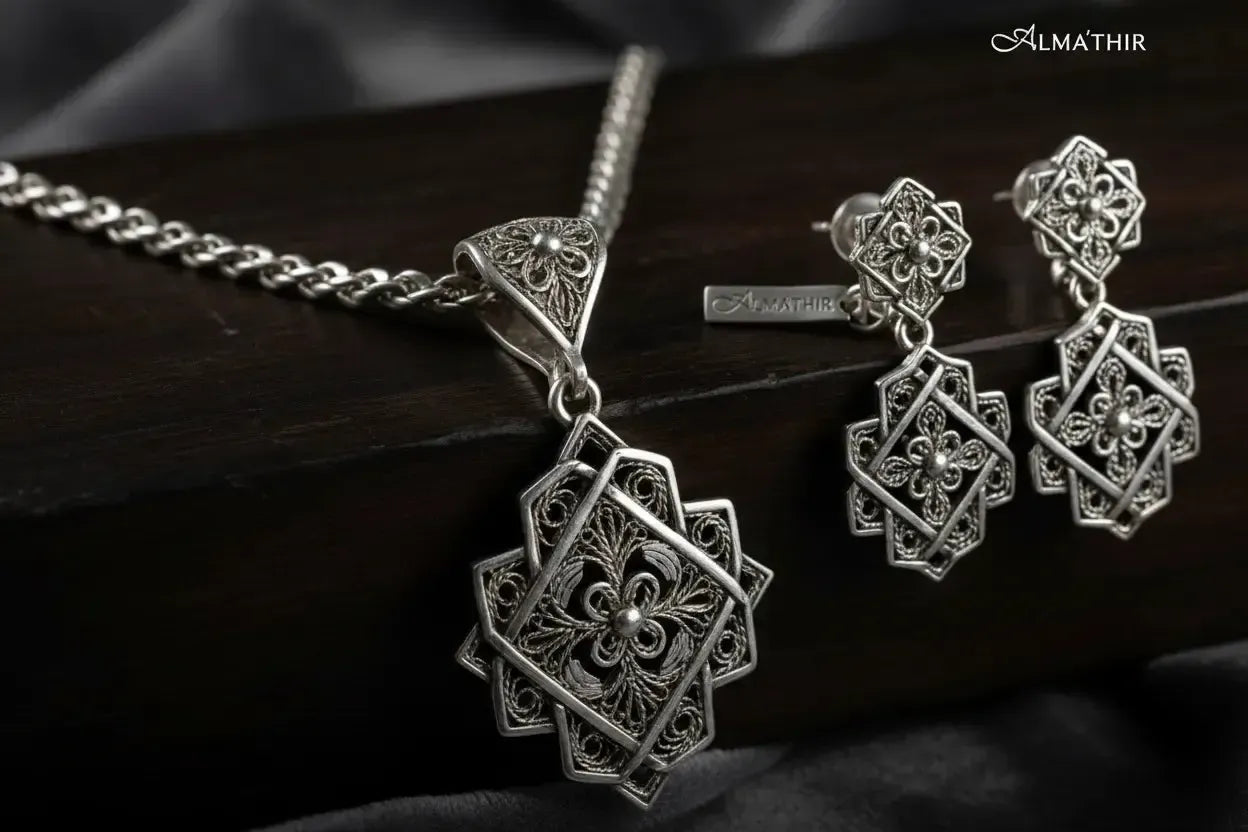
Filigree is the art of working with extremely fine silver threads—sometimes less than a millimeter in diameter—to create openwork structures of remarkable lightness and complexity. The technique involves several steps:
- Drawing: solid silver is melted and then drawn into progressively finer wires through a draw plate
- Twisting: the wires are twisted two by two to create flexible and strong cables
- Shaping: the twisted wires are bent, coiled, and assembled according to precise geometric patterns
- Soldering: each joint is soldered with silver to ensure the overall solidity
- Finishing: polishing, sometimes partial oxidation to highlight the reliefs
A single filigree jewel can require several days of work. It is this exacting standard that makes it a piece of character—not a mass-produced accessory.
The Motifs of Fez Filigree
Moroccan filigree is not merely beautiful—it speaks. Each motif carries a meaning:
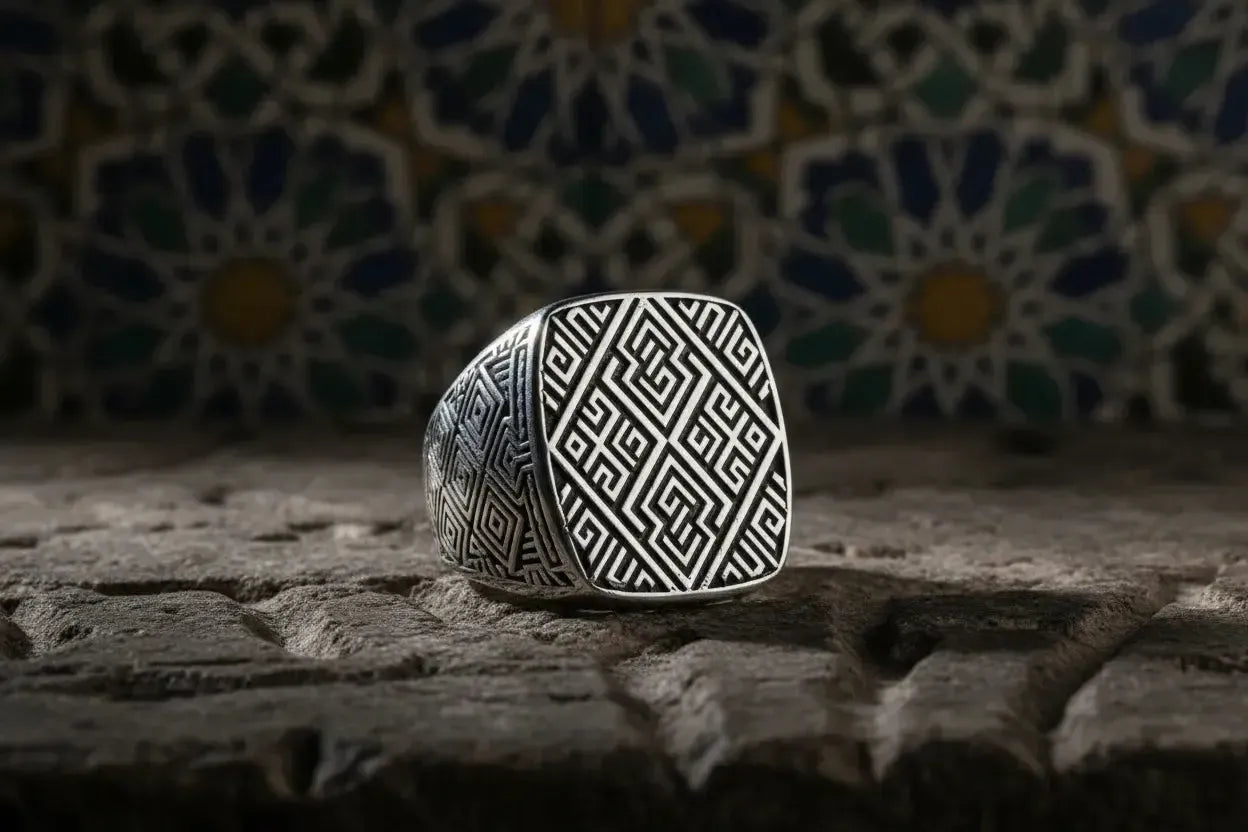
- Geometric interlacing: a direct heritage of Islamic art, symbolizing infinity and divine unity
- Floral arabesques: Andalusian influence, evoking the paradisiacal garden of Islamic tradition
- The eight-pointed star: a symbol of perfection and harmony, ubiquitous in the architecture and jewelry of Fez
- The crescent: a universal Islamic symbol, often integrated into pendants and earrings
Natural Stones in Moroccan Jewelry
Moroccan filigree naturally pairs with natural stones, chosen as much for their beauty as for their symbolism:
- Carnelian: reddish-orange, a stone of courage and vitality, omnipresent in Moroccan jewelry since antiquity
- Turquoise: blue-green, the stone of protection par excellence in Morocco—worn to ward off the evil eye
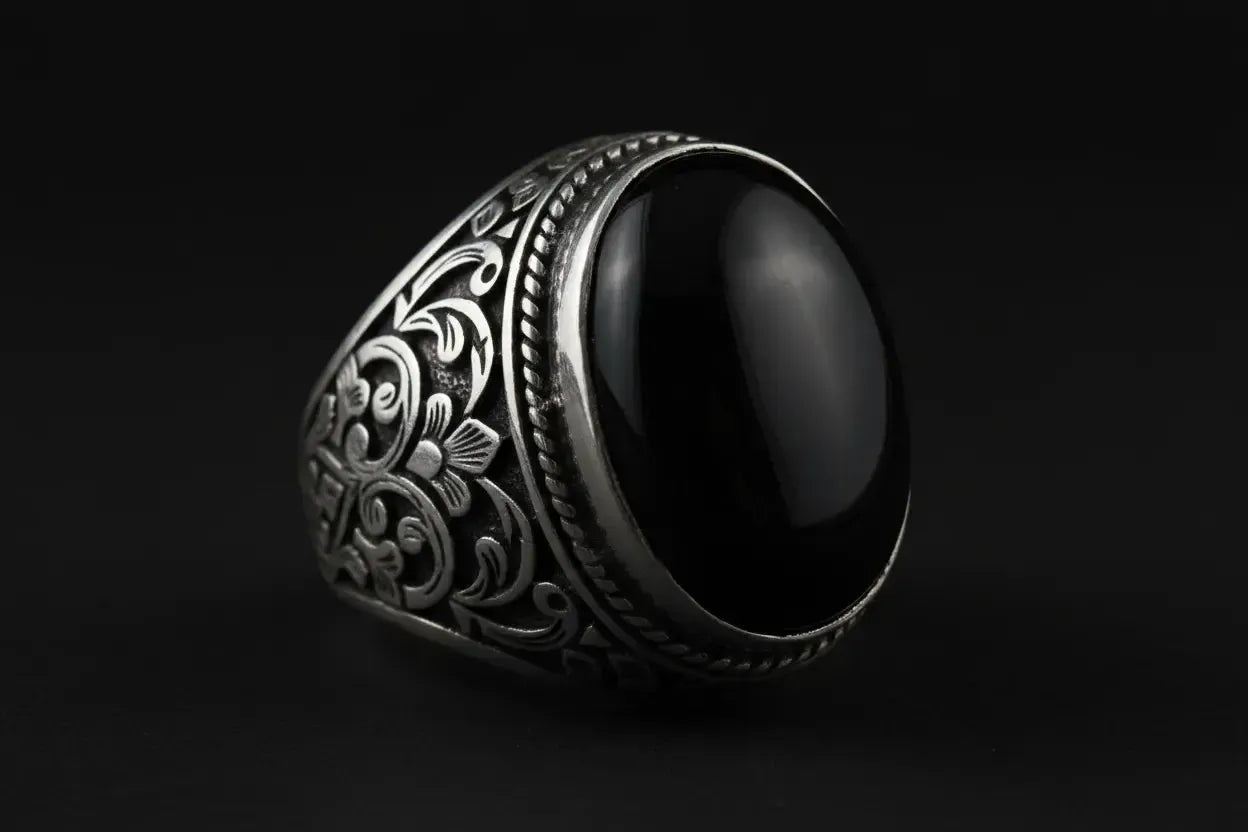
- Black Onyx: sober and powerful, a stone of protection and anchoring, widely used in signet rings and men's rings
- Amethyst: purple, a symbol of wisdom and spirituality in Eastern tradition
Signet Rings and Men's Rings: The Moroccan Male Heritage
While filigree is often associated with women's jewelry, Moroccan tradition gives a prominent place to men's jewelry. The solid silver signet ring—large, engraved with geometric patterns or adorned with a natural stone—is a symbol of virility, status, and belonging in Moroccan culture.
For centuries, the artisans of Fez have crafted men's rings in 925 silver of remarkable robustness and elegance. Pieces designed to last—not to be replaced.
Explore our selection of 925 silver signet rings, directly inspired by this Moroccan heritage.
Fez and the Andalusian Heritage: A Unique Transmission
The arrival of Andalusian artisans in Fez in the 15th century created a unique alchemy. Andalusian filigree techniques—already inherited from Arab and Byzantine goldsmiths—were enriched by local Berber motifs. This dual lineage explains why Fez jewelry is both geometric and floral, rigorous and airy.
To delve deeper into this cross-cultural heritage, discover our article on Berber and Andalusian jewelry and our comprehensive guide on Berber 925 silver jewelry.
How to Recognize Authentic 925 Silver Filigree Jewelry
Given the proliferation of imitations made from plated metal or low-grade alloys, here are some essential benchmarks:
- The 925 hallmark: all solid silver jewelry must bear the 925 or Sterling hallmark, guaranteeing 92.5% pure silver
- Weight: authentic solid silver filigree has a noticeable weight—light but present
- Wire regularity: the wires must be uniform and the welds invisible to the naked eye
- Patina: solid silver develops a natural patina over time—a sign of authenticity
At Vindicta, every piece is certified solid 925 silver. Consult our authenticity page to learn more about our guarantees.
Vindicta and the Heritage of Fez — 10 Years of Excellence
Vindicta is a brand of solid 925 silver jewelry inspired by Ottoman, Andalusian, and Art Deco traditions. For over 10 years, we have selected pieces that carry a heritage—not just accessories. Moroccan filigree, with its technical rigor and symbolic richness, is at the heart of this vision.
Every piece we select tells a story. That of Fez, of its artisans, of their hands that transform silver into memory. By choosing Vindicta, you wear this heritage—not just an accessory.
Explore our collection of vintage 925 silver jewelry, our Art Deco jewelry, and our natural stone jewelry to discover pieces that embody this soul.
✦ Vindicta — Argent 925 Massif
La pièce qui fait la différence
Certifié argent 925 · Livraison offerte dès 69€ · 10 ans d'excellence
Bijoux Orientaux Argent 925 →