
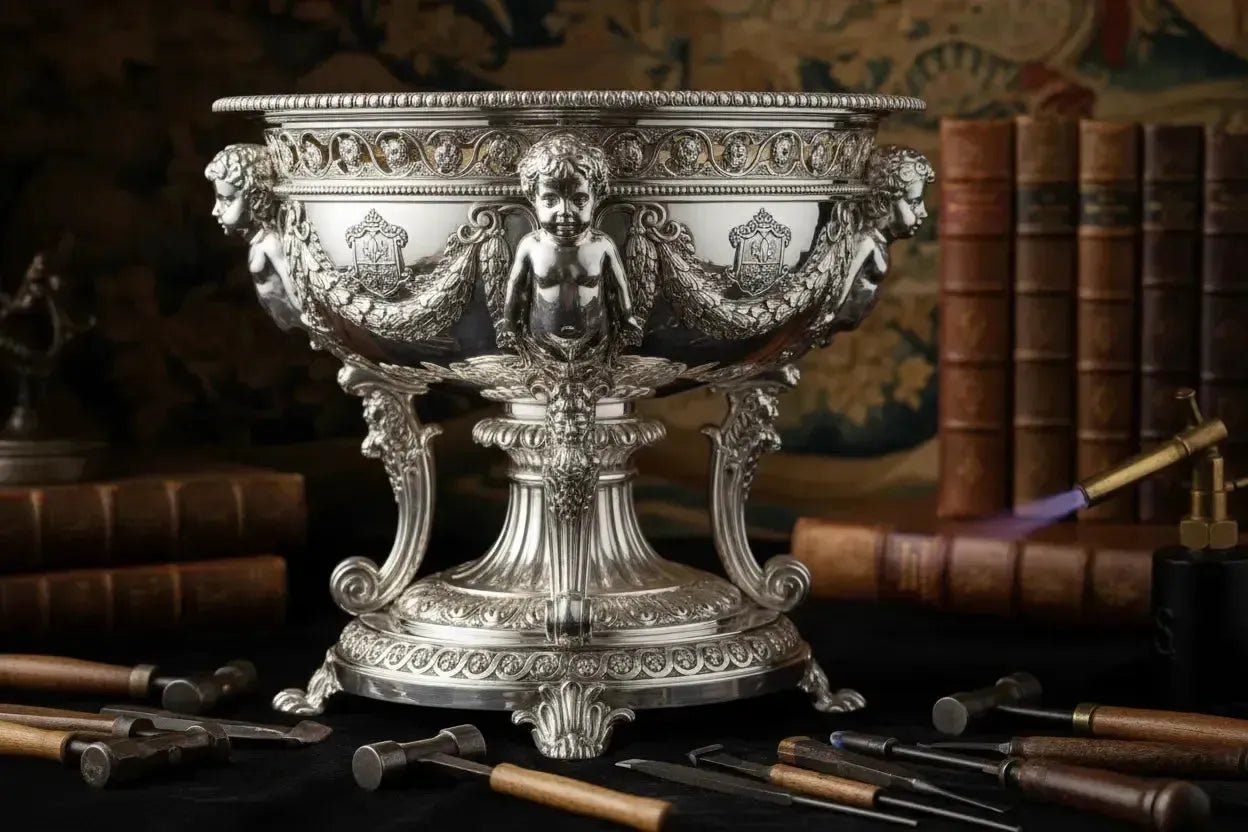
Royal French Goldsmithing: Techniques and Expertise
Royal Silversmithing: An Art in the Service of Majesty
French royal silversmithing represents the pinnacle of precious metalwork. From the Middle Ages to the Empire, French silversmiths developed exceptionally virtuosic techniques to create royal insignia, ceremonial tableware, and 925 sterling silver jewelry. This heritage continues to inspire contemporary designers.
The Great Techniques of Silversmithing
Master silversmiths mastered a vast repertoire of techniques, each requiring years of apprenticeship and practice.
Repoussé
Repoussé involves working a sheet of 925 sterling silver from the reverse side to create reliefs. The silversmith places the metal sheet on a soft support (pitch, lead) and strikes it with specialized hammers and punches to bring out the design.
This technique allows for the creation of spectacular volumes: raised faces, narrative scenes, floral ornaments. Large pieces of royal silverware, such as ewers and ceremonial platters, were often decorated with repoussé.
Chasing
Chasing complements repoussé by working the metal from the front. The silversmith uses chisels and chasing tools to refine details, create textures, and accentuate contrasts.
Chasing allows for extraordinary finesse: every fold of a garment, every strand of hair, every feather of a bird can be rendered with striking realism. The most refined 925 sterling silver jewelry benefits from this technique.
Filigree
Filigree is the art of assembling fine silver threads to create airy and delicate patterns. The threads, often twisted or braided, are soldered together to form arabesques, volutes, and geometric motifs.
This technique, particularly popular for rings and pendants, gives an impression of lightness and transparency. Filigree was often combined with pearls or precious stones.
Engraving
Engraving involves incising the metal with burins to create recessed patterns. Two main types existed:
Line engraving: fine lines incised into the metal to draw motifs, coats of arms, or inscriptions. This technique was used to personalize signet rings and silverware.
Intaglio engraving: a more elaborate technique for creating gradients and depth effects by varying the width and depth of the lines.
Guilloché
Guilloché creates repetitive geometric patterns (waves, rays, checkerboards) using a guilloché lathe. This technique, developed in the 18th century, adds texture and play of light to the silver surface.
Guilloché was often combined with translucent enameling, creating spectacular moiré effects. Royal snuffboxes and cases were frequently decorated in this way.
Enameling
Enamel is a colored vitreous paste applied to metal and then fired at high temperatures. Several techniques existed:
Cloisonné enamel: metal partitions delineate the areas to be enameled, creating patterns with crisp outlines.
Champlevé enamel: the metal is carved out to receive the enamel, which then sits flush with the surface.
Painted enamel: enamel is applied like paint, allowing for detailed scenes and miniature portraits.
Setting
Setting secures precious stones in metal. Royal silversmiths mastered several techniques:
Bezel setting: the stone is completely surrounded by metal, offering maximum protection.
Prong setting: metal prongs hold the stone, allowing light to pass through.
Pavé setting: many small stones are set side-by-side, creating a sparkling surface.
Famous Royal Silversmiths
Certain silversmiths made history through their exceptional talent:
Thomas Germain (1673-1748): silversmith to Louis XV, creator of pieces of incomparable Rococo elegance. His tureens and candelabras are masterpieces of technical virtuosity.
François-Thomas Germain (1726-1791): son of the former, he continued the family tradition with even more ambitious creations for European courts.
Martin-Guillaume Biennais (1764-1843): personal silversmith to Napoleon Bonaparte, he created the emperor's campaign necessaire and numerous prestige objects.
Jean-Baptiste-Claude Odiot (1763-1850): another great silversmith of the Empire, he created the cradle of the King of Rome and sumptuous pieces for the imperial family.
The Organization of Silversmiths: Guilds and Masterships
Silversmithing was strictly regulated by the guild system. To become a master silversmith, one had to:
- Apprenticeship: 6 to 8 years with a master to learn basic techniques
- Journeyman period: several years of perfecting skills by traveling from city to city
- Masterpiece: creation of an exceptional piece judged by the masters of the guild
- Hallmarks: obtaining personal hallmarks to mark one's creations
This system guaranteed the quality and authenticity of 925 sterling silver jewelry and silverware pieces.
Hallmarks: Guarantee of Quality
Each piece of silverware bore several hallmarks:
Maker's mark: personal mark of the creating silversmith
Assay mark: guild guarantee attesting to the metal's fineness
Duty mark: fiscal mark applied before inspection
Discharge mark: confirmation after payment of taxes
These hallmarks now allow for the identification and dating of antique pieces, guaranteeing their authenticity.
Contemporary Heritage
The techniques of royal silversmithing continue to inspire creators of 925 sterling silver jewelry. Chasing, filigree, repoussé, and setting are still practiced by today's artisans, perpetuating a thousand-year-old savoir-faire.
Our collection is part of this tradition of excellence, combining ancestral techniques with contemporary aesthetics to create exceptional jewelry and parures.
Care of 925 Sterling Silver Silversmithing
To preserve the chased details and reliefs of your jewelry, clean them regularly with a soft cloth. Recessed areas can be cleaned with a soft brush.
925 sterling silver naturally develops a patina that enhances the character of chased pieces. This light oxidation in the recesses creates contrasts that highlight the silversmith's work.
✦ Vindicta — Solid 925 silver
The piece that makes the difference
Certified 925 silver · Free shipping from €69 · 10 years of excellence
Women's 925 Silver Rings →


