
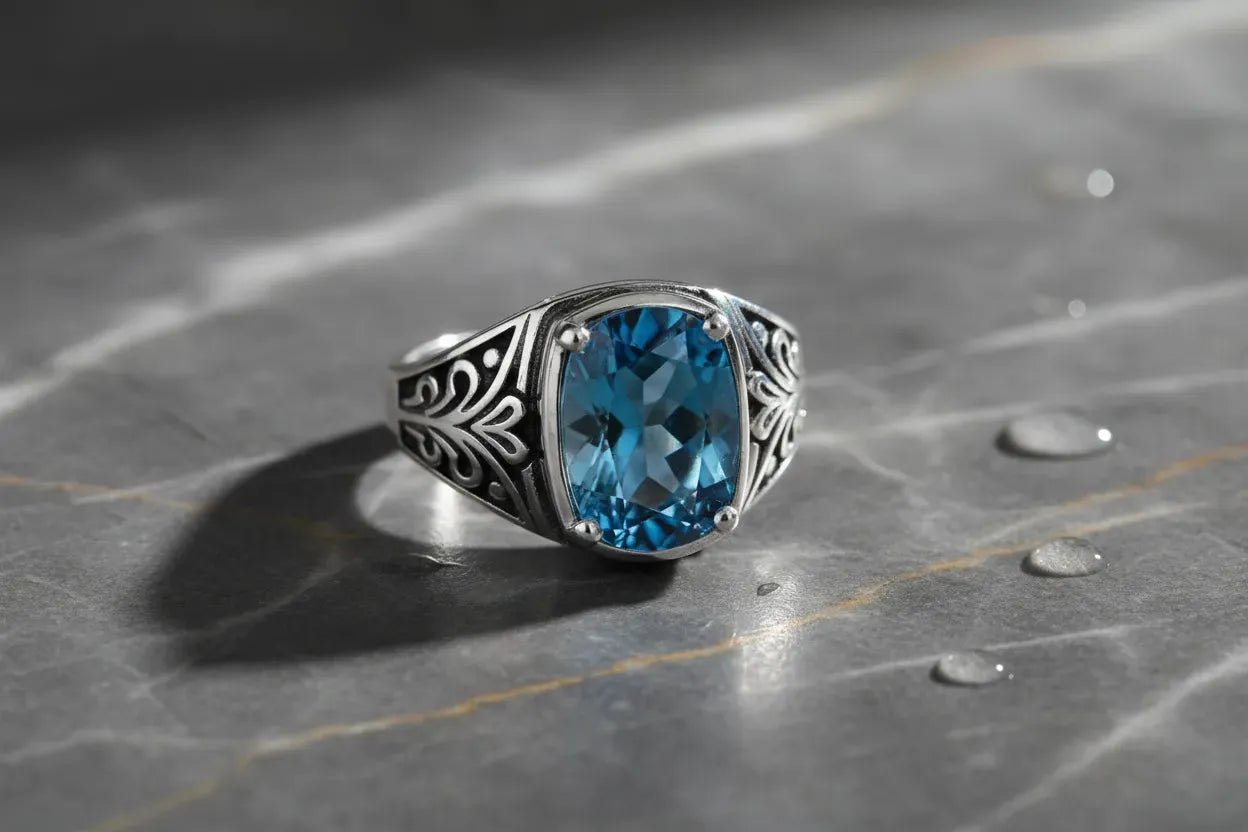
Blue Topaz: The Stone of Clarity and Serenity
Spotlight on Blue Topaz
Summary
- Introduction
- Characteristics of Blue Topaz
- History and Symbolism
- Varieties of Blue Topaz
- Meaning and Virtues
- Deposits Around the World
- Blue Topaz Jewelry at Vindicta
- The Vindicta Perspective
- Care and Advice
- Stones to Discover
- Frequently Asked Questions
- Conclusion
Introduction
Blue topaz is one of the most popular fine gemstones in contemporary jewelry. Its clear, crystalline blue — ranging from pale sky blue to intense deep blue — makes it a stone of immediate elegance and remarkable versatility. Its perfect transparency and exceptional brilliance give it a luminous presence that rivals sapphire.
An aluminum and fluorine silicate (Al₂SiO₄(F,OH)₂), topaz is one of the hardest gemstones used in jewelry (8/10). Its transparency and high refractive index give it exceptional brilliance. When paired with solid 925 sterling silver, it creates jewelry of unparalleled blue and luminous elegance.
Characteristics of Blue Topaz
Composition and Structure
- Mineral: Topaz (Al₂SiO₄(F,OH)₂ — aluminum and fluorine silicate)
- Color: Pale sky blue to intense deep blue
- Color origin: Natural or artificial irradiation (most blue topaz is treated)
- Appearance: Transparent, vitreous luster
- Crystal system: Orthorhombic
Hardness and Resistance
- 8 on the Mohs scale — one of the hardest gemstones in jewelry
- Resistant to scratches from most fine gemstones
- Perfect cleavage in one direction — sensitive to impact in this direction
Physical Properties
- Density: 3.49 to 3.57
- Refractive index: 1.609 – 1.643
- Transparency: Transparent
History and Symbolism of Topaz
Topaz is one of the most cited stones in ancient texts. It appears in the Bible (Revelation, Exodus), in Greek and Roman writings, and in Islamic traditions. Its name is believed to come from the island of Topazios (now Zabargad) in the Red Sea, where Greeks extracted a yellow-green stone they called topaz — likely chrysolite (peridot).
In ancient Rome, topaz was associated with the sun and strength. Romans believed it strengthened eyesight and protected against poisons. Roman emperors wore topazes as a symbol of power and wisdom.
In the European Middle Ages, topaz was one of the twelve stones on the breastplate of the High Priest of Israel and one of the foundational stones of the New Jerusalem in Revelation. It was worn by kings and bishops as a symbol of divine wisdom.
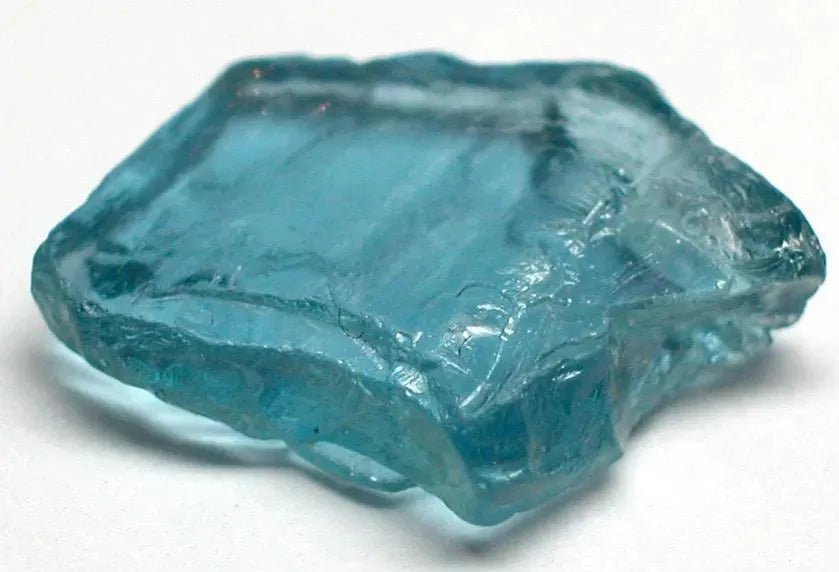
Blue topaz as we know it today is primarily a product of the 20th century — most blue topazes are colorless or pale topazes treated by irradiation to achieve their blue color. This practice is universally accepted and stable over time.
Varieties of Blue Topaz
- Sky Blue: pale and clear blue, the most common and accessible
- Swiss Blue: vibrant and luminous medium blue, highly prized in jewelry
- London Blue: deep and intense blue, almost navy, the most sought after and precious
- Natural blue topaz: very rare, natural pale blue without treatment
Meaning and Virtues of Blue Topaz
Emotional & Spiritual Level
- Communication & Expression 🔵: associated with the throat chakra, promotes clear and authentic expression
- Calm: soothes emotions and promotes serenity
- Truth: stone of honesty and intellectual clarity
- Confidence: strengthens self-confidence and assurance
- Creativity: stimulates inspiration and artistic expression
Physical Level (beliefs in lithotherapy)
- Associated with relieving sore throats and communication problems
- Used to improve sleep quality and reduce stress
- Considered a general healing stone in many traditions
Note: The virtues of lithotherapy are not scientifically proven and do not replace medical advice.
Topaz Deposits Around the World
- Brazil (Minas Gerais): world's leading producer of gem-quality topaz, all colors
- Russia (Urals, Siberia): historical high-quality topaz, highly prized by collectors
- Sri Lanka: colorless and blue gem-quality topaz
- Pakistan (Shigar Valley): high-quality topaz, spectacular crystals
- Nigeria, Mozambique: gem-quality blue topaz, growing production
Blue Topaz Jewelry at Vindicta
Blue topaz, with its clear and crystalline blue, naturally pairs with solid 925 sterling silver to create jewelry of blue and luminous elegance. Its exceptional hardness (8/10) makes it one of the most suitable stones for daily wear.
Our blue topaz creations:
- Women's 925 Silver Ring with Blue Topaz & Marcasites — Clear blue and Art Deco elegance
- 925 Silver Ring with Mystic Topaz Multi-Stones — Fascinating multi-colored reflections
Also discover our natural stone 925 silver jewelry collection.
The Vindicta Perspective
Blue topaz is the stone we recommend to those who love blue but are looking for something more accessible than sapphire. Its clear, crystalline blue has an optical quality that few other blue stones possess — and its hardness of 8/10 makes it one of the most robust stones in our selection.
What particularly interests us is mystic topaz — a colorless topaz coated with a metallic film that creates fascinating rainbow reflections. This surface treatment produces spectacular optical effects that change depending on the viewing angle. It is a contemporary stone that is part of an ancient jewelry tradition.
Blue topaz pairs particularly well with marcasite in our Art Deco aesthetic — the clear blue of the stone against the dark metallic reflections of marcasite creates a contrast of immediate elegance.
Care and Advice for your Blue Topaz Jewelry
- Impacts: avoid impacts in the direction of the cleavage — despite its hardness, topaz can cleave under a violent shock
- Cleaning: lukewarm soapy water + soft cloth. Rinse and dry immediately
- Chemicals: avoid perfumes, creams, and detergents
- Storage: soft cloth pouch, separate from other jewelry
- Mystic Topaz: avoid ultrasonic cleaners which can damage the coating
To learn more: Complete care guide for your 925 silver jewelry.
Stones to Discover
- 🔵 Turquoise — opaque blue-green, the other great blue stone of Ottoman tradition
- 🔵 Lapis Lazuli — royal blue and gold, depth and prestige
- 💙 Aquamarine — crystalline blue-green, the cousin of blue topaz
- 💜 Amethyst — royal purple, same family of communication stones
- 📖 Complete Guide to Natural Stones 2026 — everything you need to know about gemstones in jewelry
Frequently Asked Questions about Blue Topaz
Is blue topaz natural or treated?
The vast majority of blue topazes on the market are colorless or pale topazes treated by irradiation and heating to achieve their blue color. This practice is universally accepted, stable over time, and safe. Natural blue topaz (untreated) is very rare and much more expensive.
What is the difference between Sky Blue, Swiss Blue, and London Blue?
These are three intensities of blue topaz. Sky Blue is the palest and most accessible. Swiss Blue is a vibrant and luminous medium blue. London Blue is the deepest and most intense — almost navy — and the most precious of the three.
Can blue topaz be confused with sapphire?
Yes, to the naked eye, a London Blue topaz can resemble a blue sapphire. The distinction is made by hardness (sapphire 9/10 vs topaz 8/10), density, and gemological analysis. Sapphire is generally much more precious.
Conclusion
Blue topaz is an exceptional stone — clear, crystalline, with unparalleled blue elegance. Its exceptional hardness, remarkable brilliance, and versatility make it one of the most suitable fine stones for everyday jewelry.
Paired with solid 925 sterling silver and marcasite in Vindicta's Art Deco aesthetic, blue topaz creates jewelry of blue and luminous elegance — pieces that carry millennia of history and royal symbolism.
✦ Vindicta — Solid 925 silver
The piece that makes the difference
Certified 925 silver · Free shipping from €69 · 10 years of excellence
Natural Stone Jewellery →



Leave a comment
This site is protected by hCaptcha and the hCaptcha Privacy Policy and Terms of Service apply.