
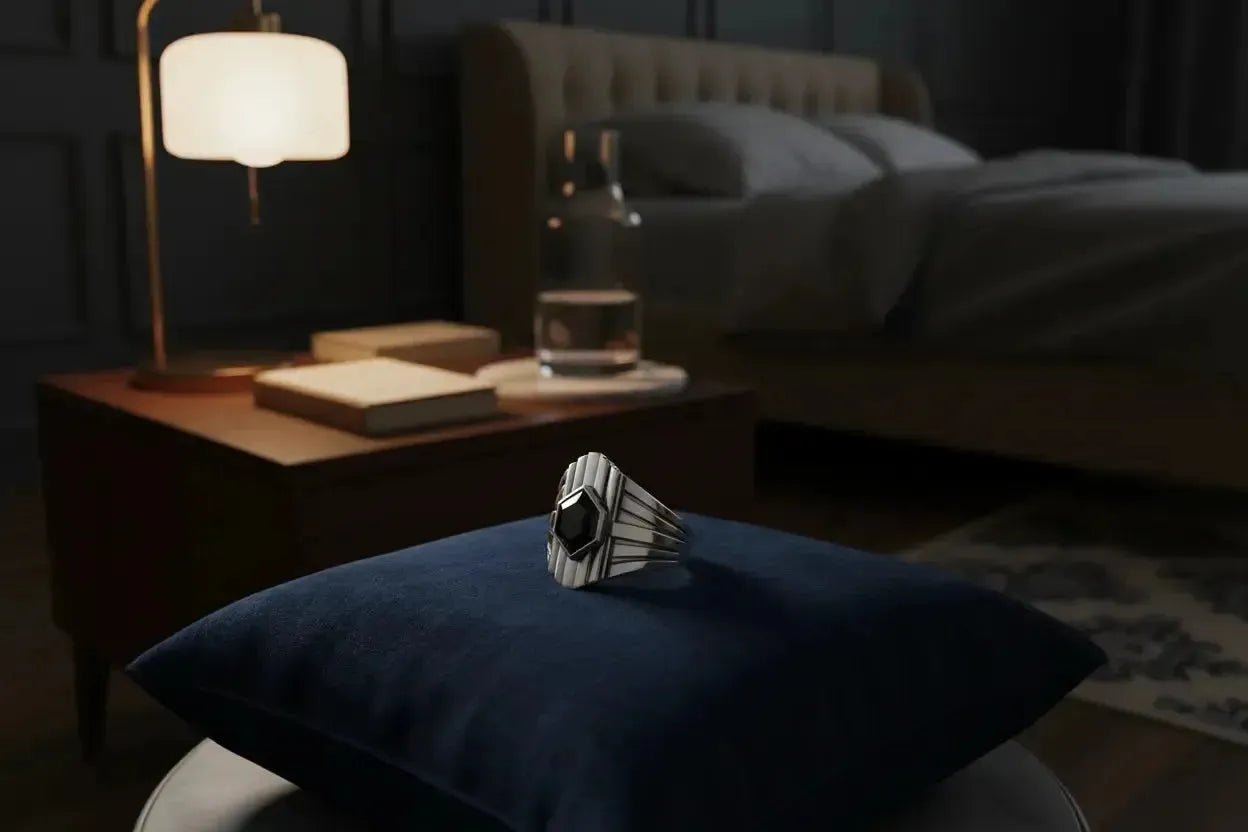
Can You Sleep with a 925 Sterling Silver Ring On?
You wear your 925 sterling silver ring all day, and the question inevitably arises in the evening: should you take it off before sleeping? Is it really necessary, or can you keep it on without risk? At Vindicta, a company specializing in solid 925 sterling silver jewelry for over 10 years, we receive this question regularly. The answer deserves to be detailed, as it depends on the type of ring, the presence or absence of a natural stone, and your sleeping habits.
In this comprehensive guide, we explain what actually happens when you sleep with a 925 sterling silver ring, the concrete risks, cases where it's acceptable, and especially how to care for your jewelry so it maintains its shine for years.
The direct answer: can you sleep with a 925 sterling silver ring?
Technically, sleeping with a solid 925 sterling silver ring poses no danger to your health. 925 sterling silver is a noble metal, mostly hypoallergenic, and does not release toxic substances when in contact with the skin. However, it is not recommended for the longevity of your jewelry. Nighttime is a period where several factors combine to accelerate the wear and tarnishing of silver.
The general rule among jewelers: remove your silver jewelry before sleeping, showering, and exercising. This simple habit can double or triple the lifespan of your piece.
What actually happens during your sleep
The human body is not inactive at night. It sweats, moves, and produces skin secretions that interact directly with metals in contact with the skin. Here are the concrete phenomena that affect your 925 sterling silver ring during sleep.
Night sweats
Even without excessive heat, the body sweats at night. This perspiration contains mineral salts, amino acids, and sulfur compounds that chemically react with silver. This reaction is precisely what causes the characteristic blackening of silver — called oxidation or sulfuration. The longer and more repeated the exposure, the faster and deeper the tarnishing sets into the metal.
Mechanical friction
During sleep, you move an average of 40 to 60 times per night. Each movement creates friction between your ring and sheets, pillows, or other jewelry if you wear multiple pieces. These repeated micro-frictions create micro-scratches invisible to the naked eye but, accumulated over weeks and months, dull the surface polish and give your jewelry a matte, worn appearance.
Pressure and deformation
Certain sleeping positions exert significant pressure on the fingers. For rings with high settings or delicate mounts, this pressure can gradually weaken the setting and, in extreme cases, lead to the loss of a natural stone. This risk is particularly real for rings set with round or cabochon stones.
Ambient humidity
A bedroom often has higher humidity levels than the rest of the home, especially at night. Humidity combined with body heat creates a micro-environment that accelerates silver oxidation and promotes the appearance of dark spots on the jewelry's surface.
Specific risks for rings with natural stones
If your ring is set with a natural stone, precautions are even more important. Natural stones each have their own sensitivity to mechanical and chemical stresses:
- Black Onyx: a hard stone (7 on the Mohs scale), relatively resistant, but sensitive to direct impacts that can crack it.
- Tiger's Eye: a fibrous stone that does not withstand repeated pressure on its surface well, risking gradual dulling.
- Amethyst: a crystal sensitive to temperature variations and impacts, can crack under repeated pressure.
- Turquoise: a porous stone that absorbs sweat and body oils, which alters its color in the long term.
- Carnelian: relatively resistant but sensitive to chemicals present in night sweats.
- Pearls: extremely sensitive to the acidity of perspiration and friction. Never sleep with pearl jewelry.
In all cases, the setting itself is the most vulnerable point. A prong or bezel setting can gradually weaken under the effect of repeated nocturnal pressures, eventually releasing the stone without you realizing it.
In which cases can you keep your ring on at night?
There are situations where keeping your 925 sterling silver ring on at night is acceptable without major risk:
- A plain, stoneless wedding band: a simple 925 sterling silver ring with a comfort fit (rounded interior) and no setting can be worn at night without major problems, provided it is cleaned regularly.
- A ring that cannot be removed: if your finger has swollen during the day and the ring no longer fits, do not force it. Wait until morning, when circulation is restored and your finger has deflated.
- An exceptional night: forgetting to remove your ring once has no serious consequences. It is the daily repetition that wears out the jewelry in the long term.
How to care for your 925 sterling silver ring daily
Whether you sleep with your ring or not, regular maintenance is essential to preserve its shine and durability. Here are the essential practices adopted by connoisseurs:
- Remove your ring before sleeping and store it in a closed box or soft fabric pouch to prevent oxidation from contact with air and humidity.
- Clean it regularly with a dry microfiber cloth. For a deeper cleaning, use lukewarm water with a few drops of mild soap, then dry immediately and completely.
- Avoid chemicals: perfumes, creams, hand sanitizers, and household products are the enemies of 925 sterling silver. Put your jewelry on last, after your beauty routine.
- Store your jewelry separately to avoid scratching between pieces. Each piece of jewelry deserves its own space in your box.
- Use an anti-tarnish cloth specifically designed for silver for occasional cleaning and to restore shine to your piece.
For more detailed jewelry care, consult our complete 925 sterling silver care guide with all our jewelry selection tips.
925 Sterling Silver and Water: The Same Logic Applies
The question of sleep naturally leads to that of water. Can you shower with a 925 sterling silver ring? The answer is similar: technically possible, but not recommended in the long term. Tap water contains chlorine and limescale that accelerate tarnishing. Pool water, with its concentrated chlorine, is particularly aggressive for silver and natural stones.
Discover our full article: 925 Sterling Silver and Water: Can You Shower with Your Jewelry?
Why choose solid 925 sterling silver over plated?
A plated piece of jewelry loses its surface layer within a few months of normal use. A piece of solid 925 sterling silver jewelry can be cleaned, polished, and restored indefinitely — it does not degrade deeply and retains its value for decades. To understand all the differences: 925 Sterling Silver, Gold Plated, Steel: What are the Differences?
Conclusion
Sleeping with a 925 sterling silver ring is not dangerous for you, but it is an action that wears out your jewelry faster than necessary. Night sweats, mechanical friction, pressure, and humidity accumulate night after night to tarnish and weaken your piece. The habit of removing your ring in the evening is the best investment you can make to preserve its beauty for years.
At Vindicta, every piece we select is certified solid 925 sterling silver, designed to last and driven by a clear vision: to offer you character jewelry, without compromise on quality or identity. By choosing Vindicta, you wear a legacy — not an accessory.
Discover our collections: Women's 925 Sterling Silver Rings — Men's 925 Sterling Silver Rings — Natural Stone Jewelry.
✦ Vindicta — Solid 925 silver
The piece that makes the difference
Certified 925 silver · Free shipping from €69 · 10 years of excellence
Natural Stone Jewellery →



Leave a comment
This site is protected by hCaptcha and the hCaptcha Privacy Policy and Terms of Service apply.