
Marcasite vs. Pyrite: Differences, Properties, and Uses in Jewelry
Marcalite and pyrite are two minerals often confused, yet fundamentally different. Discover their essential distinctions and why jewelry uses one rather than the other.
Before going into detail, consult our complete guide to marcasite to understand this mineral in its full jewelry dimension. And to discover how it pairs with 925 silver, read our article 925 Silver and Marcasite, the timeless duo of jewelry.
Marcasite and Pyrite: Same Composition, Different Structures
Identical Chemical Composition
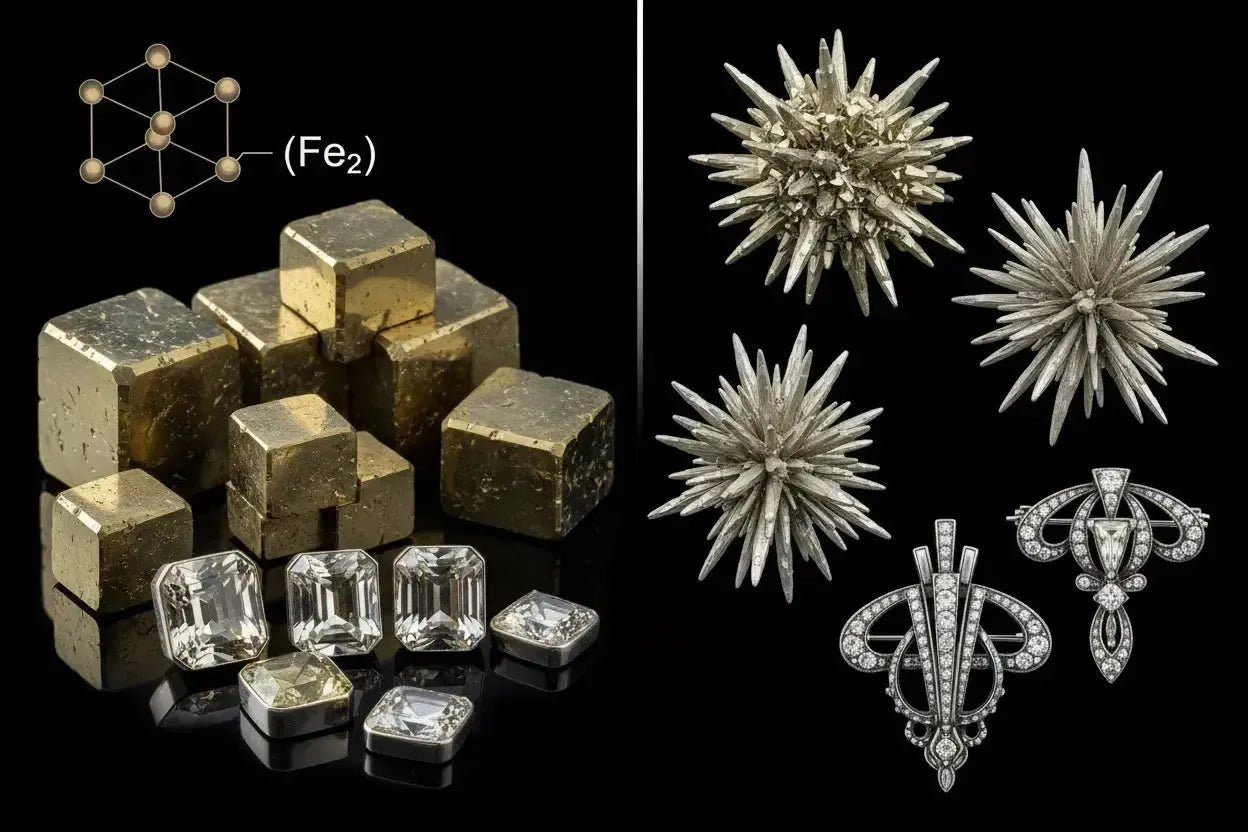
Marcasite and pyrite share the same chemical formula: FeS₂ (iron disulfide). This explains the frequent confusion between the two minerals. However, their crystalline structure is radically different:
- Pyrite: Cubic system — crystals in cubes, pyritohedrons, or octahedrons
- Marcasite: Orthorhombic system — crystals in blades, stars, or cockscombs
This difference in crystalline structure leads to very different physical and chemical properties, especially in terms of stability and use in jewelry.
Comparative Table
| Property | Marcasite | Pyrite |
|---|---|---|
| Chemical formula | FeS₂ | FeS₂ |
| Crystal system | Orthorhombic | Cubic |
| Hardness (Mohs) | 6 – 6.5 | 6 – 6.5 |
| Density | ~4.9 g/cm³ | ~5.0 g/cm³ |
| Color | Pale yellow to grey | Bright golden yellow |
| Luster | Dull metallic | Bright metallic |
| Chemical stability | Unstable (oxidizes) | Stable |
| Jewelry use | Yes (faceted) | Rare (too unstable in jewelry) |
Visual Differences: How to Distinguish Them
Color
- Pyrite: Bright golden yellow — nicknamed "fool's gold" for its resemblance to gold
- Marcasite: Pale yellow to metallic grey — duller, less golden
Luster
- Pyrite: Very bright metallic luster, almost mirror-like
- Marcasite: Dull metallic luster, with iridescent reflections depending on the angle
Crystal Shape
- Pyrite: Perfect cubes, characteristic striated faces
- Marcasite: Flattened blades, star or cockscomb shapes — more irregular
Stability: The Decisive Factor for Jewelry
Pyrite Disease
Marcasite is chemically less stable than pyrite. In the presence of humidity and oxygen, it can oxidize and produce sulfuric acid — a phenomenon called "pyrite disease". This process can deteriorate untreated mineralogical specimens.
Why Jewelry Uses "Marcasite"
Paradoxically, what jewelers call "marcasite" is actually faceted pyrite. The historical confusion between the two minerals has led to the use of the term "marcasite" to refer to small metallic stones set in silver. In jewelry:
- Pyrite is more stable and better suited for setting
- It is easier to facet into regular shapes
- Its metallic luster resists time better
- The term "marcasite" has remained due to jewelry tradition
History of Confusion
Until the 19th century, mineralogists did not clearly distinguish between marcasite and pyrite. The term "marcasite" was used to refer to all shiny iron sulfides. It was modern mineralogical classification that separated the two species, but jewelry vocabulary retained the old usage.
This jewelry tradition dates back to the Victorian and Art Deco eras, the heyday of marcasite in jewelry. Discover this fascinating history in our article on marcasite in royal jewelry.
Uses in Jewelry
"Marcasite" (Faceted Pyrite) in Jewelry
The small metallic stones set in our 925 silver jewelry are faceted pyrite. Their use in jewelry offers:
- Discrete metallic luster: Steel grey with golden reflections
- Hand-cut facets: Each stone is unique
- Individual setting: Stone by stone in 925 silver
- Durability: Permanent luster, does not tarnish
Raw Pyrite in Decoration
Raw pyrite (unfaceted) is used in:
- Mineralogical decoration (perfect cubes)
- Lithotherapy (protective stone, confidence)
- Costume jewelry (raw, unfaceted pendants)
How to Recognize Quality in Jewelry
Whether you are buying a "marcasite" jewel, here are the quality criteria to check:
- Individual setting: Each stone set, not glued
- Regular facets: Neat cut, uniform luster
- Certified 925 silver: Visible hallmark on the jewel
- Clean finishes: No burrs or asymmetry
Our complete buying guide gives you all the tools to evaluate a marcasite jewel. And every Vindicta piece is certified and verifiable on our authenticity page.
Maintenance: Marcasite vs. Raw Pyrite
“Marcasite” jewelry (faceted set pyrite) requires specific maintenance different from raw mineral specimens:
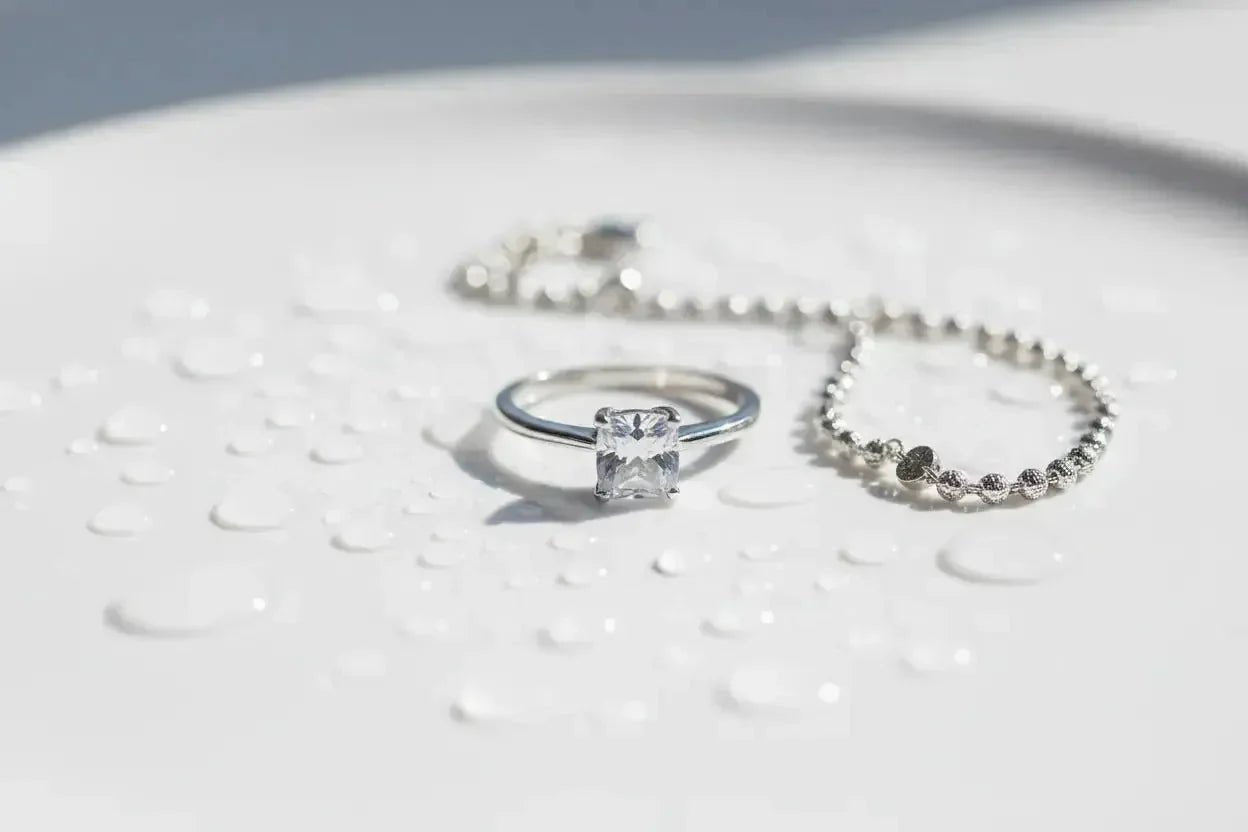
- Avoid prolonged water exposure: Risk of silver and stone oxidation
- No ultrasonics: Risk of stone loosening
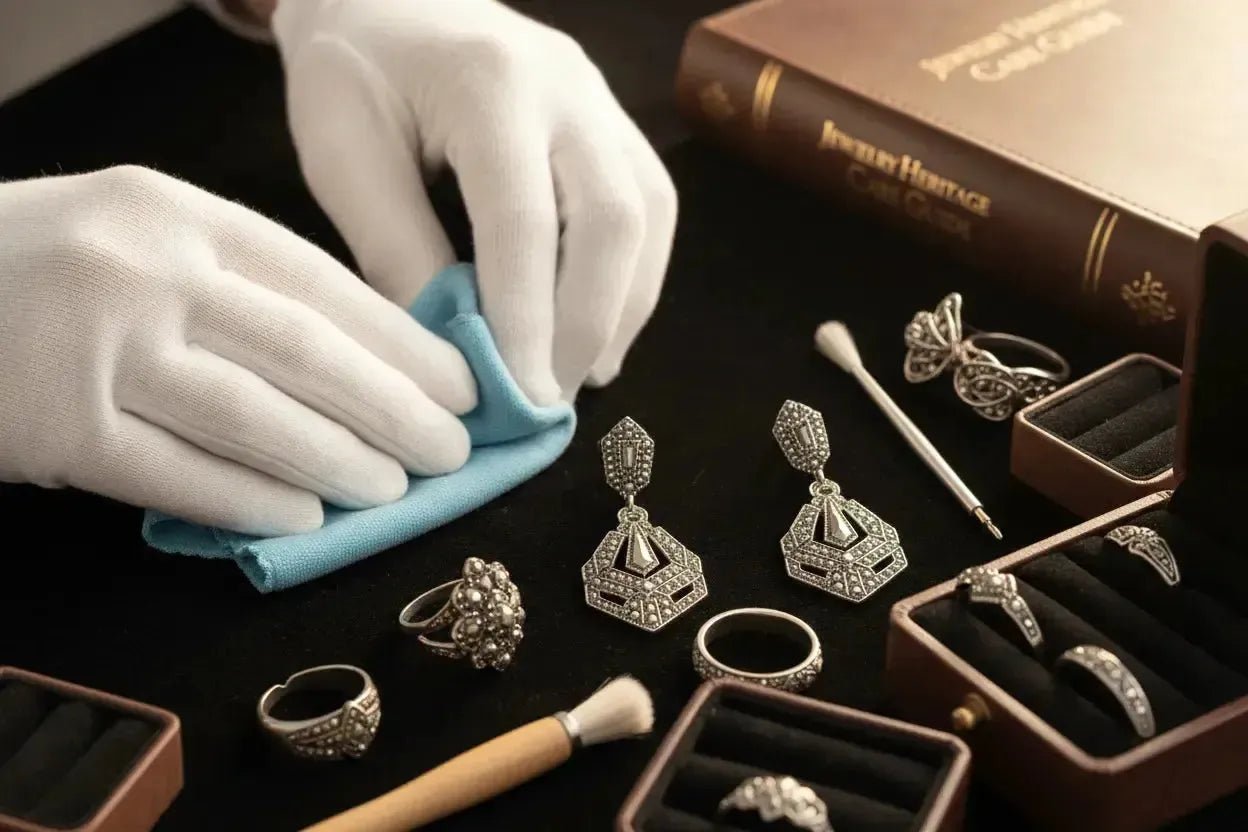
- Soft cloth: After each wear
- Dry storage: Closed case, away from humidity
Consult our complete marcasite and 925 silver jewelry care guide for all the steps to take.
Our Marcasite Jewelry: The Excellence of Setting
At Vindicta, every "marcasite" jewel is made with stones selected for their brilliance and regularity, hand-set in certified solid 925 silver. Discover our selection:
- Men's Geometric Pattern 925 Silver Marcasite Ring — masculine Art Deco
- Fleur de Lys 925 Silver Marcasite Earrings — classic elegance
- Onyx & Marcasite 925 Silver Art Deco Earrings — dramatic contrast
- Men's Black Marcasite 925 Silver Ring — masculine elegance
Find all our creations in our complete collection of marcasite and 925 silver jewelry.
To Go Further
- Blackened Silver vs. Marcasite — two dark aesthetics, two techniques
- Marcasite jewelry for men — rings, bracelets, cufflinks
- 925 Silver & Marcasite Watch-Bracelets — Art Deco elegance on the wrist
- 925 Silver & Marcasite — why this duo is timeless
Conclusion: Two Minerals, One Jewelry Tradition
Marcasite and pyrite are two distinct minerals sharing the same chemical composition but different crystalline structures. In jewelry, the term "marcasite" traditionally refers to pyrite facets set in silver — a historical confusion that gave birth to one of the most beautiful jewelry traditions.
At Vindicta, we perpetuate this tradition with pieces made of certified solid 925 silver, hand-set marcasites, and designs inspired by the great eras of jewelry. Each piece of jewelry is verifiable on our authenticity page.
✦ Vindicta — Solid 925 silver
The piece that makes the difference
Certified 925 silver · Free shipping from €69 · 10 years of excellence
Natural Stone Jewellery →



Leave a comment
This site is protected by hCaptcha and the hCaptcha Privacy Policy and Terms of Service apply.