
How to Recognize a Genuine Natural Agate?
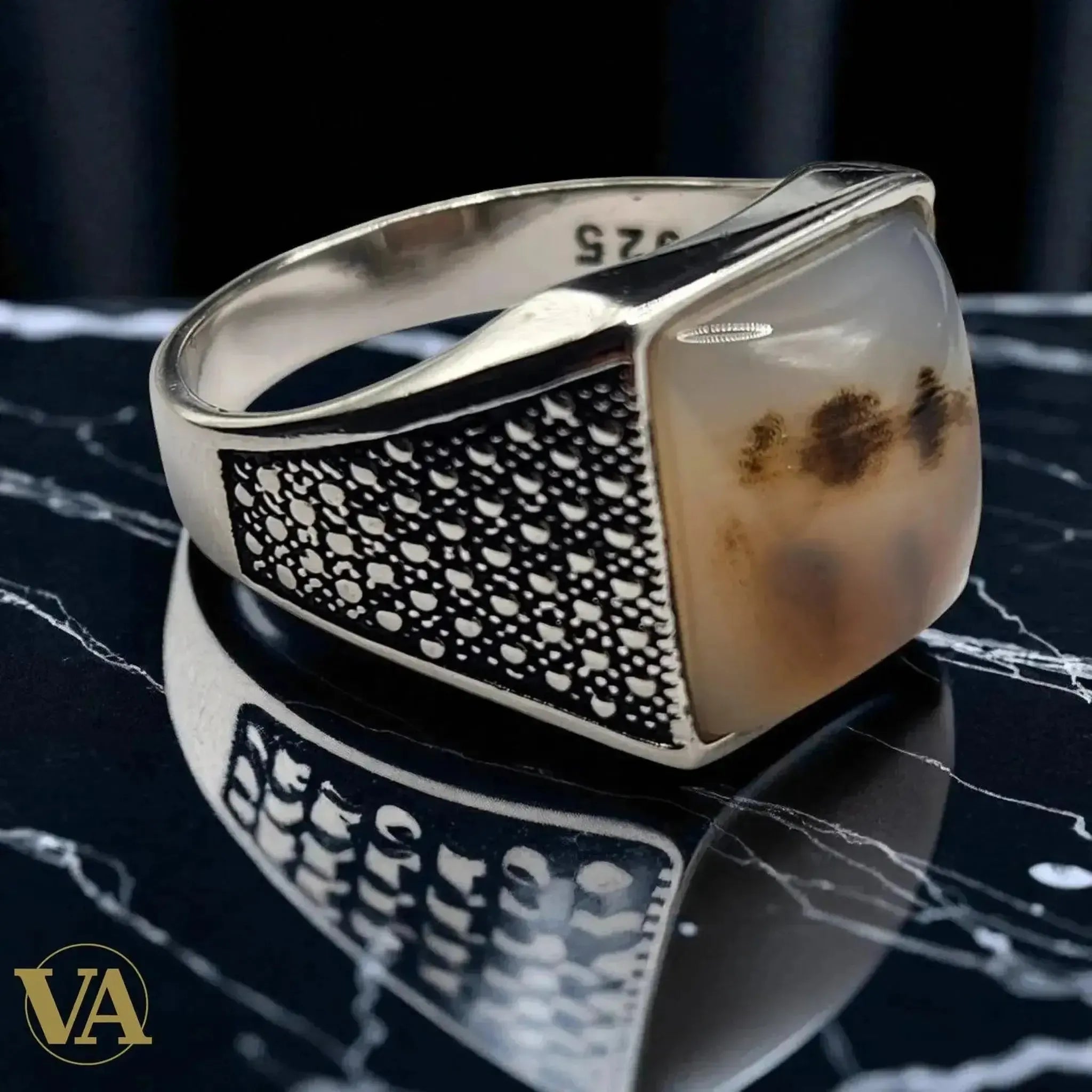
Agate is one of the most widely used stones in men's jewelry, especially on signet rings, thanks to its unique natural patterns — bands, veins, and dendritic inclusions that resemble plant-like branching. That natural beauty also makes it a frequent target for imitations. Here's how to tell a genuine agate from a dyed or synthetic stone before buying. To learn more specifically about green agate — its history, properties, and deposits — see our complete guide to green agate.
Why Agate Is Easy to Imitate
Natural agate belongs to the chalcedony family, a microcrystalline variety of quartz. Its translucent layered structure, which creates its signature patterns, can be reproduced artificially by dyeing cheap natural white agate, or even fully simulated with colored glass or resin. The market is full of stones sold as “natural agate” that have actually been chemically treated to intensify or even out their color.
Signs of a Genuine Natural Agate
Irregular Patterns, Never Perfectly Symmetrical
Nature never produces two identical agates. If the banding pattern looks perfectly regular, repetitive, or symmetrical from one end of the stone to the other, that's a strong red flag — excessive regularity often gives away an artificial reproduction rather than a natural geological formation.
Colors That Stay Within a Natural Range
Natural agate typically comes in earthy tones — gray, brown, beige, rust, sometimes pale blue or soft green. Bright, saturated colors (electric blue, intense purple, neon green) are almost always the result of artificial dye applied to a porous natural white or gray agate.
The Edge-Transparency Test
Held up to a light source, a genuine agate usually lets a bit of light through at its thinnest edges, revealing its translucent layered structure. A colored-glass or resin imitation will often show a more uniform, artificial transparency, without the characteristic layering.
Coolness to the Touch
Like most natural stones, agate stays cool to the touch longer than a synthetic material like glass or resin, which warms up faster against the skin. This isn't a definitive scientific test, but it's a useful supporting clue.
Weight Relative to Size
Natural agate has a higher density than glass or resin. A stone that feels unusually light for its size, once removed from its setting or compared to an authentic agate of similar size, can give away a substitute material.
Dendritic Agate: A Special Case
Dendritic agates, recognizable by their branching inclusions resembling plant stems or cracks, are particularly hard to convincingly fake — these patterns come from mineral inclusions (often manganese oxide) that formed naturally over millions of years. A genuine dendritic agate shows branching that looks organic and irregular, never repeated or overly clean patterns. Crude imitations often show “branches” that are too straight or arranged too systematically, as if drawn rather than naturally formed.
Banded Agate: Telling Real Layers Apart
On a banded agate, the color layers should form slightly wavy or irregular lines, never perfectly straight along the whole length of the stone. These bands formed through successive silica deposits over thousands of years — a geological process that always leaves subtle variations in thickness from one band to the next.
Where to Buy with Confidence
The 925 hallmark on the silver setting only guarantees the metal, not the stone — the two authenticities are independent. Look for a jeweler who explicitly states “natural agate” (rather than “dyed agate” or simply “agate” with no further detail) on their product page, and who can answer your questions about the stone's origin.
Dyed Agate Isn't a Scam by Itself
An important nuance: a natural agate dyed to intensify its color is still a natural stone, simply treated — a common and legitimate practice in jewelry when clearly disclosed. The issue isn't the dyeing itself, but the lack of transparency about it, or selling an entirely synthetic material (glass, resin) under the misleading label “agate.”
At Vindicta: Natural Agate, No Compromises
Our men's signet rings in 925 silver set with banded or dendritic agate use exclusively natural stones, with all their irregularities and individual character — meaning every piece is genuinely one of a kind, shaped by nature itself. No artificial dye, no glass imitation: what you see on the stone is the result of millions of years of geological formation, not a colorant.
A beautiful agate doesn't need to be perfect to be precious — its irregularities are exactly what prove its authenticity.
✦ Vindicta — Solid 925 silver
The piece that makes the difference
Certified 925 silver · Free shipping from €69 · 10 years of excellence
Natural Stone Jewellery →



Leave a comment
This site is protected by hCaptcha and the hCaptcha Privacy Policy and Terms of Service apply.